Introduction
Education plays an important role in building a better future, but the cost of schooling, college education, and professional courses can create financial difficulties for many students. Scholarships provide financial assistance to eligible students and help them continue their education.
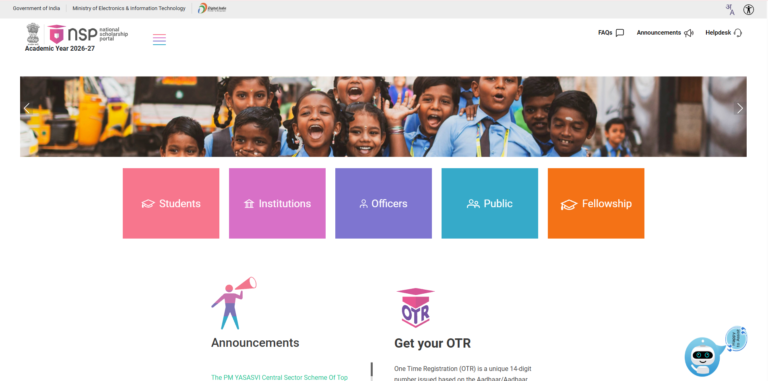
To make scholarship information and application facilities more accessible, the Government of India provides the National Scholarship Portal (NSP), an online platform that brings together various scholarship schemes offered by central government ministries, departments, and other participating authorities.
Through this portal, students can explore available scholarships, check eligibility requirements, complete One-Time Registration (OTR), submit applications, and monitor the progress of their scholarship requests.
In this guide, DigiStudyLab.in explains everything students should know about the National Scholarship Portal, including its purpose, benefits, registration process, eligibility, application procedure, required documents, and payment tracking.
What Is the National Scholarship Portal (NSP)?
The National Scholarship Portal (NSP) is a Government of India digital platform developed to facilitate the administration and application of various scholarship schemes.
It provides a common online platform where eligible students can discover scholarship opportunities offered by participating government ministries, departments, and institutions.
Instead of visiting multiple websites to find information about different government scholarship programmes, students can use NSP to explore the schemes available through the portal.
The platform supports various activities, including:
- Scholarship scheme discovery.
- One-Time Registration (OTR).
- Fresh scholarship applications.
- Renewal applications.
- Online application verification.
- Application progress tracking.
- Scholarship payment tracking through the Public Financial Management System (PFMS).
Official website: https://scholarships.gov.in/
Objectives of the National Scholarship Portal
The National Scholarship Portal aims to make scholarship administration more accessible and organized.
Its major objectives include:
- Providing a common platform for various government scholarship schemes.
- Simplifying the scholarship application process.
- Helping students identify scholarships according to their eligibility.
- Reducing duplication through identity-based registration and verification.
- Supporting online application verification by participating institutions and government authorities.
- Improving transparency in scholarship processing.
- Facilitating the tracking of scholarship disbursements.
Benefits of Using the National Scholarship Portal
The NSP platform offers several benefits to students seeking financial assistance for education.
1. Access to Multiple Scholarship Schemes
Students can explore scholarship opportunities offered by participating central government ministries, departments, and other authorities through a common platform.
2. Convenient Online Applications
Eligible students can complete their scholarship applications online without having to visit multiple government offices for the initial application process.
3. One-Time Registration
The OTR facility provides students with a unique registration number that can be used for scholarship applications across their academic career on NSP.
4. Scholarship Eligibility Information
Students can explore available schemes and review their eligibility conditions before applying.
5. Application Tracking
The portal provides facilities to check the progress of scholarship applications, including verification-related information where available.
6. Scholarship Payment Tracking
Students can use the payment tracking facility linked to PFMS to check the status of scholarship disbursements.
7. Fresh and Renewal Applications
The platform supports fresh applications for eligible new applicants and renewal applications for students continuing under applicable scholarship schemes.
Types of Scholarships Available on NSP
The National Scholarship Portal hosts different scholarship schemes offered by participating government departments and authorities.
The availability of each scheme depends on its guidelines, eligibility conditions, academic year, and application schedule.
Some major scholarship categories include:
1. Pre-Matric Scholarships
Pre-matric scholarships are intended for eligible students studying at school level, generally before Class 11.
These schemes may provide financial assistance to students belonging to specified categories or qualifying under particular economic and academic conditions.
2. Post-Matric Scholarships
Post-matric scholarships generally support eligible students pursuing education after Class 10.
Depending on the scheme, beneficiaries may include students studying in higher secondary schools, colleges, universities, and other recognized institutions.
3. Merit-Based Scholarships
Merit-based scholarships are awarded according to academic performance and the specific conditions established by the concerned scheme.
Students may need to satisfy prescribed examination marks, admission, and institutional requirements.
4. Means-Based Scholarships
Means-based scholarships consider financial circumstances, such as family income, along with other eligibility requirements.
These schemes aim to support students who face financial difficulties in continuing their education.
5. Scholarships for Specific Categories
Some schemes are designed for particular groups of students, including:
- Scheduled Caste (SC) students.
- Scheduled Tribe (ST) students.
- Other Backward Classes (OBC) students.
- Economically Backward Classes (EBC).
- Denotified, Nomadic and Semi-Nomadic Tribes (DNT).
- Students with disabilities.
- Students from the North Eastern Region.
- Other eligible groups specified under individual schemes.
Important: These are broad scholarship categories, not a guarantee that every scheme is available to every student. Always check the individual scheme guidelines on NSP.
Who Can Apply for Scholarships Through NSP?
The National Scholarship Portal does not have one common eligibility requirement for all scholarships.
Eligibility depends on the particular scheme selected by the applicant.
Common eligibility factors include:
- Indian citizenship or other nationality conditions specified by the scheme.
- Academic qualification.
- Current class, course, or year of study.
- Family’s annual income.
- Category or community, where applicable.
- Academic performance.
- Admission to an eligible educational institution.
- Disability status, where applicable.
- Other conditions prescribed by the concerned department.
For example, one scholarship may be intended for school students from economically weaker families, while another may support students pursuing technical or professional education.
Before applying, students should carefully read the official eligibility conditions, income limits, and scheme guidelines.
What Is One-Time Registration (OTR) on NSP?
One-Time Registration (OTR) is a mandatory registration facility introduced for students applying for scholarships through the National Scholarship Portal.
It provides each registered student with a unique 14-digit OTR number based on Aadhaar or Aadhaar Enrolment ID (EID).
The OTR number is intended to remain applicable throughout the student’s academic career on NSP, reducing the need to repeat the initial registration process every academic year.
Benefits of OTR
- Provides a unique identification number for scholarship applications.
- Simplifies registration for eligible scholarship schemes.
- Helps reduce duplicate registrations.
- Can be used for fresh and renewal applications.
- Avoids repeating the initial OTR process every academic year.
Is OTR Registration Free?
Yes. According to the official NSP OTR guidelines, there is no registration fee for generating an OTR through the portal.
Students should avoid unofficial websites or individuals demanding money for OTR registration.
Official OTR registration page:
https://scholarships.gov.in/otrapplication/
How to Register for OTR on the National Scholarship Portal
Before applying for a scholarship, students must complete the mandatory OTR process.
Follow these steps:
Step 1: Visit the Official NSP Website
Open the official National Scholarship Portal:
Navigate to the One-Time Registration section.
Step 2: Read the OTR Guidelines
Carefully read the instructions displayed on the registration page.
Make sure you understand the Aadhaar, EID, mobile verification, and face-authentication requirements.
Step 3: Select the Appropriate Aadhaar Option
The portal provides different registration routes depending on whether the student has Aadhaar, an Aadhaar Enrolment ID, or neither.
Students should follow the applicable instructions.
For eligible minor applicants without Aadhaar or EID, the portal provides a parent or legal guardian-based registration facility.
Step 4: Enter the Required Information
Provide the requested details accurately.
These may include:
- Aadhaar number or EID, as applicable.
- Student’s name.
- Date of birth.
- Gender.
- Parent’s details.
- Mobile number.
- Email address, where requested.
Ensure that the information matches the relevant official records.
Step 5: Complete OTP Verification
Verify the required mobile number or Aadhaar authentication using the OTP process displayed on the portal.
Step 6: Complete Face Authentication
The official OTR process requires face authentication after generating a registration reference number.
Students are instructed to download the NSP OTR mobile application and the AadhaarFaceRD service on a compatible Android device.
Follow the instructions provided by the official portal to complete authentication.
Step 7: Generate Your OTR Number
After successful authentication and registration, the portal generates your unique 14-digit OTR number.
Keep this number safe because it will be required for scholarship applications.
Important: Generating an OTR does not mean that you have applied for a scholarship. You must separately complete and submit the application for your selected scheme.
How to Apply for a Scholarship Through NSP
Once your OTR is generated, you can proceed with the scholarship application process.
Step 1: Visit the National Scholarship Portal
Open:
Go to the student login or scholarship application section.
Step 2: Login Using Your OTR
Enter your OTR number and password to access your student account.
Complete any additional authentication requested by the portal.
Step 3: Select the Academic Year
Choose the appropriate academic year for which you want to apply.
Make sure that the selected year matches your current course and scholarship application requirements.
Step 4: Explore Available Scholarship Schemes
Visit the Schemes on NSP section.
Review the available scholarship programmes and their individual requirements.
Check the following details before proceeding:
- Eligibility conditions.
- Family income limits.
- Educational qualifications.
- Course and institution requirements.
- Required documents.
- Scholarship amount and benefits.
- Application closing date.
Step 5: Select the Appropriate Scholarship
Choose the scholarship scheme that matches your eligibility.
The portal may provide eligibility information to help students identify suitable schemes.
From Academic Year 2026–27, NSP states that students may apply for one merit-based scholarship scheme and one or more welfare-based scholarship schemes, subject to the applicable scheme eligibility criteria.
Step 6: Complete the Application Form
Enter all requested academic, personal, institutional, and other relevant details.
Check the information carefully before proceeding.
Step 7: Upload Required Documents
Upload the documents requested under the selected scholarship scheme.
Make sure the files are clear, readable, and in the accepted format and size.
Step 8: Review Your Application
Before submitting, verify:
- Personal information.
- Academic details.
- Bank account information.
- Institution details.
- Uploaded documents.
- Scheme eligibility information.
Incorrect information may result in application defects or rejection.
Step 9: Submit the Application
Complete the final submission process.
Save or download the application acknowledgement or reference details wherever available.
Step 10: Follow the Verification Process
After submission, your application may undergo verification by the educational institution and the concerned government authorities.
Monitor your application account for updates, defects, or requests for correction.
Documents Required for NSP Scholarship Applications
The required documents vary according to the selected scholarship scheme.
Commonly requested documents may include:
| Document | Purpose |
|---|---|
| Aadhaar or applicable identification details | Identity verification |
| Academic marksheets | Educational qualification |
| Income certificate | Family income verification |
| Caste or community certificate | Category-based eligibility |
| Disability certificate or UDID details | Disability-related eligibility |
| Bank account details | Scholarship payment |
| Admission or bonafide certificate | Educational institution verification |
| Fee receipt | Course fee verification, where applicable |
| Domicile certificate | State or residence-related eligibility |
| Passport-size photograph | Identification, where requested |
Not every student needs to upload every document. Check the requirements of the specific scholarship scheme and follow the instructions displayed in your application.
How to Check NSP Scholarship Application Status
After submitting your scholarship application, you can monitor its progress through the official portal.
Follow these steps:
- Visit https://scholarships.gov.in/
- Open the student login section.
- Login using your OTR number and password.
- Select the appropriate academic year and application.
- Open the application status or related tracking section.
- Review the latest available verification information.
Depending on the scheme and application stage, the status may indicate whether your application is submitted, pending verification, defective, verified, or otherwise processed.
If your application is marked defective, carefully read the remarks and follow the correction instructions within the permitted time.
How Does NSP Scholarship Verification Work?
Scholarship verification is an important part of the application process.
Submitting an application does not automatically guarantee scholarship approval.
Depending on the scheme, the application may pass through different verification stages.
1. Institute-Level Verification
The educational institution checks the student’s academic information, admission details, and other relevant records.
2. District or State-Level Verification
Where applicable, designated district or state authorities review the application and verify the information.
3. Ministry or Department-Level Processing
The concerned ministry or department may carry out further scrutiny and processing according to the scheme guidelines.
4. Scholarship Approval and Disbursement
Eligible applications that complete the required checks may proceed towards sanction and payment.
The exact verification workflow depends on the individual scholarship scheme.
Students should regularly check their application status and communicate with their institution’s scholarship nodal officer if verification remains pending.
How to Track NSP Scholarship Payment Status
The National Scholarship Portal provides a payment tracking facility linked to the Public Financial Management System (PFMS).
Students can use the available payment tracking option to check the status of scholarship disbursements.
Steps to Track Scholarship Payments
- Visit the National Scholarship Portal.
- Open the Track Your Payment option.
- Follow the link to the PFMS payment tracking facility.
- Enter the information requested by the PFMS portal.
- Submit the details to view the available payment information.
Official PFMS website:
Important Bank Account Requirements
Before applying, students should ensure that their bank account information is accurate.
Depending on the scholarship scheme and payment process, Aadhaar seeding and NPCI mapping may be relevant for Direct Benefit Transfer (DBT).
Students should:
- Verify that their bank account is active.
- Check that the account details are correct.
- Confirm Aadhaar seeding requirements where applicable.
- Check their bank’s NPCI mapping status if required.
- Contact their bank if there are payment-related issues.
An application being verified or approved does not necessarily mean that the payment has already been credited.
What Is the Difference Between Fresh and Renewal Applications?
The National Scholarship Portal provides fresh and renewal application facilities for eligible scholarship schemes.
| Fresh Application | Renewal Application |
|---|---|
| For eligible new applicants | For existing scholarship beneficiaries |
| Requires a new application for the relevant scheme | Requires renewal under the applicable scheme |
| Eligibility is checked for initial selection | Continued eligibility and academic progress are checked |
| OTR is required | Existing OTR is used |
Students applying for renewal should check the academic progress, marks, attendance, course continuation, and other requirements specified by their scholarship scheme.
Renewal is not automatic and must be completed within the prescribed application period.
NSP Scholarship Academic Year and Important Dates
The National Scholarship Portal operates according to academic-year-specific application schedules.
For Academic Year 2026–27, the official portal indicates that the portal opened from June 1, 2026.
However, different scholarship schemes have different opening dates, student application deadlines, and verification schedules.
Some schemes may close earlier than others, while certain schemes may have extended application windows.
Students should check the following information before applying:
- Scheme opening date.
- Student application closing date.
- Defective application correction deadline.
- Institute verification deadline.
- District, State, or Ministry verification deadline.
Important: Do not rely on old scholarship deadline articles or assume that all NSP schemes share one common closing date. Always refer to the live scheme listing on the official portal.
Official scheme listing:
https://scholarships.gov.in/All-Scholarships
Common NSP Registration and Application Problems
Students may encounter technical or application-related problems while using the portal.
Here are some common issues and possible solutions.
1. Unable to Generate OTR
If you cannot generate your OTR:
- Check whether the Aadhaar or EID information is correct.
- Verify your registered mobile number.
- Follow the official face-authentication instructions.
- Ensure that the required applications are installed.
- Check whether Aadhaar biometrics are locked.
The NSP portal advises users experiencing face-authentication failures to check their Aadhaar biometric lock status.
2. Face Authentication Failed
Face authentication may fail because of device compatibility, application issues, biometric settings, or other technical problems.
Try the following:
- Update the NSP OTR application.
- Update AadhaarFaceRD.
- Use a compatible Android device.
- Ensure adequate lighting.
- Follow the face-authentication instructions.
- Check Aadhaar biometric lock settings.
3. Incorrect Personal Information
If your personal information does not match your Aadhaar or official records, verify the details before submitting your application.
Incorrect demographic details may cause authentication or verification problems.
4. Application Marked Defective
If your application is marked defective:
- Read the remarks carefully.
- Identify the missing or incorrect information.
- Contact your institution if necessary.
- Correct the details within the permitted period.
- Resubmit the application if the portal allows it.
5. Institute Verification Pending
If your application remains pending at the institute level, contact your institution’s scholarship nodal officer.
Confirm whether the institution has received and processed your application.
6. Scholarship Payment Not Received
If your application has been approved but payment has not arrived:
- Check the latest payment status on PFMS.
- Verify your bank account information.
- Check Aadhaar seeding and NPCI mapping where applicable.
- Contact your bank or the concerned scholarship authority for assistance.
Can Students Apply for Multiple Scholarships Through NSP?
The possibility of applying for multiple scholarships depends on the applicable scheme rules.
For Academic Year 2026–27, the official NSP portal states that students may apply for one merit-based scholarship and one or more welfare-based scholarship schemes, subject to eligibility criteria.
However, this does not mean students can receive multiple scholarships without restrictions.
Some scholarship schemes prohibit receiving other financial assistance for the same educational purpose or impose specific conditions on overlapping benefits.
Always read the individual scheme guidelines before applying for more than one scholarship.
Is the National Scholarship Portal Safe to Use?
The National Scholarship Portal is an official Government of India platform.
Students should nevertheless follow basic precautions while submitting personal and financial information online.
Safety Tips for Students
- Use only the official website: https://scholarships.gov.in/
- Never share your OTP or password with strangers.
- Do not disclose Aadhaar details unnecessarily.
- Avoid clicking suspicious scholarship application links.
- Do not pay unauthorized agents promising scholarship approval.
- Never provide false academic or income information.
- Keep copies of your application and acknowledgement.
- Verify scholarship announcements through official government sources.
The official NSP guidelines state that OTR registration itself does not require a fee.
Students who need assisted application services can also check the official portal’s Common Service Centre (CSC) information and applicable charges.
Frequently Asked Questions About the National Scholarship Portal
1. What is the official website of the National Scholarship Portal?
The official National Scholarship Portal website is https://scholarships.gov.in/. Students can explore scholarship schemes, register for OTR, submit applications, and access other available services.
2. Is NSP registration free?
Yes. Generating an OTR through the official National Scholarship Portal is free. Students should avoid unofficial websites charging fees for OTR generation.
3. What is an OTR number in NSP?
OTR stands for One-Time Registration. It is a unique 14-digit identification number issued to a student based on Aadhaar or Aadhaar Enrolment ID and is used for scholarship applications on NSP.
4. Is OTR mandatory for NSP scholarships?
Yes. The official portal states that OTR is mandatory for scholarship applications through NSP.
5. Can students apply without Aadhaar?
The official OTR facility provides alternative registration provisions for applicants with an Aadhaar Enrolment ID and certain minor applicants without Aadhaar or EID using parent or legal guardian details. Follow the current portal instructions.
6. Can school students apply for NSP scholarships?
Yes. Eligible school students may apply for applicable pre-matric or other school-level scholarship schemes available on the portal.
7. Can college students apply through NSP?
Yes. Eligible college and university students can apply for scholarships available for their course, institution, academic performance, and other prescribed conditions.
8. How can I check whether I am eligible for a scholarship?
Visit the Schemes on NSP section and review the eligibility conditions, income limits, academic qualifications, and other requirements for each scholarship.
9. How can I check my NSP scholarship application status?
Login to the official NSP portal using your OTR number and password. Open the relevant academic-year application and check its latest available status.
10. How can I track my scholarship payment?
Use the Track Your Payment facility on NSP, which provides access to the PFMS payment tracking service.
11. What should I do if my scholarship application is rejected?
Read the rejection remarks and identify the reason. If you believe the rejection is incorrect, contact your institution’s scholarship nodal officer or the relevant scheme authority through the official grievance or support facility.
12. Can I use the same OTR number every academic year?
Yes. OTR is intended to remain applicable throughout the student’s academic career, so the same OTR can be used for subsequent eligible scholarship applications.
13. Does generating an OTR mean my scholarship application is complete?
No. OTR is only the initial registration process. You must separately select an eligible scholarship scheme, complete its application, and submit it within the prescribed deadline.
14. Can I apply for NSP scholarships through a Common Service Centre?
Yes. The official NSP announcements provide information about scholarship-related services available through participating Common Service Centres. Check the official portal for the applicable service charges and details.
Conclusion
The National Scholarship Portal is an important digital initiative that helps eligible students discover and apply for various government scholarship schemes through a common platform.
From school-level scholarships to higher education assistance, NSP provides access to opportunities that may help students continue their education and reduce financial difficulties.
By understanding the OTR process, checking eligibility carefully, submitting accurate information, and monitoring application verification and payment status, students can make better use of the available scholarship facilities.
DigiStudyLab.in aims to make educational opportunities and useful government services easier to understand and access. Students are encouraged to explore the available scholarship schemes and follow the official instructions before submitting applications.
Visit the Official National Scholarship Portal:
Explore more Government Services & Portals guides on DigiStudyLab.in to learn about useful digital services and educational opportunities.
Official References
- National Scholarship Portal: https://scholarships.gov.in/
- NSP Student Section: https://scholarships.gov.in/Students
- NSP Scholarship Schemes: https://scholarships.gov.in/All-Scholarships
- NSP OTR Registration: https://scholarships.gov.in/otrapplication/
- NSP Student FAQs: https://scholarships.gov.in/studentFAQs
- Public Financial Management System: https://pfms.nic.in/
- Ministry of Education: https://www.education.gov.in/
Scholarship eligibility, application dates, financial assistance, and verification procedures may change. Students should always refer to the latest official scheme guidelines and announcements before applying.