Introduction
Quality education should not be limited by a student’s financial background, geographical location, or access to expensive learning resources.
Today, students in India can access a wide range of educational resources through government-supported digital learning initiatives. These platforms provide textbooks, video lessons, online courses, examination preparation materials, digital libraries, practical experiments, and other learning opportunities.
Whether you are a school student, college learner, competitive examination aspirant, teacher, or lifelong learner, these resources can help you continue learning without necessarily spending money on expensive courses.
The Government of India has introduced several digital education initiatives to improve access to learning through online platforms, television, digital libraries, and other educational resources.
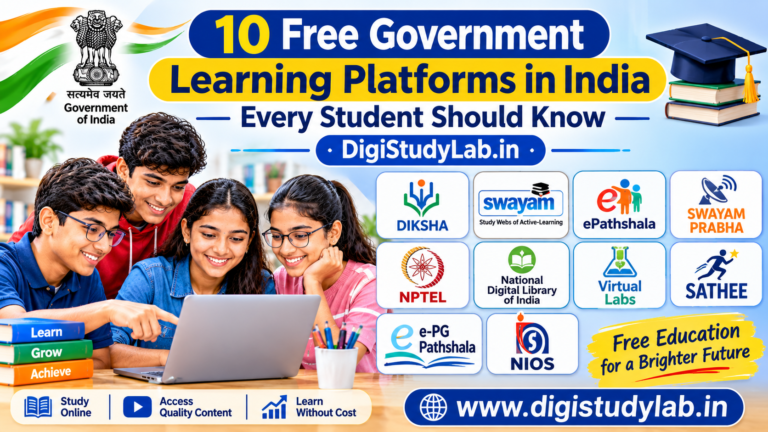
In this guide, Digi Study Lab.in explores 10 free government learning platforms in India that students should know about, including what each platform offers, who can benefit from it, and how to access its resources.
An important point to remember is that some platforms provide free learning materials while charging fees for optional examinations, certificates, or other services. Always check the conditions of an individual course or programme before enrolling.
1. DIKSHA – Digital Learning Resources for School Students
Official website: https://diksha.gov.in/
DIKSHA stands for Digital Infrastructure for Knowledge Sharing. It is a national digital platform developed to support school education in India.
The platform provides educational resources for students, teachers, and parents. It includes curriculum-linked content contributed by NCERT and various State and Union Territory education departments.
DIKSHA is particularly useful for students who want to access learning materials related to their school curriculum.
What does DIKSHA offer?
- Digital textbooks and educational resources.
- Interactive learning content.
- Educational videos and explanations.
- QR-code-linked textbook resources.
- Teacher training materials.
- Learning resources in multiple Indian languages.
- Accessible educational content for different learner needs.
One useful feature is the connection between physical textbooks and digital resources. Students can scan QR codes in supported textbooks to access related educational material.
DIKSHA also supports online and offline learning through available download features, depending on the resource.
Who should use DIKSHA?
- School students.
- Teachers.
- Parents supporting children’s education.
- Learners looking for curriculum-related resources.
Why it is useful: DIKSHA helps students supplement classroom learning with digital educational materials that are aligned with school curricula.
2. SWAYAM – Free Online Courses From Leading Institutions
Official website: https://swayam.gov.in/
SWAYAM stands for Study Webs of Active-Learning for Young Aspiring Minds.
It is an initiative of the Ministry of Education, Government of India, designed to make quality online education accessible to learners across the country.
The platform hosts courses covering different subjects and educational levels, from school education to postgraduate learning.
Courses are prepared by experienced teachers and faculty members from recognised institutions.
What does SWAYAM offer?
- Video lectures.
- Downloadable reading materials.
- Online quizzes and assessments.
- Discussion forums.
- Courses across different academic disciplines.
- Opportunities to learn from faculty at leading institutions.
SWAYAM uses a structured learning approach that combines video lessons, reading materials, self-assessment, and discussion activities.
Students can explore courses in subjects such as:
- Mathematics.
- Science.
- Computer science.
- Engineering.
- Business and management.
- Humanities.
- Social sciences.
- Language learning.
Are SWAYAM courses free?
The learning content and course access are generally free.
However, learners who want an official course certificate may need to register for a separately conducted proctored examination and pay the applicable examination fee.
Certificate eligibility and assessment conditions vary by course.
Who should use SWAYAM?
- School students.
- College students.
- University learners.
- Working professionals.
- Teachers.
- Anyone interested in learning new subjects.
Why it is useful: SWAYAM allows learners to study subjects beyond their regular academic curriculum and explore courses offered by leading educational institutions.
3. ePathshala – Free NCERT Textbooks and Educational Materials
Official website: https://epathshala.nic.in/
ePathshala is an educational initiative that provides digital learning resources developed by NCERT.
It helps students and teachers access educational materials through a website and mobile application.
Students who cannot easily obtain physical textbooks can use ePathshala to explore available digital versions of NCERT learning materials.
What does ePathshala offer?
- Digital NCERT textbooks.
- Educational audio resources.
- Video learning materials.
- Supplementary educational resources.
- Resources for teachers and students.
- Digital learning materials accessible through supported devices.
Depending on availability, learners can access textbooks and resources in different languages and formats.
How can students benefit?
Students can use ePathshala to:
- Read textbooks digitally.
- Revise lessons before examinations.
- Access learning materials while travelling.
- Supplement classroom learning.
- Explore educational resources without purchasing additional study material.
Who should use ePathshala?
- Students studying NCERT-based curricula.
- CBSE students.
- Teachers.
- Parents.
- Learners looking for digital textbooks.
Why it is useful: It provides a convenient way to access official NCERT educational resources without depending entirely on printed textbooks.
4. SWAYAM PRABHA – Educational Television Channels
Official website: https://www.swayamprabha.gov.in/
Not every student has reliable internet connectivity or access to a computer. For learners who depend on television, educational broadcasting can provide another way to access learning resources.
SWAYAM PRABHA is an educational broadcasting initiative that provides educational programmes through dedicated DTH television channels.
The initiative forms part of India’s broader efforts to make education accessible through multiple delivery methods.
What does SWAYAM PRABHA offer?
- Educational video programmes.
- Subject-related lessons.
- School-level educational content.
- Higher education programmes.
- Lectures and academic discussions.
- Learning programmes for different educational levels.
Students can use these programmes to revise lessons, understand difficult topics, and supplement their regular studies.
The availability and channel arrangements may vary, so learners should check the official website for current schedules and access information.
Who should use SWAYAM PRABHA?
- School students.
- College learners.
- Students with limited internet access.
- Learners who prefer television-based education.
- Teachers and educational institutions.
Why it is useful: It provides an alternative to internet-based learning and helps make educational content accessible through television.
5. NPTEL – Free Courses in Engineering, Science and Technology
Official website: https://nptel.ac.in/
NPTEL stands for National Programme on Technology Enhanced Learning.
It is a joint initiative of the Indian Institutes of Technology (IITs) and the Indian Institute of Science (IISc).
NPTEL provides online learning resources in engineering, science, technology, management, and other academic subjects.
It is especially useful for college students and learners interested in developing technical knowledge.
What does NPTEL offer?
- Video lectures.
- Online courses.
- Downloadable learning materials.
- Weekly assignments.
- Subject-specific learning resources.
- Online certification opportunities.
Some popular subject areas include:
- Computer science and programming.
- Artificial intelligence.
- Data science.
- Electronics and communication.
- Mechanical engineering.
- Civil engineering.
- Mathematics.
- Physics.
- Chemistry.
- Management.
Are NPTEL courses free?
Learners can generally access course materials and study content free of charge.
However, students who want an official NPTEL certificate usually need to register for and pay the applicable certification examination fee, subject to the course’s rules.
Who should use NPTEL?
- Engineering students.
- Science students.
- College learners.
- Working professionals.
- Technology enthusiasts.
- Anyone interested in structured technical learning.
Why it is useful: NPTEL provides an opportunity to study technical subjects through courses prepared by faculty from leading Indian institutions.
6. National Digital Library of India (NDLI) – A Digital Library for Learners
Official website: https://ndl.iitkgp.ac.in/
The National Digital Library of India is a digital repository designed to help learners discover educational resources from different sources.
It is developed and managed by IIT Kharagpur under an initiative supported by the Ministry of Education.
Unlike a conventional library that primarily provides access to physical books, NDLI helps users search for digital educational materials across different subjects and academic levels.
What does NDLI offer?
Depending on the resource and its access conditions, users can discover:
- Books and study materials.
- Academic articles.
- Educational videos.
- Audio learning resources.
- Research materials.
- Course-related content.
- Other digital educational resources.
Students can explore materials related to science, engineering, humanities, social sciences, technology, and many other subjects.
How can students use NDLI?
For example, a student preparing for a science examination can search for relevant educational resources, compare available materials, and explore additional explanations.
A college student working on an academic project can use the library to discover relevant reading and research resources.
Who should use NDLI?
- School students.
- College and university students.
- Researchers.
- Teachers.
- Competitive examination aspirants.
- Lifelong learners.
Why it is useful: NDLI helps learners discover educational resources from multiple sources through one digital search platform.
Please note that individual resources may have different access conditions, including open access, registration requirements, or restrictions determined by their providers.
7. Virtual Labs – Online Practical Experiments
Official website: https://www.vlab.co.in/
Practical learning is an important part of science and engineering education. However, not every educational institution has access to well-equipped laboratories.
Virtual Labs is an initiative supported by the Ministry of Education that helps learners perform or explore laboratory experiments through digital environments.
It provides web-based experiments and simulations in different scientific and technical subjects.
What does Virtual Labs offer?
- Online laboratory experiments.
- Interactive simulations.
- Experiment procedures.
- Learning objectives.
- Supporting theory and explanations.
- Practical learning activities.
Students can explore subjects such as:
- Physics.
- Chemistry.
- Biology.
- Electronics.
- Computer science.
- Engineering.
- Other technical disciplines.
How can students benefit?
For example, a physics student can explore an experiment through a virtual environment to understand a scientific concept.
An engineering learner can use available simulations to study technical principles before working with physical laboratory equipment.
Virtual Labs can supplement practical education, although it does not necessarily replace hands-on laboratory experience.
Who should use Virtual Labs?
- Science students.
- Engineering students.
- College learners.
- Teachers.
- Students interested in practical experimentation.
Why it is useful: It makes selected laboratory activities and scientific experiments accessible through a computer or supported digital device.
8. SATHEE – Free Competitive Examination Preparation Resources
Official website: https://sathee.iitk.ac.in/
SATHEE is a learning and examination preparation initiative developed by the Ministry of Education in collaboration with IIT Kanpur.
The platform is designed to support students preparing for competitive examinations.
It provides educational resources, practice opportunities, and learning support to help aspirants strengthen their preparation.
What does SATHEE offer?
- Video-based lessons.
- Practice questions.
- Mock tests and assessments.
- Learning resources for competitive examinations.
- Progress-tracking features.
- Preparation support and guidance.
The platform has been associated with preparation for examinations such as JEE, NEET, and other competitive examinations. Learners should check the current portal for the examinations and resources available.
How can students benefit?
Students preparing for competitive examinations can use the available resources to:
- Revise important concepts.
- Practise examination-style questions.
- Identify weaker subjects.
- Improve problem-solving skills.
- Organise their preparation.
Who should use SATHEE?
- JEE aspirants.
- NEET aspirants.
- Competitive examination candidates.
- Students seeking structured examination preparation.
Why it is useful: SATHEE provides an additional learning and practice resource for students who may not be able to afford expensive coaching programmes.
9. e-PG Pathshala – Postgraduate Learning Resources
Official website: https://epgp.inflibnet.ac.in/
e-PG Pathshala is an educational initiative that provides postgraduate-level learning resources across different academic subjects.
It is developed under the University Grants Commission’s National Mission on Education through Information and Communication Technology, with educational content coordinated through the INFLIBNET Centre.
The platform is particularly useful for students pursuing higher education who need additional academic resources.
What does e-PG Pathshala offer?
- Postgraduate-level educational content.
- Subject-specific learning modules.
- Academic explanations.
- Reading materials.
- Resources across different disciplines.
- Structured educational content.
Learners can explore subjects from areas such as:
- Arts and humanities.
- Social sciences.
- Commerce.
- Education.
- Management.
- Sciences.
- Other postgraduate disciplines.
Who should use e-PG Pathshala?
- Postgraduate students.
- University learners.
- Research-oriented students.
- Teachers.
- Learners interested in advanced academic subjects.
Why it is useful: It provides additional subject-specific educational material for learners pursuing higher studies.
10. National Institute of Open Schooling (NIOS) – Flexible School Education
Official website: https://nios.ac.in/
The National Institute of Open Schooling (NIOS) is an autonomous institution under the Ministry of Education, Government of India.
Unlike the other digital resource platforms discussed in this article, NIOS provides an open schooling pathway for learners who need flexible access to formal school education.
It is particularly useful for students who cannot follow a conventional school timetable or need an alternative route to complete their school education.
What does NIOS offer?
- Secondary-level education.
- Senior Secondary-level education.
- Open and distance learning opportunities.
- Flexible learning arrangements.
- Subject choices under applicable rules.
- Vocational education programmes.
- Educational support materials.
NIOS provides opportunities for learners to pursue recognised school-level qualifications through its prescribed admission, examination, and assessment systems.
Is NIOS free?
NIOS is not simply a free digital course library. Admission, examination, and other applicable fees may be charged depending on the programme and learner category.
Students should carefully review the official admission prospectus, eligibility conditions, fee structure, and examination rules before applying.
Who should consider NIOS?
- Students who need flexible schooling.
- Learners who have discontinued conventional schooling.
- Students seeking an alternative route to complete Class 10 or Class 12.
- Learners balancing education with other responsibilities.
Why it is useful: NIOS offers a flexible educational pathway for learners who need an alternative to conventional classroom-based schooling.
Bonus: PM e-VIDYA – India’s Multi-Mode Digital Education Initiative
Official website: https://pmevidya.education.gov.in/
PM e-VIDYA is an important Government of India initiative that brings together different digital, online, and broadcast-based educational efforts.
It was introduced to improve access to education through multiple delivery methods, including digital platforms, television, radio, and specialised educational resources.
Its components include initiatives such as DIKSHA, SWAYAM, SWAYAM PRABHA, educational radio, and specialised learning resources.
Rather than being just another independent learning website, PM e-VIDYA functions as a broader framework connecting different educational initiatives.
It is particularly relevant for learners who may not have reliable access to the internet or conventional classroom resources.
Comparison of the 10 Government Learning Platforms
The following table provides a quick overview to help students choose the most suitable platform.
| Platform | Best suited for | Main learning resources |
|---|---|---|
| DIKSHA | School students | Curriculum-linked materials |
| SWAYAM | School to postgraduate learners | Online courses |
| ePathshala | School students | NCERT textbooks |
| SWAYAM PRABHA | Students with limited internet access | Educational TV programmes |
| NPTEL | Engineering and science learners | Technical courses |
| NDLI | Students and researchers | Digital academic library |
| Virtual Labs | Science and engineering students | Online experiments |
| SATHEE | Competitive exam aspirants | Lessons and practice |
| e-PG Pathshala | Postgraduate learners | Advanced academic content |
| NIOS | Flexible school education | Open schooling programmes |
Are Government Learning Platforms Completely Free?
Many government-supported learning initiatives provide free access to educational content. However, the cost of using a platform depends on the specific service, course, examination, or programme.
It is important to distinguish between free learning materials and paid academic services.
For example:
- SWAYAM course materials are generally free, but certificate examinations may involve fees.
- NPTEL learning materials are generally free, while certification examinations may be chargeable.
- DIKSHA provides many free educational resources.
- ePathshala provides free access to available digital NCERT resources.
- NIOS has applicable admission and examination fees.
- NDLI provides access to resources with different access conditions depending on the content provider.
Before enrolling in any course or programme, always read its official terms and fee information.
How to Choose the Right Learning Platform
You do not need to register on every platform. The best choice depends on your educational level and learning objectives.
Here are some simple recommendations.
If You Are a School Student
Start with DIKSHA and ePathshala for curriculum-related materials and textbooks.
You can also explore SWAYAM and SWAYAM PRABHA for additional learning resources.
If You Are a College Student
Explore SWAYAM, NPTEL, and the National Digital Library of India.
These platforms can help you expand your knowledge beyond your regular college curriculum.
If You Are Preparing for Competitive Examinations
Explore SATHEE for available examination preparation resources.
You can also use SWAYAM and NDLI to strengthen your understanding of relevant subjects.
If You Are an Engineering or Science Student
NPTEL and Virtual Labs are useful starting points.
They provide opportunities to study technical concepts and explore practical learning activities.
If You Are Pursuing Postgraduate Education
Explore e-PG Pathshala, SWAYAM, and NDLI for advanced academic materials.
If You Need Flexible School Education
Visit the NIOS official website and review its eligibility, admission, subject, and examination requirements.
Tips for Making the Most of Free Online Learning Resources
Having access to educational platforms is only the first step. You also need a consistent approach to make learning effective.
Follow these practical suggestions:
- Set a clear learning goal: Decide what subject or skill you want to study.
- Choose the right platform: Select resources that match your educational level.
- Create a study timetable: Allocate regular time for learning.
- Take notes: Record important concepts, examples, and definitions.
- Practise regularly: Use quizzes, assignments, and available assessments.
- Revise previous lessons: Revisit topics to strengthen your understanding.
- Avoid unnecessary distractions: Study in a focused environment.
- Verify official information: Always check course details and announcements on the platform’s official website.
- Check certificate conditions: Understand examination requirements and fees before enrolling.
- Stay consistent: Regular learning is more valuable than occasional long study sessions.
Remember that completing a course is not the only measure of success. Understanding and applying what you learn are equally important.
Frequently Asked Questions
1. Which government platform is best for free online learning in India?
There is no single best platform for everyone. DIKSHA and ePathshala are useful for school education, SWAYAM and NPTEL offer structured online courses, NDLI helps discover academic resources, and SATHEE supports competitive examination preparation.
2. Can students access government learning platforms without paying?
Many government-supported platforms provide free access to educational resources and learning content. However, some services, examinations, certificates, or formal programmes may involve fees.
3. Is SWAYAM completely free?
SWAYAM provides free access to its course learning materials. However, learners seeking official certificates may need to pay the applicable examination fee and meet the course requirements.
4. Which platform provides free NCERT textbooks?
ePathshala provides access to available digital NCERT textbooks and educational resources. DIKSHA also offers curriculum-linked resources, including digital content connected to supported textbooks.
5. Which government platform is useful for engineering students?
NPTEL is particularly useful for engineering students because it offers courses and learning materials in engineering, science, technology, and related subjects. Virtual Labs can supplement practical learning.
6. Which platform is useful for JEE and NEET preparation?
SATHEE provides learning and examination preparation resources for competitive examinations, including JEE and NEET-related preparation. Students should check its current official portal for available courses and materials.
7. Can working professionals use SWAYAM?
Yes. SWAYAM is open to learners beyond traditional school and college students. Working professionals can explore courses that match their interests, career objectives, and available study time.
8. What is the difference between DIKSHA and SWAYAM?
DIKSHA primarily focuses on school education resources, teacher support, and curriculum-linked learning materials. SWAYAM is a broader online course platform offering courses across different educational levels and disciplines.
9. Is NIOS the same as an online learning platform?
No. NIOS is an open schooling institution that provides flexible school education pathways. It has learning resources, but its primary role includes formal education, admission, assessment, and certification under its prescribed rules.
10. Do government learning platforms provide certificates?
Some platforms offer certification opportunities. However, eligibility, examination requirements, and applicable fees vary. Students should check the official conditions of each course or programme.
Conclusion
India offers several government-supported learning platforms that help students, teachers, researchers, and lifelong learners access educational resources.
From school textbooks on ePathshala and DIKSHA to online courses through SWAYAM and NPTEL, digital libraries through NDLI, and examination preparation resources through SATHEE, learners have many opportunities to expand their knowledge.
These platforms can be particularly valuable for students who cannot afford expensive coaching programmes, additional textbooks, or private online courses.
However, remember that free access to learning resources does not automatically mean that every certificate, examination, or formal programme is free.
Choose platforms according to your educational goals, verify information through official websites, and make consistent use of the resources available.
At Digi Study Lab.in, we believe that quality learning should be accessible to everyone. Our goal is to help students and lifelong learners discover useful educational resources, improve their knowledge, and make informed decisions about their learning journey.
Discover free learning opportunities. Build knowledge. Keep growing.
References and Official Resources
- Ministry of Education – Digital Education Initiatives
- PM e-VIDYA – Government of India
- DIKSHA – Digital Infrastructure for Knowledge Sharing
- SWAYAM – Free Online Courses
- ePathshala – NCERT Digital Resources
- SWAYAM PRABHA – Educational Television
- NPTEL – Online Courses
- National Digital Library of India
- Virtual Labs – Online Experiments
- SATHEE – Competitive Examination Preparation
- e-PG Pathshala – Postgraduate Learning
- National Institute of Open Schooling