India’s aviation sector has grown rapidly in the last few decades—new airports, expanding airline networks, affordable regional flights, and digital tools that make air travel faster. Behind all of this development is a key government ministry responsible for planning, policies, coordination, and public-facing services: the Ministry of Civil Aviation (MoCA).
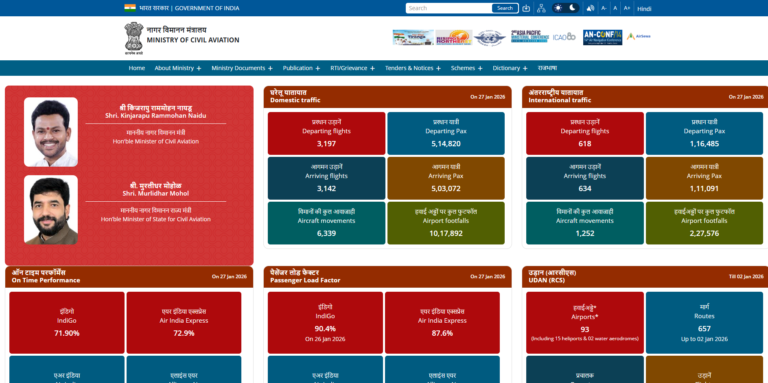
The Ministry of Civil Aviation is the nodal ministry of the Government of India for the development and regulation of civil aviation. This includes matters related to airports, airline operations, air connectivity, passenger facilities, safety frameworks, and the overall modernization of the aviation ecosystem. The ministry’s official portal is an important source of authentic government information, including documents, policies, circulars, publications, and citizen-focused resources.
If you are exploring government websites and public services to build awareness and practical knowledge, Digistudylab.in regularly publishes educational guides that help you understand how Indian ministries work, what services they provide, and where to find official resources—this post is created in the same learning-focused style so you can confidently use the ministry portal when needed.
Official Website (MoCA): https://www.civilaviation.gov.in/
Historical Background and Evolution
After India became independent in 1947, the civil aviation sector began developing into an organized system for national and international air travel. The Ministry was tasked with building policy frameworks, ensuring safety, and delivering air transport services that connect every part of the country to the rest of the world. Over the decades, with liberalization and growth in private airlines, aviation expanded significantly, placing India among the fastest-growing air markets globally.
Understanding the Ministry of Civil Aviation: What It Does and Why It Matters
The Ministry of Civil Aviation is responsible for:
Designing and implementing national policies for civil aviation
Supporting the orderly growth of air transport (passengers and cargo)
Coordinating airport development and modernization
Ensuring aviation safety and security frameworks through specialized bodies
Promoting connectivity, including regional routes and underserved areas
In a country as large and diverse as India, aviation is more than just travel—it supports:
Tourism and hospitality
Trade and cargo movement
Emergency and disaster response logistics
Economic growth and job creation
Regional development and faster connectivity
That’s why MoCA’s role has become increasingly important as India expands airports, builds new terminals, strengthens passenger rights, and integrates digital systems in air travel.
The MoCA Official Portal: What You Can Learn and Use It For
The official portal of the Ministry of Civil Aviation is designed to provide:
Ministry overview and organizational information
Documents such as Acts, rules, guidelines, circulars, notifications, policies
Passenger-focused resources like the Passenger Charter of Rights
Publications, press releases, and scheme documents (including RCS/UDAN materials)
RTI and grievance-related sections
This makes the portal useful not only for exam preparation and general learning, but also for practical tasks like checking passenger rights or understanding how aviation governance is structured.
Leadership and Administration: “Who’s Who” Section
MoCA provides a Who’s Who page that lists key officials, designations, and contact references—helpful for understanding administration and accountability.
This section is useful when you are:
Researching ministry structure for education
Looking for official offices (for formal communication/RTI paths)
Understanding who handles what in the ministry setup
Organizational Setup: Key Bodies Under the Ministry (Most Important Section)
One of the most educational parts of the MoCA portal is Organization Setup, which explains the main institutions that manage safety, airports, security, regulation, and investigations.
The Ministry functions under the leadership of:
Union Minister of Civil Aviation – The Cabinet Minister responsible for overall policy and administration.
Minister of State for Civil Aviation – Helps the Cabinet Minister in administrative and operational oversight.
Secretary & Other Senior Officials – Civil servants who manage implementation and daily administration.
The Ministry’s headquarters is located at Rajiv Gandhi Bhavan, Safdarjung Airport Area, New Delhi.
1) Directorate General of Civil Aviation (DGCA)
DGCA is the primary regulator for civil aviation in India and is mainly associated with:
Safety regulation and oversight
Regulation of air transport services within/to/from India
Enforcement of civil aviation standards and airworthiness
Coordination with global civil aviation standards, including ICAO alignment
If you are learning aviation governance, DGCA is crucial because it influences:
airline operational standards
licensing and regulations
safety systems and compliance
You can also find aviation rules and regulatory materials through DGCA’s official resources (linked across the ecosystem).
2) Bureau of Civil Aviation Security (BCAS)
Aviation security is a major concern worldwide. BCAS is responsible for:
Laying down standards and measures for security of civil flights
Supporting security systems at domestic and international airports
Creating frameworks that help reduce risks and improve airport security operations
The MoCA portal includes dedicated references and information about BCAS and its background.
3) Airports Authority of India (AAI)
AAI plays a major role in the development and management of airport infrastructure and operations. It is deeply connected with:
Airport development and modernization
Air navigation and airport operational support
Infrastructure upgrades that improve passenger experience and capacity
When you see new airport expansions, runway upgrades, terminal development, or navigation improvements, AAI is often one of the key implementing bodies across India’s aviation ecosystem.
AAI also provides public information on schemes like RCS–UDAN from the airport development angle.
4) Airports Economic Regulatory Authority (AERA)
AERA is important for economic regulation in the airport sector. It is generally associated with:
Economic oversight and tariff-related regulation at major airports
Ensuring fairness and transparency in airport-related economic decisions
AERA’s role matters because airports are not just infrastructure—they are also complex economic systems involving airlines, passengers, and service operators.
5) Aircraft Accident Investigation (Safety Investigations Framework)
For aviation safety, investigation systems are essential. The MoCA ecosystem includes frameworks for accident/incident investigation and related rules. Regulatory and legal documents connected to aviation safety and operations are available through official resources.
6) Indira Gandhi Rashtriya Uran Akademi (IGRUA)
IGRUA is a premier aviation training institute in India where aspiring pilots receive theoretical and practical flight training. This institution helps meet the growing demand for trained aviation professionals domestically and internationally.
Laws and Acts: The Legal Foundation of Civil Aviation in India
MoCA hosts and publishes a range of important legal documents under its Acts section. This is extremely helpful for:
Competitive exams
Research and education
Understanding how aviation is governed legally
Some key acts available through the ministry’s Acts section include:
The Aircraft (Amendment) Act, 2020
The Anti-Hijacking Act, 2016
The Carriage by Air (Amendment) Act, 2016
The Tokyo Convention Act, 1975
The Carriage by Air Act and Amendment 2009
In addition, foundational aviation legal texts like The Aircraft Act, 1934 and Aircraft Rules, 1937 are available through official government sources connected to the aviation regulatory ecosystem.
Wings India Air Show
The biennial Wings India air show, organized by the Ministry, serves as a platform to showcase India’s aviation industry, foster global engagement, and attract investments in aviation infrastructure and technology.
Key Policies and Legislation
The Ministry oversees and administers crucial aviation laws, including:
Aircraft Act, 1934
Aircraft Rules, 1937
Various civil aviation requirements to align India with international standards.
These legal frameworks define how aircraft are regulated, how airports are operated, and how safety and passenger rights are protected.
Passenger Charter of Rights: Learn What Air Passengers Are Entitled To
The Passenger Charter of Rights is one of the most useful citizen-focused resources available through the MoCA portal. It is designed to help you understand:
Airline responsibilities
Passenger rights during delays/cancellations
Key expectations around refunds, information, and service standards
If you run an educational website like Digistudylab.in, this is a high-value resource to reference because many people travel by air but are not fully aware of what they can demand or expect as a passenger.
Passenger Charter page (MoCA): https://www.civilaviation.gov.in/ministry-documents/passenger-charter-of-rights
Major Schemes and Initiatives You Should Know
Regional Connectivity Scheme (RCS) and UDAN
The MoCA portal provides official publications and documents related to the Regional Connectivity Scheme (RCS), which includes the UDAN concept and manuals.
Why this matters (educational point):
Regional connectivity aims to expand air access beyond metro cities
It helps connect smaller cities, tier-2/tier-3 locations, and underserved routes
It encourages balanced development and improves mobility
MoCA’s RCS publication area includes UDAN-related documents such as manuals and scheme versions.
Digi Yatra: Paperless and Faster Airport Movement (Digital Initiative)
Digi Yatra is often described as a digital initiative connected to India’s airport experience, using identity verification approaches (including facial recognition) to streamline passenger movement.
From a learning perspective, Digi Yatra is important because it represents:
Digital transformation in public infrastructure
Faster passenger processing
The growing role of technology in transport governance
Grievances and Passenger Support: AirSewa Portal
For passengers, one of the most practical services connected to MoCA is AirSewa, which supports grievance reporting, tracking, and passenger support.
AirSewa offers features such as:
Submitting grievances online
Checking status and relevant travel information
Accessing airport information and FAQs
AirSewa portal: https://airsewa.gov.in/
(Also referenced via National Portal of India services listing.)
RTI and Public Authorities: Transparency and Access
The MoCA portal also includes RTI-related resources, including lists of public authorities under the ministry—useful for learning how transparency systems are structured across departments.
How the Ministry Supports India’s Aviation Future
The ministry’s role continues to expand because aviation is evolving in multiple directions:
Airport modernization and capacity expansion
Passenger convenience through digital systems
Safety and security frameworks aligned with global standards
Regional connectivity and broader access
Supporting policies for a growing market
For learners and exam preparation, MoCA is an excellent example of how a ministry works with:
regulatory bodies (like DGCA)
operational bodies (like AAI)
security frameworks (like BCAS)
legal and policy documents (Acts, rules, guidelines)
public service portals (AirSewa and passenger charter)
How to Use the MoCA Website Effectively (Simple Navigation Guide)
When you open the official website, these sections are especially useful for educational and practical purposes:
About Ministry → organization setup, vision/mission, who’s who
Ministry Documents → acts, rules, policies, circulars, notifications
Passenger Charter of Rights → passenger protections and expectations
Publication / RCS → scheme documents and manuals
RTI/Grievance → transparency and complaint-related pathways
Educational Importance for Visitors
Understanding the Ministry of Civil Aviation offers learners insight into how government systems influence everyday life — from enabling mobility to framing security and economic policies that affect millions of travelers each year. Aviation is not just about airlines and airports; it’s about integrated systems of governance, technology, diplomacy, and public service.
Conclusion
The Ministry of Civil Aviation plays a vital role in shaping India’s air transport system by ensuring safety, accessibility, infrastructure development, and transparent governance. From regulating airlines and airports to protecting passenger rights and expanding regional connectivity, the ministry influences how millions of people travel every year.
Through this educational guide published on Digistudylab.in, you can clearly understand how India’s civil aviation framework works, which authorities manage different responsibilities, and how official government portals support citizens, learners, and researchers. Exploring such ministries helps build stronger awareness of India’s governance system and the public services that support national growth.
For verified updates, official documents, and latest announcements, always refer to the official website of the Ministry of Civil Aviation:
https://www.civilaviation.gov.in/