Rail transport has played a decisive role in shaping modern India. From enabling economic activity and industrial expansion to connecting distant regions and cultures, railways remain one of the most influential public infrastructure systems in the country. Every day, millions of people rely on trains for travel, employment, trade, education, and essential services.
To manage this vast and complex transport network, the Government of India operates through the Ministry of Railways, a central ministry responsible for planning, policy-making, administration, and development of Indian Railways. The ministry ensures that railway services remain safe, accessible, affordable, and continuously evolving to meet the needs of a growing nation.
For learners who want to understand how Indian government ministries function and how public infrastructure is managed at a national level, Digistudylab.in provides educational and informative content focused on government departments, official portals, and public service systems. Through this detailed guide, you will gain complete knowledge about the Ministry of Railways, its structure, responsibilities, history, and the purpose of its official website https://indianrailways.gov.in/.
Introduction to the Ministry of Railways
The Ministry of Railways is a key administrative body of the Government of India responsible for the country’s rail transport system. It administers and manages Indian Railways, one of the largest and most complex rail networks in the world.
With headquarters at Rail Bhavan, New Delhi, the ministry oversees the policy direction and operations of rail services across India. It functions under the leadership of the Minister of Railways, supported by Ministers of State and senior civil servants.
Importance of Indian Railways in National Life
Indian Railways isn’t just a transport network — it is a symbol of national integration, connecting towns and cities across vast geographic, cultural, and economic diversities. It plays a pivotal role in:
Facilitating interstate travel and boosting tourism
Supporting freight movement, which propels economic growth
Creating millions of jobs directly and indirectly
Enabling affordable and accessible travel for all sections of society
It is also one of the largest employers in the world, with over a million people working across various departments.
History of Railways and the Ministry
The roots of India’s railway system go back to the 19th century. The earliest railway lines were built under British colonial rule, and by the mid-20th century, an integrated national system began to emerge. In 1951, Indian Railways was reorganized under the Ministry of Railways.
Since then:
Indian Railways has grown to include thousands of stations, tens of thousands of kilometres of track, and a huge fleet of locomotives and coaches.
The Ministry of Railways has evolved into a modern administrative body, responsible for strategic planning, network expansion, safety, and competency standards.
Organizational Structure of the Ministry
The Ministry of Railways operates through a well-defined structure to deliver complex rail operations efficiently:
1. Leadership
Minister of Railways: The Cabinet Minister who heads the ministry.
Ministers of State: Assist the main minister by handling specific portfolios.
2. Railway Board
The Railway Board is the executive arm under the Ministry, tasked with policy execution and operational management of Indian Railways. It includes:
Chairman & CEO
Members heading departments such as operations, infrastructure, finance, and rolling stock
Director-Generals responsible for personnel, safety, health, and security
3. Zonal Railways
Indian Railways is divided into 18 administrative zones, each headed by a General Manager who reports to the Railway Board. This helps decentralized management of:
Train operations
Maintenance and infrastructure
Safety and compliance
Customer service and station operations
Role and Responsibilities of the Ministry of Railways
The Ministry of Railways performs a wide range of responsibilities that directly affect daily life across the country.
Policy Planning and Governance
The ministry designs long-term and short-term railway policies related to:
Network expansion
Electrification
High-speed rail development
Sustainability initiatives
Digital transformation
These policies guide how Indian Railways adapts to future transportation needs.
Infrastructure Development
One of the primary roles of the ministry is infrastructure creation and maintenance, including:
Railway tracks and signaling systems
Bridges and tunnels
Railway stations
Electrification networks
Dedicated freight corridors
Large-scale projects are planned and executed under the supervision of the ministry.
Passenger Services Management
Passenger comfort and safety are major priorities. The ministry oversees:
Train scheduling and operations
Coach design and maintenance
Safety systems and inspections
Accessibility for senior citizens and persons with disabilities
Cleanliness and onboard services
Although ticket booking is handled through IRCTC, policy direction comes from the Ministry of Railways.
Freight and Logistics Operations
Indian Railways plays a crucial role in national logistics. The ministry manages freight transport for:
Coal and minerals
Agricultural products
Industrial raw materials
Containers and goods trains
Efficient freight movement supports India’s manufacturing and power sectors.
Railway Safety and Security
Safety is a critical responsibility of the ministry. Measures include:
Track monitoring systems
Modern signaling technology
Accident investigation mechanisms
Training of railway staff
Railway Protection Force (RPF) operations
Continuous improvements are introduced to reduce accidents and enhance reliability.
Human Resource Management
Indian Railways is one of the world’s largest employers. The ministry supervises:
Recruitment through Railway Recruitment Boards
Staff training institutions
Promotions and service rules
Welfare schemes for employees
This ensures skilled manpower across technical and administrative roles.
Research & Development
Bodies like the Research Design and Standards Organisation (RDSO) contribute technical expertise, standards, and innovations for rail systems.
Indian Railways: A National Institution
Indian Railways is not just a transport provider. It is a national institution contributing to:
Economic integration
Social mobility
Disaster relief operations
Employment generation
Regional development
It connects metropolitan cities, towns, villages, and remote regions under one transport network.
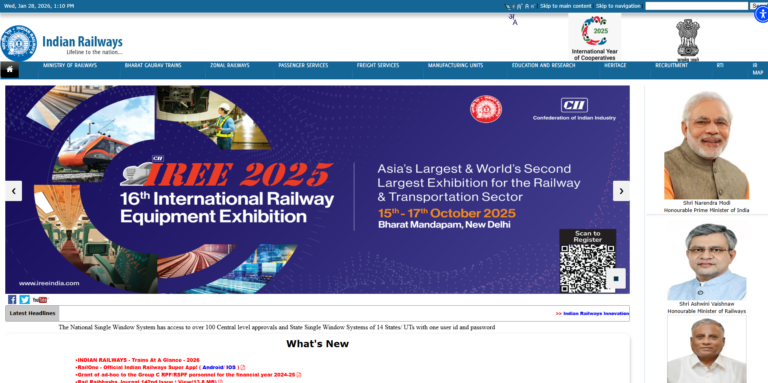
Official Portal: https://indianrailways.gov.in/
The official website of Indian Railways, managed by the Ministry of Railways, provides a single-window digital interface to access a wide range of services and government information related to rail transport in India.
This portal is essential for learners, travellers, and ordinary citizens to:
Access Passenger Services
Through linked services and enquiry tools such as:
PNR Status Check
Seat Availability
Train Time Table
Fare Enquiries
Chart Preparation & Travel Information
These services help travellers plan and manage their train journeys efficiently.
Government Resources
The portal provides access to:
Annual reports and achievements
Railway tenders and recruitment notices
Safety and policy documents
Contact information of departments and officials
Accessibility and Inclusion
The portal includes resources for differently-abled passengers and guidelines for bulk bookings, freight services, and official communications.
👉 Visit the official portal here: https://indianrailways.gov.in/
Railway Tenders and Procurement
Government tenders related to railway projects are published to maintain transparency and allow fair participation by contractors and companies.
Recruitment and Employment Notices
Official recruitment updates and examination-related announcements are published through authorized channels connected to the railway administration.
Annual Reports and Statistics
The portal includes:
Performance reports
Budget highlights
Infrastructure growth statistics
Safety records
These documents are useful for students and researchers studying public administration.
Policies and Circulars
Important railway rules, safety guidelines, and operational circulars are published for public reference.
Key Online Services Linked to Indian Railways
While the main portal provides government-level information, several linked services help passengers with practical travel needs:
🟢 PNR Enquiry
Check your Passenger Name Record (PNR) status online to know if your ticket is confirmed, on the waiting list, or under reservation.
🟢 Seat Availability & Train Schedule
Search for seat availability for specific classes on trains between your origin and destination.
🟢 Live Train Status (NTES)
Real-time tracking of trains helps travellers stay updated about delays or expected arrival times.
(Note: While booking itself is largely done via the IRCTC platform, the government portal links to external services for convenience.)
Role in Indian Government Services
The Ministry of Railways, as part of the Indian government, contributes to public administration and national service via:
Public infrastructure investment
Safety and security protocols
Employment and training through transparent recruitment
Expansion of rail connectivity to remote areas
Engagement with citizens via initiatives like passenger grievance redressal and technological upgrades
The Ministry also aligns with national schemes related to infrastructure growth, integrated logistics, and regional development.
Digital Transformation in Railways
The Ministry of Railways has actively promoted digital governance, including:
Online enquiry systems
Real-time train tracking
Data-driven operations
Paperless administration
Integrated passenger platforms
These initiatives aim to improve efficiency and transparency.
Railway Budget and Financial Management
Earlier, railways had a separate budget. Now, it is integrated into the Union Budget while maintaining distinct financial reporting.
The ministry manages:
Capital expenditure planning
Revenue generation
Infrastructure funding
Public-private partnerships
This ensures sustainable growth of the rail network.
Research, Development, and Innovation
The ministry supports technological innovation through specialized organizations that focus on:
New train designs
Safety technologies
Energy efficiency
Signaling systems
Track modernization
Innovation is essential to meet modern transport demands.
Educational Value of the Ministry of Railways Portal
For learners, the portal serves as:
A case study of large-scale public sector management
A learning resource for governance structure
An example of infrastructure planning
A reference for competitive exam preparation
This makes it especially useful for educational platforms like Digistudylab.in that focus on knowledge-based learning.
Learning & Career Opportunities
The Railways offers diverse career paths, from technical and operational roles to administrative leadership and civil services:
📍 Exams and recruitment are handled through official channels like Railway Recruitment Boards and cells.
Always rely on the official portal and government notice channels for authentic information — beware of fraudulent job offers circulating unofficially.
Modern Developments and Innovations
Indian Railways is not just about conventional trains — it is continuously innovating:
Station redevelopment schemes like the Amrit Bharat Station Scheme enhance passenger experience and infrastructure.
Adoption of modern digital monitoring & safety systems such as train protection technologies.
Integrated mobile apps and digital tools are emerging to make travel more seamless.
Why Understanding the Ministry Matters
For students, researchers, and citizens:
It fosters civic awareness about national transport systems
Helps understand how large public sector organizations are structured
Encourages informed use of services and participation in public feedback
Opens windows into careers and public sector administration
The official portal acts as the primary gateway to understanding this craftsmanship of governance.
Importance of Official Sources
Citizens are always advised to rely only on official government portals like:
https://indianrailways.gov.in/
for accurate information, avoiding unofficial websites or misleading sources.
Conclusion
The Ministry of Railways stands as one of the most vital institutions within the Government of India. By managing Indian Railways, it ensures nationwide connectivity, economic movement, and accessible transportation for millions every day.
Through structured administration, safety-focused policies, and continuous modernization, the ministry plays a critical role in national progress. Its official portal, https://indianrailways.gov.in/, acts as a trusted source of information, enabling citizens to understand railway operations, access services, and learn about government functioning.
For educational platforms like Digistudylab.in, explaining such ministries helps learners develop awareness about public administration, infrastructure governance, and the role of government in everyday life. Understanding how the Ministry of Railways operates not only improves civic knowledge but also builds appreciation for the systems that keep the nation moving.