Introduction
The National Archives of India is the central repository of the country’s historical government records and one of the most important institutions responsible for preserving India’s documentary heritage. It plays a vital role in safeguarding official records that reflect the administrative, political, and social development of the nation over several centuries.
Established to ensure systematic preservation of valuable documents, the National Archives of India maintains records that are no longer in active administrative use but continue to hold long-term historical, legal, and research significance. These documents help in understanding how policies were formed, how governance evolved, and how major historical events shaped modern India.
To help learners clearly understand the role and importance of such national institutions, Digistudylab.in provides detailed educational and informative content related to Indian government departments and organizations. Through this article, you can explore the history, functions, and services of the National Archives of India, along with guidance on using its official website https://nationalarchives.nic.in/ to access archival information, digital records, and public resources made available by the Government of India.
What Is the National Archives of India?
The National Archives of India (NAI) is the principal archival institution of the Government of India. It serves as the central repository for non-current records of enduring value, meaning those documents that are no longer in active government use but are preserved for historical, legal, or administrative purposes.
NAI functions as an Attached Office under the Ministry of Culture, Government of India, and its primary responsibility is to ensure proper preservation, management, and accessibility of archival documents related to India’s administrative and cultural history.
In simple terms, it is a treasure trove of original documents that represent centuries of governance, social developments, files from ministries, private papers, maps, census reports, committee reports, gazettes, and much more. These records are invaluable for understanding India’s past — whether one is studying colonial rule, the freedom movement, legislative history, or the post-independence era.
A Glimpse into History
The roots of the National Archives of India trace back to the late 19th century. During the British colonial era, the need to systematically organize and preserve official records became increasingly important. This led to the establishment of the Imperial Record Department on 11 March 1891 in Calcutta (now Kolkata). Professor G.W. Forrest was its first head — known then as the “Keeper of Records.”
The department’s initial aim was to collect, appraise, and manage records created by various branches of the British Indian government. These records provided detailed insights into administrative functions and were crucial for historical reference.
In 1911, with the transfer of the capital to New Delhi, the Imperial Record Department was relocated. Over time, it evolved into what we know today as the National Archives of India. In 1947, after India gained independence, the organization adopted its present name, reflecting its role in serving independent India’s heritage and administrative needs.
The archives moved to a purpose-built structure in 1926, designed by famed architect Sir Edwin Lutyens, and remain at the intersection of Janpath and Kartavya Path in New Delhi.
Objectives and Vision
The National Archives of India plays a key role in documenting and safeguarding historical records. Its core objectives and vision include:
Preservation of Documentary Heritage: Protecting records of administrative value and cultural importance for future generations.
Encouraging Research and Knowledge Sharing: Making materials available to scholars, students, and others who wish to explore India’s past.
Scientific Administration of Public Records: Applying professional archival methods for the proper management of records across the country.
Promoting Archival Awareness: Fostering public interest in historical documents and archives.
International Collaboration: Engaging with archival institutions around the world to share best practices and expertise.
What Does the National Archives of India Contain?
The holdings of the National Archives of India are immense and varied. They span centuries and include multiple categories of historical and administrative materials.
Here are the main types of records held:
1. Public Records
These include records created by government departments and ministries over time. Examples include:
Documents from Home, Foreign, and Military Departments from the British period.
Ministry of Defence records from post-independence era.
Finance, Legislative Assembly debates, and census reports.
Public records form the backbone of administrative history and allow researchers to track social changes, policy decisions, and historical events.
2. Oriental Records
These records include historical documents in languages such as Arabic, Persian, Sanskrit, and Urdu — often written on unique materials such as palm leaf or birch bark.
3. Manuscripts
Dating back centuries, manuscripts cover religious texts, literary works, travel diaries, and local histories.
4. Private Papers
Collections of significant individuals, families, and organizations that offer perspectives on socio-cultural and political life in India. These might include letters, diaries, personal writings, and unpublished works.
5. Cartographic and Visual Records
These include maps, architectural plans, and visual materials that provide insights into geographic, cultural, and infrastructural evolution.
6. Gazetteers, Census Reports, and Administrative Lists
These documents give a detailed picture of the demographic, social, and economic landscape of India over time — essential for academic, demographic, and urban studies.
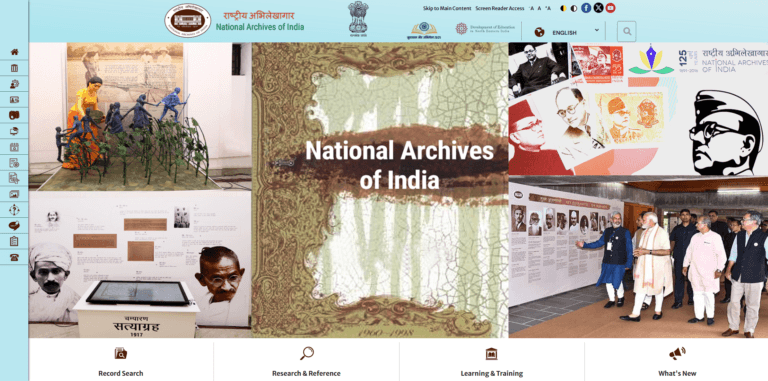
Exploring the Official Portal: https://nationalarchives.nic.in/
The official portal serves as a gateway to understanding and accessing India’s archival wealth. Here’s a breakdown of how users can engage with the portal:
Homepage and Navigation
At https://nationalarchives.nic.in/, visitors will find clear navigation to all key sections, including:
Online Records
Search a Document
Catalogue of Publications
Current Exhibitions
Research and Reference Tools
Public Records and Manuscripts
Access Guidelines
Search a Document
This section helps users find records by searching through the archives catalog. It’s especially useful for researchers who are looking for specific documents or historical data.
Online Records – Abhilekh Patal
One of the most exciting aspects of the Archives’ online presence is Abhilekh Patal — a specialized digital portal that provides access to approximately 2 million digitized records from the Archives’ collection.
The portal — whose name comes from Sanskrit words meaning “records” (Abhilekh) and “platform” (Patal) — allows users to browse, search, and view archival documents online from anywhere in the world, bridging the gap between physical archives and digital access.
Key Features of Abhilekh Patal:
Search through millions of indexed records.
Digitized historical files covering various eras of Indian history.
Download or view documents as per archival rules and permissions.
Digital access has empowered scholars, students, and history enthusiasts globally.
Netaji Papers
The Archives holds declassified files on Netaji Subhas Chandra Bose, which have been made available in digital form as part of efforts to make historical documents more transparent and accessible.
These files include detailed insights into political correspondence and significant movements during India’s freedom struggle.
Current Exhibitions
The portal also lists current and past exhibitions organized by NAI. These exhibitions often highlight specific themes or historical periods — for instance, an exhibition reflecting India’s constitutional history or colonial administration.
How to Use the Archives for Research and Learning
If you are a student, historian, academic, or curious learner, the National Archives offers several paths for research:
1. In-Person Research Visits
The Archives welcomes serious researchers. However, access to public records requires formal registration. As per archival rules, researchers must apply in prescribed forms and provide proof of bona fide purpose before consultation.
Foreign researchers may need additional documentation, such as a letter of introduction from a recognized institution or diplomatic mission.
2. Online Searches
With Abhilekh Patal and other digital tools, many archival records are accessible without visiting in person, especially helpful during academic projects or general learning.
3. Reference Tools
The National Archives provides descriptive lists, subject indexes, press lists, transfer lists, and reference media to help researchers locate relevant materials efficiently.
4. Publications
The Archives publishes research journals and catalogues on record administration, preservation science, and archival studies. These publications — some available online — help readers understand archival theory and practice in depth.
Additional Services and Programs
The National Archives of India also engages in several other important activities:
Conservation and Preservation
NAI works to conserve fragile documents through scientific methods to stop deterioration and ensure long-term preservation.
Digitization Projects
The Archives is actively converting analog records into digital formats, ensuring broader accessibility. Projects involve converting microfilm rolls and original documents into digital images — often with metadata — that can be accessed online.
Records Centres Across India
To decentralize archival resources, NAI manages Records Centres across the country, including:
Bhubaneswar
Jaipur
Puducherry
These repositories help preserve region-specific documents and facilitate easier access for researchers in those regions.
Importance for Students, Historians & Citizens
The National Archives of India is not just a repository — it is a living educational resource. It helps in:
Understanding Indian History
From colonial rule to independence and post-independence governance, the archives document state decisions, social policies, and cultural developments.
Supporting Academic Research
Students in history, political science, sociology, and related fields can obtain primary sources that lend authority to academic work.
Promoting Cultural Awareness
Documents like gazetteers, census data, and private papers reveal deep insights into societal structures, artistic movements, and local histories.
Encouraging Critical Thinking
Access to original records allows readers to interpret historical facts in context — strengthening analytical and research skills.
Conclusion
The National Archives of India stands as a pillar of India’s historical memory, preserving invaluable records that document the nation’s administrative, political, and cultural journey. By protecting and organizing these documents, the Archives ensures that future generations can study, understand, and learn from the past with authenticity and accuracy.
With initiatives such as digitization, online record access, and research support, the National Archives of India continues to modernize while maintaining its responsibility as the guardian of India’s documentary heritage. Its official portal https://nationalarchives.nic.in/ allows learners across the country to explore history beyond textbooks and gain direct exposure to original records.
At Digistudylab.in, such educational content is created to help you easily understand the structure and functioning of Indian government institutions. By learning about organizations like the National Archives of India, you gain deeper awareness of how historical knowledge is preserved and how government systems contribute to education, transparency, and national identity.