If you’ve ever searched for trusted information on women’s safety services, nutrition support for children, Anganwadi programs, child protection systems, or government initiatives for women empowerment, you’ve likely come across the Ministry of Women and Child Development (MoWCD). This ministry is one of the most important pillars of the Government of India because it focuses on two areas that directly shape a nation’s future: women and children.
This educational guide on Digistudylab.in explains what the ministry does, how its official portal works, what major schemes and missions are currently active, and how you (as a citizen, parent, volunteer, teacher, or community member) can benefit from the information and services available online.
Official website (for reference and redirection): https://wcd.gov.in/
1) What is the Ministry of Women and Child Development?
The Ministry of Women and Child Development is a central ministry under the Government of India that plans, coordinates, and supports national policies and programs related to:
Women’s welfare, safety, and empowerment
Child development, nutrition, and protection
Early childhood care and education
Support systems for vulnerable groups such as women in distress and children in difficult circumstances
The ministry works with State Governments/UT Administrations, district-level bodies, and partner institutions to implement programs on the ground, while also offering guidelines, portals, and structured missions to ensure consistent delivery across India.
2) Why this ministry matters in everyday life
Even if you never directly visit the ministry office, its initiatives affect daily life in many ways, such as:
Anganwadi services that support nutrition, growth monitoring, and early education
Women safety services like helplines and support centres
Campaigns promoting education and wellbeing of girls
Child protection systems and support services for children who need care
Policy frameworks that influence how institutions respond to women and child-related issues
In simple terms: the ministry helps strengthen families, improve health and learning outcomes, and build safer communities.
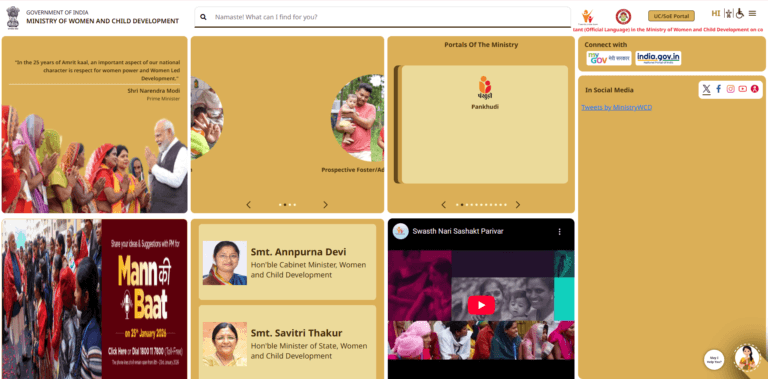
3) Understanding the official portal (wcd.gov.in)
The official portal https://wcd.gov.in/ is the ministry’s digital gateway for:
Scheme information and updates
National missions and program verticals
Notifications, guidelines, documents, and resources
Citizen-focused information, including how schemes work and who they are meant for
Many mission-specific systems also operate through dedicated portals linked with the ministry’s work. For example, major missions now run through specialized portals for detailed scheme structure and public resources.
Tip for learners and applicants:
When reading any scheme online, focus on these elements:
Objectives (what the scheme aims to achieve)
Eligibility (who can benefit)
Components/services (what support is provided)
Implementation structure (who runs it at state/district level)
Documents/guidelines (official PDFs and standard processes)
4) Three major program verticals: the ministry’s current structure
In recent years, the ministry’s major schemes have been grouped into three broad “verticals” (major mission frameworks), making it easier to understand programs by goal area:
A) Saksham Anganwadi and POSHAN 2.0
Focused on nutrition, early childhood care, and strengthening Anganwadi systems.
B) Mission Shakti
Focused on women’s safety, security, and empowerment through integrated support services.
C) Mission Vatsalya
Focused on child protection and care systems, aiming for a safe and supportive childhood.
You’ll see these three verticals repeatedly across government communications because they are the ministry’s major operational frameworks today.
5) Mission Saksham Anganwadi and POSHAN 2.0: Nutrition + Early Childhood Development
What it is
Mission Saksham Anganwadi & POSHAN 2.0 is an integrated program designed to address nutrition challenges and strengthen service delivery for:
Children (especially below 6 years)
Pregnant women and lactating mothers
Adolescent girls (as part of adolescent nutrition and support components in the mission framework)
Why Anganwadis are central
Anganwadi centres are grassroots-level service points where communities receive:
Supplementary nutrition (as per program norms)
Growth monitoring and counselling
Early childhood care and education (ECCE)
Community-based awareness on health and nutrition
The mission emphasizes improvements in content (nutrition quality and counselling) and delivery (better infrastructure and monitoring).
Modern monitoring: POSHAN Tracker (digital monitoring approach)
Many program documents and state implementations refer to ICT/digital tracking for transparency and monitoring. A key phrase you may see is “POSHAN Tracker” in various guideline and resource contexts.
“Saksham Anganwadi” concept (upgraded centres)
Across multiple states, the idea of “Saksham Anganwadi” includes upgrading infrastructure and enabling centres to deliver stronger early learning and nutrition support. News and state updates frequently highlight planned upgrades, facilities, and learning materials in these centres.
Reference link:
Mission/Scheme information (where available via ministry/state pages): https://wcd.gov.in/
Example mission page: https://www.spniwcd.wcd.gov.in/mission-saksham-anganwadi-and-poshan-2-0
6) Mission Shakti: Women safety, security, and empowerment in one mission framework
What is Mission Shakti?
Mission Shakti is a mission-mode framework to strengthen interventions for women safety, security, and empowerment.
A major advantage of Mission Shakti is that it brings multiple women-centric support systems under one umbrella, so services can work together rather than in isolation.
Two sub-schemes under Mission Shakti: Sambal and Samarthya
Mission Shakti is commonly explained as having two sub-schemes:
Sambal: Focused on safety and security
Samarthya: Focused on empowerment
Key components you should know
1) Women Helpline (181)
A well-known support service is the Women Helpline (181) which aims to provide 24×7 support and connect women to relevant services such as police assistance, medical help, legal aid, and support centers, depending on the case.
2) One Stop Centre (OSC)
One Stop Centres are designed to provide integrated support to women affected by violence—often bringing medical, legal, police facilitation, and counselling support into a coordinated system. OSC is repeatedly listed as a component under Mission Shakti’s Sambal framework.
3) Beti Bachao Beti Padhao (BBBP)
BBBP is included within Mission Shakti’s Sambal sub-scheme with modifications, as cited in mission guideline summaries and official references.
4) Nari Adalat (Women’s collective / alternative dispute resolution support)
Mission Shakti includes a component called Nari Adalat, positioned as an alternate grievance redressal mechanism for certain types of disputes at local levels through negotiation/mediation (as described in mission resources).
5) Hub for Empowerment of Women (HEW) / SANKALP: HEW
Mission Shakti also references a Hub for Empowerment of Women, intended to bridge information and knowledge gaps about schemes and help women access entitlements, while also supporting monitoring and convergence.
Reference links:
Mission Shakti portal: https://missionshakti.wcd.gov.in/
About Mission Shakti: https://missionshakti.wcd.gov.in/about
7) Mission Vatsalya: Child protection and care systems
What is Mission Vatsalya?
Mission Vatsalya focuses on ensuring a safe childhood for every child and strengthening child protection systems, emphasizing family-based care and treating institutionalization as a last resort.
What it supports (in practical terms)
Child protection work covers many real-life situations, such as:
Children without parental care or at risk
Children who need support due to family crises
Children facing neglect, abuse, exploitation, or unsafe environments
Rehabilitation and reintegration support
Mission Vatsalya is often described through official portals and guideline documents that outline structures, capacity building, and system strengthening.
Digital and citizen-facing aspects (portals)
Mission Vatsalya has a dedicated portal and citizen-related sections.
Reference links:
Mission Vatsalya portal: https://missionvatsalya.wcd.gov.in/
Citizen login area (for portal functions): https://missionvatsalya.wcd.gov.in/citizen-login
Mission Vatsalya guideline PDF (official document): https://cara.wcd.gov.in/pdf/Mission%20Vatsalya%20Guideline.pdf
8) How citizens can use these portals responsibly (and what to look for)
When using official government portals like wcd.gov.in and mission portals:
A) Use them for authentic, updated learning
Government portals typically provide:
Official program names and structures
Government-approved documents (guidelines, frameworks)
Updates and announcements
Contact/organizational details
This is ideal for educational use on Digistudylab.in because it reduces misinformation and helps learners rely on official information.
B) Understand “Centre vs State” implementation
Many schemes are:
Centrally sponsored or centrally structured
Implemented through State/UT departments and district units
So, the central ministry portal explains the mission and framework, while state portals often explain local application processes, district contacts, and state-specific updates.
C) Keep important helpline and support information handy
For women in distress and child protection, helpline and support mechanisms can be time-sensitive. Always verify the latest official numbers and processes on official portals and state authorities when needed.
9) Other official government service references (helpful for learners)
If you want a service-style listing of what government provides under the ministry, the National Government Services Portal has a section for the Ministry of Women and Child Development and notes recent updates.
Reference link:
Government Services Portal listing: https://services.india.gov.in/service/ministry_services?cmd_id=2538&ln=en
This is useful for learners because it shows how services are grouped and indexed as part of a national service window.
10) Educational summary: What you should remember
To quickly recap for Digistudylab.in readers:
MoWCD is central to India’s development priorities for women and children.
The ministry’s work is commonly organized into three verticals:
Saksham Anganwadi & POSHAN 2.0 (nutrition + early childhood)
Mission Shakti (women safety + empowerment)
Mission Vatsalya (child protection + care systems)
Dedicated portals like missionshakti.wcd.gov.in and missionvatsalya.wcd.gov.in provide deeper program structure and resources.
For learning and awareness, official portals are among the best sources because they publish standardized mission structures and documents.
Important Links (Official)
Ministry portal: https://wcd.gov.in/
Mission Shakti: https://missionshakti.wcd.gov.in/
Mission Vatsalya: https://missionvatsalya.wcd.gov.in/
Government Services listing (MoWCD): https://services.india.gov.in/service/ministry_services?cmd_id=2538&ln=en
Conclusion
The Ministry of Women and Child Development plays an essential role in strengthening India’s social framework by focusing on the welfare, nutrition, safety, and empowerment of women and children. Through national missions and structured programs, the ministry supports early childhood development, women’s safety initiatives, and child protection systems. Educational platforms like Digistudylab.in help learners understand these government efforts and gain clear insights into how the Government of India works toward inclusive national development.