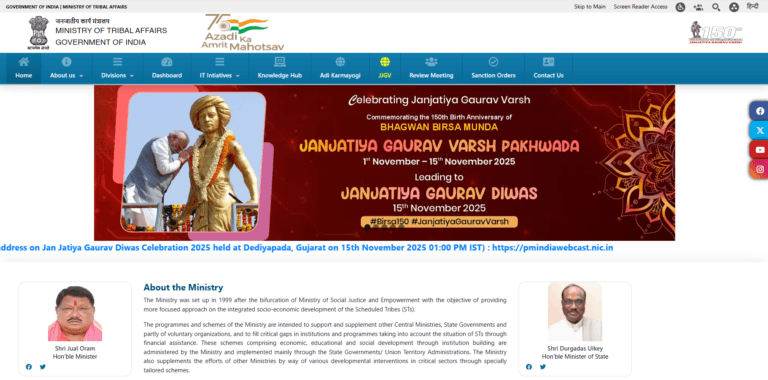
India is home to one of the largest and most diverse tribal populations in the world. To ensure that tribal communities receive focused policy attention, targeted welfare support, and coordinated development interventions, the Government of India created a dedicated ministry: the Ministry of Tribal Affairs (MoTA). The official online portal of the Ministry—https://tribal.gov.in/ (and its NIC-hosted pages on https://tribal.nic.in/ )—acts as a digital gateway for learning about tribal welfare programmes, scholarships, residential schools, livelihood missions, PVTG-focused initiatives, and many other services.
This article on Digistudylab.in presents a clear and structured overview of the Ministry of Tribal Affairs, explaining its objectives, responsibilities, major schemes, and public services, along with authentic information related to tribal development in India.
Introduction to the Ministry of Tribal Affairs
The Ministry of Tribal Affairs is the central authority responsible for the welfare, empowerment, and overall development of Scheduled Tribes (STs) in India. It acts as the nodal ministry for formulating policies, planning targeted programmes, and coordinating efforts between the central government, state governments, and various institutions.
The ministry was established in 1999, recognizing that tribal communities face unique challenges that require dedicated policy focus. These challenges include geographical isolation, limited access to education and healthcare, livelihood insecurity, and the need to preserve tribal cultures and identities while promoting socio-economic development.
1) What is the Ministry of Tribal Affairs?
The Ministry of Tribal Affairs is the nodal ministry of the Government of India for the overall policy, planning, and coordination of programmes meant for the development of Scheduled Tribes (STs).
While many sector-specific initiatives (health, education, rural development, housing, roads, etc.) are implemented by different central ministries and state governments, MoTA plays an important role by:
coordinating tribal development priorities,
supporting states with targeted funding,
filling critical gaps through special schemes, and
ensuring ST welfare remains a national focus.
When was the Ministry formed?
MoTA was set up in 1999 after the bifurcation of the Ministry of Social Justice and Empowerment, to provide a more focused approach toward the integrated socio-economic development of Scheduled Tribes.
2) Why an official portal matters (and why tribal.gov.in is useful)
Government portals are not just websites—they are public information systems. The Ministry’s portal helps citizens, researchers, educators, and beneficiaries to:
discover welfare schemes and guidelines,
access scholarship portals and application instructions,
understand flagship programmes like PM-JANMAN and PMAAGY,
find official documents, circulars, and downloadable PDFs, and
locate related institutions such as NESTS/EMRS, TRIFED, and NSTFDC.
For learners and educators using Digistudylab.in, this portal becomes a trusted reference for official programme details and authentic policy information.
✅ Official website to visit (recommended): https://tribal.gov.in/ and https://tribal.nic.in/
For authentic and up-to-date information, readers should always refer to the official Ministry portal:
https://tribal.gov.in/
Some sections and legacy resources are also accessible through:
https://tribal.nic.in/
These official platforms are recommended for verification and deeper exploration beyond educational articles.
3) Key responsibilities and subjects handled by MoTA
MoTA’s “About Ministry” section outlines the subjects allocated to it under the Government of India’s Allocation of Business Rules. These include areas such as:
tribal welfare planning, research, evaluation, training, and statistics
promotion of voluntary efforts (NGOs and civil society support)
scholarships and education support for STs
Scheduled Areas and related governance issues
coordination related to the National Commission for Scheduled Tribes
monitoring ST welfare grants and Tribal Sub-Plan mechanisms
implementation aspects related to laws such as the Protection of Civil Rights Act and the SC/ST (Prevention of Atrocities) Act—specifically where they relate to Scheduled Tribes
This is important because it shows the Ministry’s role goes beyond one scheme—it covers governance, welfare, education, and institutional development across India.
Core Functions and Responsibilities of the Ministry
The Ministry of Tribal Affairs performs a wide range of functions that support long-term development and social justice.
Policy Formulation and Planning
The ministry designs national-level policies and development strategies specifically focused on Scheduled Tribes, aligning them with constitutional provisions and national goals.
Coordination with States and Other Ministries
Most tribal welfare programmes are implemented by state governments. The ministry provides financial assistance, frameworks, and monitoring mechanisms to ensure effective implementation.
Research, Training, and Capacity Building
The ministry supports studies on tribal issues, documentation of tribal cultures, and training initiatives to improve administrative capacity.
Legal and Institutional Oversight
It also deals with matters related to Scheduled Areas, tribal rights, and coordination with constitutional bodies associated with Scheduled Tribes.
4) Major programmes and schemes featured on the Ministry portal
One of the most valuable parts of the MoTA portal is its scheme ecosystem. Below are some of the most visible and widely-referenced initiatives.
Education Initiatives for Tribal Empowerment
Education is a key pillar of tribal development, and the Ministry of Tribal Affairs places strong emphasis on improving access to quality learning.
A) Education & Empowerment: Eklavya Model Residential Schools (EMRS)
What is EMRS?
Eklavya Model Residential Schools (EMRS) were started in 1997–98 to provide quality education to Scheduled Tribe children, especially in remote areas. The goal is to help learners access better academic and professional opportunities and improve employment outcomes.
Key features highlighted on the portal
Residential schooling for ST learners with a focus on holistic development
Capacity commonly noted as 480 students per school (Class VI to XII)
Focus on academics + sports + skills + cultural preservation
Eklavya Model Residential Schools were introduced to provide quality education to tribal children, especially in remote and tribal-dominated regions. These residential schools aim to create an environment that supports academic excellence, physical development, and cultural awareness.
The objectives of EMRS include:
Providing free, quality residential education
Reducing dropout rates among tribal learners
Preparing students for higher education and competitive careers
Encouraging holistic development through academics, sports, and life skills
Why EMRS matters
In many tribal-dominated regions, challenges like distance from schools, lack of teachers, and limited learning infrastructure can reduce educational access. EMRS tries to address these gaps by creating high-quality residential learning environments.
NESTS: The institutional backbone
EMRS is supported through the National Education Society for Tribal Students (NESTS), which is dedicated to improving tribal education outcomes through EMRS expansion and management.
These schools are managed and supported by the National Education Society for Tribal Students (NESTS), a dedicated organization working under the Ministry of Tribal Affairs.
Learners can explore official EMRS and NESTS details through the ministry’s portal and related institutional websites linked there.
B) Scholarships & Direct Benefit Transfer: Tribal Scholarship Systems
Education support is not only about schools—it is also about enabling learners to afford education without dropping out due to financial pressure.
MoTA provides scholarship support through centrally sponsored schemes, implemented via States/UTs, often linked with Direct Benefit Transfer (DBT) to beneficiaries’ bank accounts.
Common scholarship categories you may see (on official portals)
Pre-Matric scholarships (for school-level support)
Post-Matric scholarships (for higher classes/college)
National Fellowship and higher education support
Overseas scholarship support for eligible candidates
Most of these benefits are delivered through direct bank transfers, improving transparency and efficiency. Scholarship-related information and application links are available through the ministry’s official portal and associated scholarship platforms.
Official portals referenced by MoTA ecosystem include:
Scholarship pages on tribal.nic.in and DBT interfaces
National Tribal Fellowship Portal: https://fellowship.tribal.gov.in/
National Overseas Scholarship Portal: https://overseas.tribal.gov.in/
Tip for learners: Always verify deadlines, eligibility, and required documents on the official portals because schedules can change.
C) PM-JANMAN: A mission-mode programme for PVTGs (Particularly Vulnerable Tribal Groups)
What is PM-JANMAN?
Pradhan Mantri Janjati Adivasi Nyaya Maha AbhiyaN (PM-JANMAN) was launched during FY 2023–24 for the socio-economic development of 75 Particularly Vulnerable Tribal Group (PVTG) communities across 18 states and one Union Territory, as described on the Ministry portal.
What does it aim to do?
PM-JANMAN aims to saturate PVTG families and habitations with essential facilities such as:
safe housing
clean drinking water
improved access to education, health, nutrition
road and telecom connectivity
electrification of unelectrified households
sustainable livelihood opportunities
within a mission timeline (noted as 3 years on the portal).
Multi-ministry implementation
A key point: the mission’s objectives are met through multiple interventions implemented by multiple line ministries—MoTA coordinates and anchors the tribal-focused mission direction.
Why this matters (learning perspective)
PVTG communities are often located in hard-to-reach regions and face higher vulnerability due to geography, isolation, limited services, and historical exclusion. A mission-mode approach helps bring multiple services together rather than offering isolated support.
For official reading and documents, PM-JANMAN has dedicated pages and downloadable guidelines on the Ministry portal.
You can also read an overview on MyScheme (Government of India) which summarizes the mission objective.
D) PMAAGY: Pradhan Mantri Adi Adarsh Gram Yojana (Model Village Development)
What is PMAAGY?
MoTA revamped the earlier Special Central Assistance to Tribal Sub-Scheme (SCA to TSS) into Pradhan Mantri Adi Adarsh Gram Yojna (PMAAGY) for implementation during 2021–22 to 2025–26, aiming to transform tribal-majority villages into “Adarsh Grams” (model villages).
Coverage and approach (as per official release)
The PIB release states it is envisaged to cover 36,428 villages with:
at least 50% tribal population, and
at least 500 ST persons
The scheme emphasizes:
integrated socio-economic development,
a convergence approach (aligning multiple schemes),
preparing a Village Development Plan (VDP) based on local needs and aspirations,
closing gaps in key sectors like roads, telecom, schools, anganwadi centres, health, water, and sanitation.
Why model villages are important
“Model village” initiatives help concentrate resources for visible improvements—roads, drinking water, digital connectivity, and local institutions—so that development is measurable and replicable.
E) Tribal Livelihoods: PMJVM, Van Dhan, TRIFED and value-chain support
Livelihood support is central to tribal empowerment—especially in areas connected to forests, traditional crafts, minor forest produce (MFP), and local markets.
PMJVM: Pradhan Mantri Janjatiya Vikas Mission
MoTA’s livelihood section explains that PMJVM was formulated by merging earlier schemes related to:
marketing of Minor Forest Produce through MSP and value-chain development, and
institutional support for tribal product development and marketing.
TRIFED
TRIFED (Tribal Cooperative Marketing Development Federation of India) is a national-level cooperative body under the administrative control of MoTA, and it plays a major role in marketing and promoting tribal products and MFP-based livelihoods.
Van Dhan Vikas Kendras (VDVKs)
Van Dhan programmes aim to help tribal communities move up the value chain—by organizing groups, setting up common facilities, enabling value addition, packaging, branding, and better market access. Official/public releases also describe VDVKs as clusters of tribal SHGs and provide scale figures for sanctioned centres and members.
For learners, this is a practical example of development economics:
raw produce → value addition → branding/market linkage → better income stability
F) Financial Inclusion and Entrepreneurship: NSTFDC
What is NSTFDC?
The National Scheduled Tribes Finance and Development Corporation (NSTFDC) is an apex organisation set up in 2001 under MoTA, aimed at the economic upliftment of Scheduled Tribes through concessional financial assistance under various schemes.
This is important because welfare is not only about subsidies; it is also about enabling:
entrepreneurship,
income generation,
self-employment,
skill-linked finance,
and support systems for long-term economic mobility.
5) Digital governance tools and transparency features you’ll notice
Government portals increasingly focus on transparency and easier access. MoTA-linked systems include:
NGO Grants Online System
MoTA provides an NGO grant portal that supports online application processing, recommendations, sanctions, monitoring, and grievance features—improving transparency in grants-in-aid and utilisation tracking.
Dashboards and documents
For mission-mode programmes (like PM-JANMAN), the portal provides quick links, guidelines, dashboard references, and document libraries that support data-driven monitoring.
These systems are valuable for public accountability and for learners who want to study how governance is managed at scale.
6) How to use the Ministry portal (step-by-step for beginners)
If you are visiting the portal for the first time, here’s an easy navigation approach:
Step 1: Start at the home page
Go to: https://tribal.gov.in/ (or https://tribal.nic.in/).
Step 2: Read “About Ministry”
This section helps you understand MoTA’s responsibilities and policy role.
Step 3: Explore schemes by theme
Look for sections such as:
Education (EMRS/NESTS)
Scholarships/DBT
Livelihood missions (PMJVM/Van Dhan/TRIFED)
PVTG mission initiatives (PM-JANMAN)
Village development (PMAAGY)
Step 4: Use official portals for applications
When a scheme has an application process, the Ministry typically provides a dedicated portal link (example: fellowship, overseas, scholarship DBT).
Step 5: Download guidelines and verify from PDFs
Policy details can be misunderstood when paraphrased. PDFs and official guidelines are the most reliable sources for eligibility, process flow, and accountability rules.
7) Why learning about MoTA is important for understanding Indian government
Studying the Ministry of Tribal Affairs helps you understand:
how targeted ministries are formed to address specific population needs,
how “nodal ministries” coordinate multi-sector development,
how mission-mode programmes integrate services (housing + water + roads + telecom + education),
how institutions like TRIFED and NSTFDC support livelihoods and finance,
and how governance uses portals, dashboards, DBT, and online grant tracking.
In short, MoTA is a strong example of how the Indian government designs welfare systems—combining policy, funding, institutions, and digital delivery.
Conclusion: Use Digistudylab.in to learn, and tribal.gov.in to verify
For educational learning, guides like this on Digistudylab.in can help you understand concepts clearly—what the ministry is, why schemes exist, and how tribal development is approached.
But for official updates, deadlines, eligibility rules, and the newest documents, always refer to the Ministry’s official portal:
✅ Official website: https://tribal.gov.in/ and https://tribal.nic.in/
“For official notifications, guidelines, and latest updates, always refer to the Ministry of Tribal Affairs’ official portal.”