India’s democracy doesn’t start and end in Parliament or State Assemblies—it also lives in villages, in Gram Sabhas, and in local institutions that take everyday decisions about water, sanitation, roads, schools, health, livelihoods, and community wellbeing. This is the idea behind Panchayati Raj: bringing governance closer to you through local self-government.
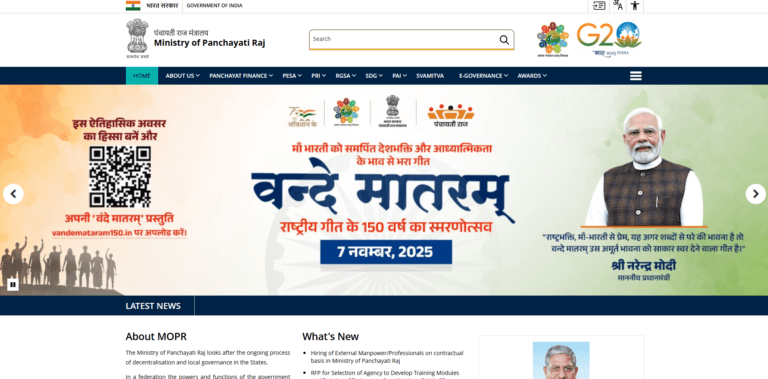
To support this system, the Government of India created the Ministry of Panchayati Raj (MoPR). The ministry looks after matters related to Panchayati Raj and Panchayati Raj Institutions (PRIs) and supports decentralisation and local governance across States and Union Territories. The official portal of the ministry is:
Official website: https://panchayat.gov.in/
This blog post on Digistudylab.in explains the ministry’s role, the Panchayati Raj structure, and the most useful portals/services linked to MoPR—so you can learn how rural local governance is organised in India and how transparency and planning are being strengthened through digital systems.
1) What is the Ministry of Panchayati Raj?
The Ministry of Panchayati Raj is a Government of India ministry that supports the ongoing process of decentralisation and local governance. After constitutional reforms strengthened local bodies, India effectively works as a system of three tiers of governance—Union, State, and Local Self Government (Panchayats in rural areas, urban local bodies in towns and cities).
MoPR was created in May 2004 and is headed by a Cabinet-rank minister. The ministry’s portal also lists the current leadership.
Why does this ministry matter?
Because “local” issues are often the most direct issues in daily life:
Drinking water supply and quality
Sanitation and waste management
Village roads and streetlights
Local health services and nutrition
Primary education support and community facilities
Livelihood and skill development
Social justice measures and inclusion
Panchayats are expected to plan and implement many such priorities through participatory local planning.
2) Panchayati Raj in the Constitution: The Big Reform (73rd Amendment)
A major milestone in India’s rural local governance was the 73rd Constitutional Amendment Act, 1992, which:
Added Part IX to the Constitution titled “The Panchayats”
Covered provisions from Article 243 to 243(O)
Added the Eleventh Schedule with 29 subjects linked to Panchayats
This reform strengthened the legal foundation of Panchayats and made local self-government more systematic across States.
What does this mean in simple words?
It means Panchayats are not just “informal village committees.” They are constitutionally recognised institutions with defined structures, elections, reservations, financial arrangements, and planning responsibilities (implemented through State laws and rules).
3) The Three-Tier Panchayat System (How Rural Local Government Is Structured)
While exact details vary by State, rural Panchayati Raj typically operates at three levels:
Gram Panchayat (Village level)
Block Panchayat / Panchayat Samiti (Block level)
District Panchayat / Zila Parishad (District level)
At the grassroots, the Gram Sabha (village assembly of eligible voters) plays a vital role in participation, accountability, and approving plans.
MoPR’s work broadly supports PRIs through:
Capacity building and training
Planning frameworks and guidance
Strengthening local finance and accountability
Digital governance platforms and transparency tools
Special initiatives and national-level campaigns
4) What You Can Learn and Access from the Official MoPR Portal (panchayat.gov.in)
The MoPR website acts as a central learning and reference point for Panchayati Raj in India. It hosts sections such as:
About the ministry and its structure
PRI-related information (constitutional provisions, elections, best practices, reservation, etc.)
Panchayat finance resources (including Finance Commission-related references)
PESA resources (for Scheduled Areas)
National initiatives such as GPDP, eGramSwaraj, AuditOnline, SVAMITVA, National Panchayat Awards, and more
If you are exploring Indian government systems for study, competitive exams, general knowledge, or civic awareness, this portal is a reliable official source.
5) Key MoPR Initiatives and Portals You Should Know
MoPR doesn’t function only through one website. It supports multiple specialised portals that focus on planning, accounting, audits, land/property records, meetings, and performance tracking. Here are the most important ones.
A) eGramSwaraj: Digital Planning + Accounting + Transparency for Panchayats
eGramSwaraj is one of the most important e-governance initiatives linked with Panchayati Raj Institutions. MoPR describes it as a tech-based, integrated system for information gathering, micro-level planning, and work-based accounting for Panchayats. It has a very large user base of PRIs across States and UTs.
On the eGramSwaraj portal itself, it is described as a user-friendly web-based system launched to strengthen e-governance in PRIs and improve transparency in decentralised planning, progress reporting, and work-based accounting.
Official portal: https://egramswaraj.gov.in/
What can you typically find on or through eGramSwaraj?
Depending on what is publicly accessible versus login-based, eGramSwaraj is designed around:
Panchayat profile information
Planning and reporting dashboards
Accounting and payments (work-based accounting)
Progress reporting (physical and financial)
Audit-related links and tracking integration
Why it matters (for transparency and accountability)
When local planning, work tracking, and accounting move into structured digital systems, it becomes easier to:
Reduce confusion and duplication
Improve record-keeping
Track projects and spending
Strengthen citizen trust through clearer reporting
For learners on Digistudylab.in, eGramSwaraj is a great example of how governance increasingly uses technology for public administration.
B) GPDP (Gram Panchayat Development Plan): The People-Centric Planning System
The GPDP initiative is about building a structured Panchayat Development Plan (PDP) for economic development and social justice.
The GPDP campaign portal explains that Panchayats are mandated to prepare PDPs through a comprehensive and participatory process, involving convergence with schemes of relevant ministries/line departments—linked to the 29 subjects in the Eleventh Schedule.
Official campaign portal: https://gpdp.nic.in/
What “participatory planning” means in practice
A good GPDP process usually involves:
Community meetings and consultations
Identifying local needs and prioritising them
Matching needs with budgets, schemes, and timelines
Creating an actionable plan that can be monitored
In a well-functioning Panchayat, planning is not only top-down—it’s shaped by people’s priorities.
C) Panchayat Nirnay (MeetingOnline): Gram Sabha & Panchayat Meeting Management
MoPR links to a portal often referred to as Panchayat Nirnay, hosted on meetingonline.gov.in, which focuses on scheduling and conducting Gram Sabha meetings and discussions linked to planning and resolutions.
Portal: https://meetingonline.gov.in/
Why this is important
The Gram Sabha is central to local participation. A digital system that helps organise and document meetings can:
Support better documentation of community decisions
Improve transparency in resolutions and planning approvals
Encourage consistent community participation
D) AuditOnline: Strengthening Audits and Financial Accountability
MoPR supports stronger audit processes through AuditOnline, described as a configurable platform enabling government entities to facilitate internal and external audits and comply with standards/guidelines set by the Comptroller and Auditor General (CAG).
Portal: https://auditonline.gov.in/
Why audit systems matter
Audits are not just about “checking mistakes.” They help:
Improve financial discipline
Detect irregularities early
Strengthen systems and controls
Increase public confidence in how funds are used
For anyone learning governance on Digistudylab.in, AuditOnline is a strong example of how accountability frameworks are being digitised.
E) SVAMITVA: Property Records and Village Mapping for Empowerment
SVAMITVA is a central sector scheme of MoPR. The SVAMITVA portal states that it was launched nationwide on National Panchayati Raj Day (24 April 2021) after a pilot phase.
Official portal: https://svamitva.nic.in/
What SVAMITVA aims to support (in simple terms)
SVAMITVA is closely associated with:
Surveying villages and mapping inhabited areas
Creating clearer property records for households
Issuing property-related documents/cards (as per scheme design)
This can reduce disputes, support better planning, and help households and Panchayats strengthen local revenue systems—depending on implementation in each State/UT.
(For a learner’s perspective: SVAMITVA is one of the most discussed examples of how land/asset documentation supports rural empowerment and local governance.)
F) RGSA: Capacity Building and Strengthening PRIs
The Rashtriya Gram Swaraj Abhiyan (RGSA) is a key centrally sponsored scheme associated with building capabilities of Panchayati Raj Institutions. The RGSA site states the revamped RGSA was approved on 13 April 2022 for implementation from 1 April 2022 to 31 March 2026.
MoPR’s RGSA page hosts frameworks and training/capacity-building resources.
RGSA portal: https://rgsa.gov.in/
MoPR RGSA page: https://panchayat.gov.in/en/rgsa/rashtriya-gram-swaraj-abhiyan-rgsa/
Why capacity building is a big deal
Even with legal powers, institutions need:
Trained elected representatives
Skilled staff and clear processes
Tools for planning, budgeting, and reporting
Systems for transparency and grievance handling
Schemes like RGSA focus on strengthening these “how to govern well” capabilities.
6) Special Focus Areas Visible on the MoPR Website
The MoPR navigation structure highlights several thematic areas that are useful for learning and exam preparation. A few important ones include:
A) PESA (for Scheduled Areas)
The MoPR portal includes a dedicated PESA section with items like the PESA Act, model rules, and compliance-related references.
Why learners should notice this:
Governance in Scheduled Areas has special constitutional and legal provisions, and PESA is a major topic in Indian polity and rural development.
B) Panchayat Finance & Finance Commission Grants
MoPR includes a “Panchayat Finance” area with references to Finance Commission-related rural local body grants, operational guidelines, and advisories.
Why it matters:
Local development needs money, and the quality of financial systems (planning + accounting + audits) strongly affects outcomes.
C) National Panchayat Awards
The portal also lists “Awards,” including National Panchayat Awards, which recognise performance and best practices.
Why it matters:
Awards are not only ceremonial—they are also used to spread successful local governance models and motivate improvements.
7) How to Use These Portals as a Learner (or a Citizen)
Even if you are not a Panchayat official, these portals can still be useful for learning and civic understanding.
Step 1: Start with MoPR’s main portal
Go to: https://panchayat.gov.in/
Use it to understand:
What Panchayati Raj is
What the ministry supports
Which initiatives exist and why
Step 2: Explore the “Introduction” page for a clean overview
The MoPR “Introduction” page summarises decentralisation and local governance, and explains how the 73rd/74th amendments strengthened local self-government.
Step 3: Use eGramSwaraj to understand transparency systems
Go to: https://egramswaraj.gov.in/
Read the description about planning, progress reporting, and accounting transparency.
Step 4: Use GPDP portal to learn participatory planning
Go to: https://gpdp.nic.in/
Read how planning connects to economic development, social justice, and the Eleventh Schedule’s 29 subjects.
Step 5: Learn the purpose of audits and accountability
Go to: https://auditonline.gov.in/
Understand how audit platforms support standardised, trackable audits.
Step 6: Understand rural property mapping reforms via SVAMITVA
Go to: https://svamitva.nic.in/
Note the nationwide launch date and the scheme’s basic purpose.
8) Why This Topic Is Important for Competitive Exams and General Knowledge
If you’re preparing for exams (or simply strengthening your understanding of India), Panchayati Raj is a high-value topic because it connects to:
Indian Constitution (73rd Amendment, Part IX, Eleventh Schedule)
Governance and decentralisation
Rural development administration
Transparency tools (planning, accounting, audits)
Special provisions for Scheduled Areas (PESA)
Digital governance initiatives (eGramSwaraj, meeting portals, etc.)
For Digistudylab.in readers, this topic is also practical civic education: it explains how decisions can be planned locally and how systems are being created to track funds and projects.
Conclusion
The Ministry of Panchayati Raj is a central pillar in strengthening rural local self-government in India. Beyond being a ministry, it acts as a national supporter of:
decentralised planning,
PRI capacity building,
transparent accounting,
stronger audits,
and digital governance platforms that make local administration more trackable and accountable.
If you want to understand how India’s grassroots democracy is structured and improved, MoPR’s portal (https://panchayat.gov.in/) is one of the best official starting points.