India is one of the world’s most ecologically diverse countries, home to vast forests, rich biodiversity, long coastlines, deserts, mountains, rivers, and varied climatic zones. Managing such environmental diversity while supporting economic growth and development requires strong policy planning, scientific decision-making, and effective governance. To achieve this balance, the Government of India has established a dedicated institution responsible for protecting the natural environment and addressing climate-related challenges.
The Ministry of Environment, Forest and Climate Change (MoEFCC) plays a central role in shaping India’s environmental policies and ensuring sustainable development. It acts as the key authority for environmental protection, forest conservation, wildlife preservation, pollution control, and climate change mitigation at the national level.
As environmental issues such as global warming, deforestation, biodiversity loss, air pollution, and water contamination continue to impact human life, the importance of this ministry has grown significantly. Understanding its structure, objectives, and services helps citizens gain awareness about India’s environmental governance system and the role of the government in safeguarding natural resources.
Through educational platforms like Digistudylab.in, learners and knowledge seekers can explore how Indian ministries function, how environmental policies are framed, and how citizens can stay informed about sustainability initiatives implemented across the country.
Introduction to the Ministry of Environment, Forest and Climate Change
The Ministry of Environment, Forest and Climate Change, commonly known as MoEFCC, is a central government ministry of India responsible for planning, promoting, coordinating, and overseeing the implementation of environmental and forestry policies.
The ministry works at the intersection of development and conservation, ensuring that economic growth does not come at the cost of ecological imbalance. It also represents India in international environmental forums and global climate negotiations.
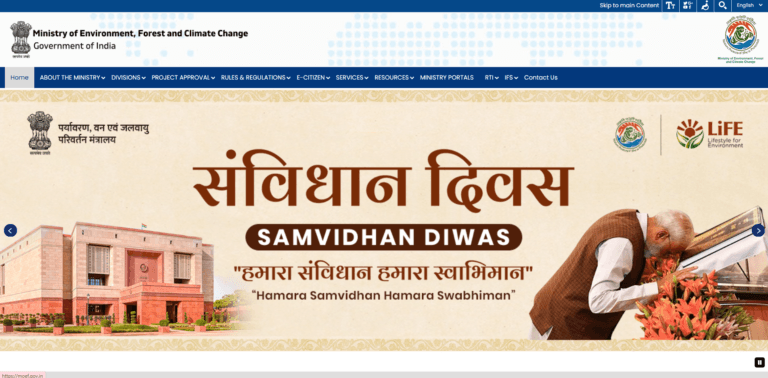
The official website of the ministry is:
https://moef.gov.in/
This portal serves as an important source of authentic information related to environmental laws, notifications, climate action plans, wildlife conservation programs, forest policies, and national sustainability missions.
Historical Background of MoEFCC
The origins of environmental governance in India can be traced back to the early decades after independence. Initially, environmental matters were handled by different departments under agriculture and planning bodies.
Key milestones include:
1972 – After the Stockholm Conference on the Human Environment, India realized the need for a dedicated environmental authority.
1980 – The Department of Environment was established.
1985 – It was upgraded to a full-fledged ministry named the Ministry of Environment and Forests.
2014 – Climate change was formally included, and the ministry was renamed as the Ministry of Environment, Forest and Climate Change.
This change reflected India’s increasing commitment to global climate responsibility and sustainable development.
Vision and Mission of the Ministry
Vision
To protect and improve the quality of the environment while promoting sustainable development for present and future generations.
Mission
Conservation of forests, wildlife, and biodiversity
Prevention and control of pollution
Sustainable management of natural resources
Addressing climate change through mitigation and adaptation
Fulfilling India’s international environmental commitments
Organizational Structure of MoEFCC
The ministry functions through a well-defined administrative and technical structure.
Major components include:
Minister and Minister of State
Secretary and Additional Secretaries
Scientific divisions
Regional offices
Autonomous and statutory bodies
Environmental institutions and research centers
This multi-level structure ensures effective coordination between central government, state governments, research organizations, and international agencies.
Key Departments and Associated Organizations
The Ministry supervises several important institutions that support its work.
1. Central Pollution Control Board (CPCB)
Monitors air and water pollution
Implements pollution control laws
Coordinates with State Pollution Control Boards
Sets environmental quality standards
2. National Biodiversity Authority (NBA)
Protects biological diversity
Regulates access to biological resources
Implements Biological Diversity Act, 2002
3. Wildlife Institute of India (WII)
Conducts wildlife research
Provides training in conservation science
Supports protected area management
4. Indian Council of Forestry Research and Education (ICFRE)
Forestry research and development
Sustainable forest management
Capacity building and education
5. National Tiger Conservation Authority (NTCA)
Implements Project Tiger
Monitors tiger reserves
Strengthens wildlife protection systems
Major Functions of the Ministry
The Ministry of Environment, Forest and Climate Change performs a wide range of critical functions that directly impact national development and public well-being.
Environmental Policy Formulation
The ministry formulates national policies related to:
Environmental protection
Climate resilience
Sustainable development
Conservation planning
Environmental Impact Assessment (EIA)
Reviews development projects
Grants environmental clearances
Ensures ecological safeguards
Balances development and environment
Forest Conservation
Implements Forest Conservation Act
Regulates diversion of forest land
Promotes afforestation and reforestation
Protects forest-dependent communities
Wildlife Protection
Implements Wildlife Protection Act, 1972
Manages national parks and sanctuaries
Prevents poaching and illegal wildlife trade
Conserves endangered species
Climate Change Coordination
National Action Plan on Climate Change (NAPCC)
India’s climate commitments
Adaptation and mitigation strategies
Carbon market development
Environmental Laws Administered by MoEFCC
The ministry is responsible for administering several important environmental legislations.
Major Acts include:
Environment (Protection) Act, 1986
Forest Conservation Act, 1980
Wildlife Protection Act, 1972
Air (Prevention and Control of Pollution) Act, 1981
Water (Prevention and Control of Pollution) Act, 1974
Biological Diversity Act, 2002
These laws form the backbone of India’s environmental governance system.
Climate Change and India’s Global Role
Climate change has emerged as one of the most pressing challenges of the 21st century. The Ministry plays a vital role in shaping India’s response.
International Participation
India actively participates in:
United Nations Framework Convention on Climate Change (UNFCCC)
Paris Agreement
Conference of Parties (COP)
Intergovernmental climate negotiations
India’s Climate Commitments
Reduction in emission intensity
Promotion of renewable energy
Creation of carbon sinks
Climate-resilient infrastructure development
MoEFCC coordinates these commitments across ministries and states.
National Action Plan on Climate Change (NAPCC)
The NAPCC includes several national missions:
National Solar Mission
National Mission for Enhanced Energy Efficiency
National Mission on Sustainable Habitat
National Water Mission
National Mission for Sustaining Himalayan Ecosystem
National Mission for Green India
National Mission for Sustainable Agriculture
National Mission on Strategic Knowledge for Climate Change
Each mission addresses a specific climate-related challenge.
Forest and Wildlife Conservation Programs
Project Tiger
Launched in 1973
Protects tiger habitats
Strengthens conservation infrastructure
India hosts more than 70% of the world’s wild tigers
Project Elephant
Conservation of elephant corridors
Human–elephant conflict mitigation
Habitat restoration
Coastal Regulation and Mangrove Protection
Coastal zone management
Mangrove conservation
Disaster risk reduction
Environmental Clearance and Regulatory Services
One of the most important roles of the ministry is regulating development activities.
Environmental Clearance Process
Mining projects
Industrial units
Infrastructure development
Power plants
Construction projects
The process ensures environmental sustainability through scientific evaluation.
Digital Services and Online Portals
The ministry has embraced digital governance to improve transparency and accessibility.
Key online systems include:
Parivesh Portal (for environmental clearances)
EIA notifications and documents
Public consultation information
Environmental data repositories
These platforms enable stakeholders to access information easily through the official website https://moef.gov.in/.
Role in Sustainable Development
MoEFCC plays a vital role in achieving sustainable development goals by:
Protecting natural ecosystems
Promoting green growth
Supporting renewable energy
Encouraging sustainable lifestyles
Integrating environmental thinking into development planning
Sustainability lies at the heart of the ministry’s long-term vision.
Public Awareness and Environmental Education
Environmental protection cannot succeed without public participation.
The ministry promotes awareness through:
Environmental campaigns
World Environment Day initiatives
School and community programs
Green skill development schemes
Climate literacy programs
Educational platforms like Digistudylab.in help extend this awareness by presenting government information in a simplified and learner-friendly format.
Research, Innovation, and Scientific Support
MoEFCC supports:
Environmental research
Climate modeling
Biodiversity studies
Pollution monitoring technologies
Sustainable resource management
Scientific institutions under the ministry provide evidence-based policy support.
Importance of MoEFCC for Citizens
The work of the ministry directly affects daily life by influencing:
Air quality
Water safety
Forest conservation
Climate resilience
Disaster preparedness
Public health
Understanding this ministry helps citizens appreciate how environmental governance supports long-term national welfare.
How the Official Website Helps the Public
The official portal https://moef.gov.in/ provides:
Government notifications
Policy documents
Environmental laws
Press releases
Climate reports
Conservation programs
Public notices
Educational materials
It acts as a central knowledge hub for environmental information in India.
Educational Value for Learners
For learners, competitive exam aspirants, researchers, and general knowledge seekers, MoEFCC is an important topic because:
It features in civil services and government exams
It helps understand Indian administration
It explains environmental laws and governance
It builds awareness of climate change policies
Platforms like Digistudylab.in aim to simplify such government topics for easy understanding and lifelong learning.
Conclusion
The Ministry of Environment, Forest and Climate Change stands as one of the most crucial pillars of India’s governance system. In a rapidly developing nation, balancing economic progress with environmental responsibility is a complex challenge, and this ministry serves as the guiding force in maintaining that balance.
Through strong policies, scientific research, international cooperation, and public awareness initiatives, MoEFCC works continuously to protect India’s forests, wildlife, biodiversity, and climate future. Its efforts contribute not only to national sustainability but also to global environmental stability.
By learning about ministries like MoEFCC through educational platforms such as Digistudylab.in, citizens gain a deeper understanding of how the Indian government functions and how collective responsibility plays a role in protecting the planet for future generations.