Introduction
Coal has played a central role in India’s economic growth for decades. From electricity generation to industrial manufacturing, coal remains one of the most important primary energy resources supporting the nation’s development. Managing such a critical resource requires strong governance, long-term planning, and transparent administration. This responsibility is carried out by the Ministry of Coal, a key ministry under the Government of India.
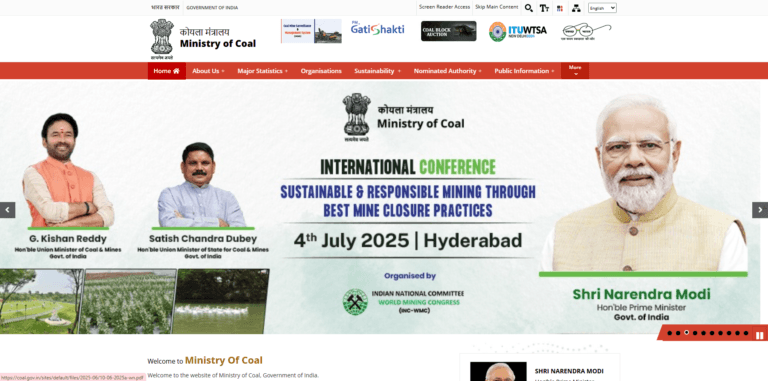
The Ministry of Coal is responsible for policy formulation, planning, development, and regulation of coal and lignite resources across the country. Through its official website https://www.coal.gov.in/, the ministry provides detailed information related to coal production, allocation, policies, public sector undertakings, auctions, statistics, and citizen-oriented services.
At Digistudylab.in, educational content like this helps learners understand how Indian government ministries function, how natural resources are managed, and how official portals contribute to transparency and governance. This guide is designed to provide a complete understanding of the Ministry of Coal, its structure, responsibilities, and the services available through its official portal.
Overview of the Ministry of Coal
The Ministry of Coal is a central administrative body of the Government of India entrusted with the overall supervision of coal and lignite mining in the country. It works under the Allocation of Business Rules of the Government of India and plays a vital role in ensuring energy security for the nation.
Coal continues to be the primary fuel for India’s thermal power sector, which generates a significant share of the country’s electricity. In addition, coal supports industries such as steel, cement, fertilizers, and heavy engineering. Because of this wide dependency, the ministry’s role goes far beyond mining — it directly influences industrial growth, infrastructure development, and national energy planning.
Historical Background of Coal Mining in India
Coal mining in India has a long history dating back to the 18th century. The first commercial coal mine was established in 1774 during the British period. Over time, coal mining expanded rapidly to meet the demands of railways, factories, and later, large-scale power generation.
After independence, the coal sector underwent major restructuring. To ensure better control, safety, and systematic development, coal mines were nationalized in the 1970s. This led to the formation of major public sector organizations such as Coal India Limited, which later became the world’s largest coal-producing company.
Since then, the Ministry of Coal has been responsible for guiding the sector through modernization, mechanization, environmental regulations, and policy reforms.
Key Objectives of the Ministry of Coal
The Ministry of Coal functions with several long-term objectives aimed at balancing development with sustainability. These include:
Ensuring adequate availability of coal for all priority sectors
Promoting scientific and environmentally responsible mining
Increasing domestic coal production to reduce imports
Introducing transparency in coal allocation and pricing
Encouraging private participation through commercial mining
Supporting research and innovation in coal utilization
These objectives form the foundation of the ministry’s policy framework.
Major Functions and Responsibilities
The Ministry of Coal performs a wide range of administrative, regulatory, and developmental functions.
1. Policy Formulation
The ministry frames national policies related to coal exploration, mining, supply, pricing mechanisms, and conservation. These policies guide both public and private sector participants.
2. Exploration and Resource Assessment
It oversees geological exploration to identify coal and lignite reserves. This includes evaluating coal blocks for future mining and ensuring efficient utilization of available resources.
3. Coal Production Planning
The ministry sets annual and long-term production targets for coal companies to meet the country’s growing energy demand.
4. Allocation and Auction of Coal Blocks
Coal blocks are allocated through transparent auction processes. This system promotes fair competition and efficient resource utilization.
5. Regulation of Coal Quality
The ministry monitors coal grading, sampling, and quality standards to ensure consistency in supply.
6. Conservation and Mine Closure
Guidelines are issued for mine closure, land reclamation, and post-mining environmental management.
Public Sector Undertakings Under the Ministry
Several major organizations operate under the administrative control of the Ministry of Coal.
Coal India Limited (CIL)
Coal India Limited is the largest coal producer in the world. It operates through multiple subsidiaries across different coal-bearing regions of India. CIL plays a crucial role in supplying coal to thermal power plants and core industries.
Neyveli Lignite Corporation India Limited (NLCIL)
NLCIL focuses on lignite mining and power generation. It plays an important role in southern India’s energy infrastructure.
Singareni Collieries Company Limited (SCCL)
SCCL is a joint venture between the Government of India and the Government of Telangana. It supplies coal primarily to power plants in southern India.
Central Mine Planning and Design Institute (CMPDI)
CMPDI acts as the technical consultancy arm of the coal sector. It provides planning, design, and exploration services for mining projects.
Statutory and Allied Organizations
Coal Controller’s Organisation (CCO)
The CCO monitors coal quality, grades, and production reporting. It also evaluates mining plans and oversees mine closure procedures.
Coal Mines Provident Fund Organisation (CMPFO)
CMPFO manages provident fund, pension, and insurance benefits for coal mine workers, ensuring social security within the sector.
Commercial Coal Mining in India
One of the most significant reforms introduced by the Ministry of Coal is commercial coal mining. Under this system:
Private companies can mine coal without end-use restrictions
Coal can be sold in the open market
Auctions are conducted through transparent bidding
This reform aims to increase competition, improve efficiency, and attract investment in the coal sector.
National Coal Index (NCI)
The National Coal Index is a price index developed by the ministry to bring transparency in coal pricing. It reflects a weighted average of coal prices based on different sources such as notified prices, auction prices, and import prices.
This index helps industries understand price trends and improves market transparency.
Coal Gasification and Clean Coal Initiatives
The Ministry of Coal promotes cleaner and more efficient use of coal through advanced technologies such as:
Coal gasification
Coal liquefaction
Underground coal gasification
These technologies aim to reduce environmental impact while maximizing energy output.
Digital Initiatives and Data Transparency
The ministry emphasizes digital governance through:
Online dashboards for production monitoring
Digital auction platforms
Public access to statistical data
Online reporting systems
These initiatives support transparency and accountability in coal administration.
Services Available on the Ministry of Coal Website
The official portal https://www.coal.gov.in/ provides a wide range of educational and informational resources.
Key sections include:
About the Ministry
Organisational structure
Policies and acts
Coal block information
Auction and allocation details
Press releases and notifications
Statistics and reports
Contact details of officials
The portal serves as a reliable source for anyone seeking authentic government information related to India’s coal sector.
Educational Importance of the Ministry of Coal Portal
For learners and general readers, the Ministry of Coal website is valuable because it:
Explains how natural resources are governed
Demonstrates public sector administration
Provides real government data for study
Helps understand India’s energy planning
Supports competitive exam preparation
At Digistudylab.in, such content helps build awareness about Indian governance systems in a simple and structured way.
Role of the Ministry in India’s Energy Security
India’s growing population and industrial expansion demand stable energy supply. The Ministry of Coal contributes to energy security by:
Increasing domestic coal production
Reducing import dependence
Supporting power generation
Ensuring long-term resource planning
Its decisions directly impact electricity availability, industrial growth, and economic stability.
Environmental Responsibility and Sustainable Mining
While coal remains essential, the ministry also focuses on sustainability through:
Progressive mine closure plans
Land reclamation programs
Afforestation initiatives
Monitoring environmental compliance
These measures aim to balance development with environmental responsibility.
Conclusion
The Ministry of Coal plays a fundamental role in shaping India’s energy landscape. From policy formulation and production planning to digital governance and transparency, the ministry ensures that coal resources are managed efficiently and responsibly.
The official portal https://www.coal.gov.in/ acts as a comprehensive information platform where citizens, learners, and researchers can access authentic government data, policies, and updates.
Through educational platforms like Digistudylab.in, such government-related content helps people better understand how ministries operate and how national resources are administered for the country’s progress.
For official updates and verified information, visitors are encouraged to refer directly to the Ministry of Coal’s website.

](https://rukminim1.flixcart.com/image/800/800/book/4/0/5/a-glossary-of-terms-used-in-coal-mining-1883-hardcover-original-imaedgfwecwgcwsz.jpeg?q=90)