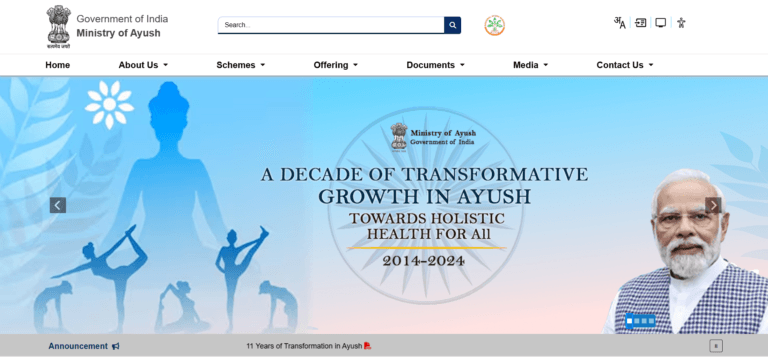
If you’ve ever searched for authentic information on Ayurveda, Yoga, Naturopathy, Unani, Siddha, Sowa-Rigpa, or Homoeopathy, the Ministry of AYUSH website is one of the most reliable places to begin. The official portal—ayush.gov.in—acts as a digital gateway to India’s government-led initiatives for promoting traditional and indigenous systems of healthcare, education, research, quality standards, and public programs.
This post is written in an Education and Informative theme for learners, aspirants, educators, health researchers, and citizens who want to understand how the Ministry works and how the website helps people access services, schemes, and official resources.
Official website (for reference and official updates): https://ayush.gov.in/
1) What is the Ministry of AYUSH?
The Ministry of AYUSH is a ministry under the Government of India that focuses on policy, development, and promotion of India’s traditional and complementary systems of medicine. “AYUSH” is an acronym formed from the names of the systems covered under the Ministry:
Ayurveda
Yoga & Naturopathy
Unani
Siddha
Homoeopathy
(Often also includes Sowa-Rigpa, a recognized traditional system practiced in parts of India)
Through public health programs, educational reforms, research support, and standards/regulation, the Ministry works to strengthen these systems in a structured and accountable way.
2) Why the AYUSH Ministry Matters in Indian Governance
India’s governance structure includes specialized ministries that handle focused sectors—education, health, agriculture, finance, and more. In that same ecosystem, the Ministry of AYUSH is significant because:
It institutionalizes traditional knowledge systems through national-level policy and programs.
It supports education and professional standards, so practitioners and institutions can be regulated in an organized way.
It builds public access to AYUSH services through government schemes and integration models (where policy permits).
It strengthens research and documentation, helping preserve and study traditional health knowledge through modern frameworks.
For learners and competitive-exam aspirants, understanding ministries like AYUSH also helps build clarity about how the Indian government organizes public services and national programs.
3) What You Can Find on the Official Website (ayush.gov.in)
The ayush.gov.in portal is designed as a public information and services platform. When you open the website, you’ll notice that it provides language selection and directs visitors into the main site experience. The portal also provides access to official updates and key sections that help different audiences—citizens, professionals, institutions, and NGOs.
Common things people use the site for
Reading about schemes and programs
Accessing circulars / notifications / press releases (as available)
Finding institutes, organizations, and affiliated bodies
Learning about AYUSH systems at a government overview level
Using specialized portals linked from the Ministry ecosystem
Exploring public initiatives and digital services
Because it is an official government website, it’s a trusted destination for policy-level and program-level information.
4) Major Government Programs & Schemes You’ll Hear About
The Ministry runs and supports multiple initiatives through its ecosystem. Some are large umbrella missions; others are focused schemes for education, research, and promotion.
A) National AYUSH Mission (NAM)
One of the major national-level initiatives is the National AYUSH Mission (NAM), which aims to improve access to AYUSH services, strengthen educational and healthcare infrastructure, and support quality services. The mission has its own official portal (namayush.gov.in), where you can explore components, planning, and implementation themes.
What you can explore on the NAM portal:
Mission background and vision
Components and AYUSH services
Program-related information and guidelines (where provided)
B) Ayushman Arogya Mandir (AAM-Ayush) / AYUSH Health & Wellness Centres
Within the broader public-health ecosystem, the NAM portal also hosts information about Ayushman Arogya Mandir (AAM-Ayush) / AYUSH Health & Wellness Centre operationalization, including phased rollout descriptions and related program context.
This is useful for learners trying to understand how Indian public health programs expand service delivery at the community level.
C) AYURGYAN Scheme (Education & Research Focus)
The Ministry website also lists central sector schemes, including AYURGYAN, which is described as supporting education and research initiatives in the AYUSH domain for a defined period (as shown on the Ministry portal).
This is important because it signals that the Ministry is not only about service delivery—it also invests in structured knowledge building through education and research support.
5) Digital Portals and Online Services Connected to the Ministry
Beyond the main website, the AYUSH ecosystem includes multiple specialized portals designed for specific users and use-cases.
A) AYUSH NGO Portal (ngo.ayush.gov.in)
If your visitors include NGOs or organizations seeking participation in government schemes, the AYUSH NGO Portal is a key digital service. According to the portal’s FAQ, it was developed to digitize processes involved in Central Sector Schemes, covering steps from submission of proposals to release of grants/funding.
Who benefits from this portal?
NGOs applying for grants under relevant central schemes
Organizations tracking proposal and funding workflow
Stakeholders looking for transparent, digital application processes
B) Ayush Global Portal (global.ayush.gov.in)
For an international-facing and reference-style directory approach, the Ayush Global Portal is presented as a place for country-specific information and directories (such as practitioners, where provided), helping global audiences understand AYUSH systems and their institutional ecosystem.
This can be useful for:
International learners exploring AYUSH
Researchers and institutions looking for structured references
People seeking a broad “global” overview from an official ecosystem
C) MAISP (Ministry platform for objectives/administrative overview)
There are also ministry-linked portals such as MAISP, which publicly presents objectives like promoting traditional and indigenous systems including Ayurveda, Yoga & Naturopathy, Unani, Siddha, Sowa-Rigpa and Homoeopathy.
6) AYUSH Education, Regulation, and Standards: Key Bodies to Know
Government systems don’t function only by announcements; they rely on institutions and statutory bodies. In the AYUSH ecosystem, education and professional standards are supported through commissions and quality institutions.
A) National Commission for Indian System of Medicine (NCISM)
The official NCISM website describes the Commission’s constitution under the NCISM Act, 2020, including autonomous boards constituted under the provisions mentioned on the site.
Why this matters for learners:
If someone is studying Ayurveda/Siddha/Unani/Sowa-Rigpa education pathways, understanding NCISM helps them see how education quality and standards can be structured through law-backed commissions.
B) National Commission for Homoeopathy (NCH)
Similarly, the National Commission for Homoeopathy has an official site explaining that it was constituted under the National Commission for Homoeopathy Act, 2020, and came into force via notification (details are described on official pages).
C) Pharmacopoeia Commission for Indian Medicine & Homoeopathy (PCIM&H)
Quality standards matter greatly in healthcare systems. The PCIM&H portal represents a standards-and-pharmacopoeia oriented institution in the AYUSH ecosystem.
For students and curious readers, this highlights a key governance concept: standard-setting bodies support quality, consistency, and safety frameworks.
7) Public Awareness & Citizen-Facing Tools: AYUSH Sanjivani App (Example)
The Ministry has also been associated with citizen-facing digital tools such as the Ayush Sanjivani mobile application. The Google Play listing describes it as presented by the Ministry and mentions its role in facilitating data collection related to AYUSH interventions (as described on the store page).
Additional public explainers, such as Vikaspedia’s overview, describe the app’s launch context and intent around generating data on acceptance/usage of AYUSH measures.
Note for readers: Apps and advisories evolve over time—always check the latest official updates on the portal and app listing.
8) How to Use ayush.gov.in – A Practical Walkthrough for Visitors
Many visitors land on a government website and feel unsure where to click. Here’s a simple learning-friendly guide your readers can follow.
Step 1: Start from the official homepage
Go to ayush.gov.in and enter the website in your preferred language (as offered on the portal).
Step 2: Explore schemes, programs, and updates
Look for sections such as:
Central sector schemes / missions (where listed)
Public notices, updates, archives (as available on the site)
Step 3: Use specialized portals for specific needs
For mission-level info: National AYUSH Mission portal
For NGO grants workflow: AYUSH NGO portal
For global directories/overviews: Ayush Global Portal
For statutory education regulators: NCISM / NCH
Step 4: Use the site as an educational reference
For Digistudylab.in visitors, the best use of ayush.gov.in is:
Understanding the ministry’s role in government
Learning how programs are structured
Knowing which official bodies regulate education/standards
Finding authentic links to portals and institutions
9) Educational Value for Students, Aspirants, and Researchers
Because your website focuses on learning, here are ways this topic supports education:
For school and college learners
Understanding India’s ministry structure
Awareness of traditional health systems and their official recognition
Learning the difference between “system of medicine,” “mission,” and “regulatory body”
For competitive exam aspirants (general studies)
Ministry functions and governance vocabulary
Major mission names and their purpose (e.g., NAM)
Statutory bodies created through Acts (e.g., NCISM Act / NCH Act)
For researchers and professionals
Institutional landscape (commissions, standards bodies, portals)
Program and guideline portals for operational context
10) A Balanced Reader Note (Important for Health Topics)
While the Ministry promotes AYUSH systems, health decisions should always be made responsibly:
Use official sources to understand programs and standards.
For personal health conditions, consult qualified professionals.
Avoid self-medication based on internet summaries.
This keeps your content educational and safe while still being informative.
Conclusion: Why You Should Bookmark the Ministry of AYUSH Website
The Ministry of AYUSH website (ayush.gov.in) is more than a homepage—it’s an official learning hub for understanding how India organizes and promotes traditional healthcare systems through governance, institutions, and public programs. For Digistudylab.in readers, it provides credible, structured, and ministry-backed information that supports general knowledge, exam preparation, and responsible awareness.
To explore the ministry’s resources directly, visit the official portal: https://ayush.gov.in/