Agriculture is the backbone of India’s economy and plays a vital role in ensuring food security, rural development, and national growth. To strengthen the agricultural sector and improve the livelihoods of millions of farmers, the Government of India established the Ministry of Agriculture & Farmers Welfare. This ministry functions as the apex body responsible for agricultural policies, farmer welfare programs, and sustainable farming initiatives across the country.
Within the first few paragraphs, it is important to understand that platforms like Digistudylab.in aim to simplify such government structures and schemes into easy-to-learn educational content so learners can understand how national institutions function and how they impact society.
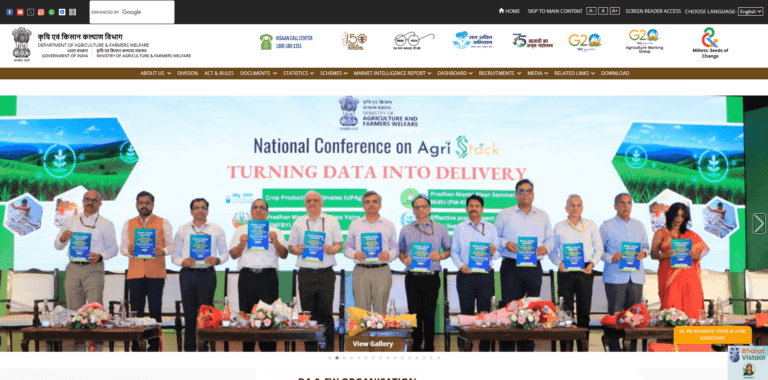
The Ministry operates through multiple departments, among which the Department of Agriculture & Farmers Welfare (DA&FW) plays a central role in implementing agricultural policies, farmer-focused schemes, and development programs. The official portal for these services is:
https://agriwelfare.gov.in/
This guide explains the ministry’s structure, objectives, functions, schemes, and the importance of the Department of Agriculture & Farmers Welfare in shaping India’s agricultural ecosystem.
Overview of the Ministry of Agriculture & Farmers Welfare
The Ministry of Agriculture & Farmers Welfare is a key branch of the Government of India responsible for framing and administering laws, policies, and programs related to agriculture and farmers. It focuses on improving agricultural productivity, ensuring food security, and supporting the welfare of farmers through innovative policies and welfare schemes.
The ministry was earlier known as the Ministry of Agriculture and was renamed in 2015 to emphasize farmer welfare and rural development along with agricultural growth.
It works across multiple areas such as:
Agricultural development
Farmer income support and welfare
Food production and crop planning
Agricultural research and innovation
Sustainable farming and climate resilience
Rural economic empowerment
Historical Background and Evolution
The roots of agricultural administration in India date back to the colonial era, when departments were formed to manage agricultural matters. After independence in 1947, the agricultural department was redesigned as a full-fledged ministry to support national food production and rural growth.
Over the decades, the ministry evolved to focus not only on crop production but also on:
Farmer income security
Agricultural technology adoption
Cooperative farming
Irrigation and resource management
Rural employment and development
The renaming of the ministry in 2015 marked a shift from production-centric policies to farmer-centric development strategies.
Organizational Structure of the Ministry
The Ministry of Agriculture & Farmers Welfare consists of multiple departments that collectively work for agricultural growth and farmer support.
The Department of Agriculture & Farmers Welfare is one of the key constituent departments and plays a major role in policy implementation, farmer schemes, and agricultural development programs.
The ministry functions through:
Departments
Divisions
Attached offices
Subordinate organizations
The Department of Agriculture & Farmers Welfare itself operates through several divisions and offices responsible for different areas of agricultural development.
Department of Agriculture & Farmers Welfare (DA&FW)
The Department of Agriculture & Farmers Welfare is responsible for the formulation, implementation, monitoring, and evaluation of agricultural policies and programs in India.
Key responsibilities include:
Promoting agricultural productivity
Supporting farmers through welfare schemes
Enhancing agricultural technology and innovation
Improving irrigation and resource management
Ensuring access to agricultural inputs and markets
Strengthening rural livelihoods
The department also works closely with state governments, agricultural universities, research institutions, and rural organizations to implement national programs.
Objectives of the Department
The primary objectives of the Department of Agriculture & Farmers Welfare include:
1. Improving Agricultural Productivity
The department develops policies to increase crop production through modern techniques, improved seeds, and scientific farming practices.
2. Ensuring Farmer Welfare
Various schemes provide financial support, insurance, pension, and welfare benefits to farmers.
3. Promoting Sustainable Agriculture
Focus on organic farming, natural farming, and environmentally friendly practices.
4. Strengthening Rural Economy
Agriculture contributes significantly to employment and rural development.
5. Supporting Agricultural Innovation
Encourages mechanization, digital agriculture, and research.
Role of the Official Portal – agriwelfare.gov.in
The official portal https://agriwelfare.gov.in/ serves as the central platform for:
Government schemes
Farmer welfare programs
Agricultural statistics
Policy updates
Notifications and services
The portal provides information to farmers, researchers, policymakers, and learners about agricultural initiatives and services.
Major Functions of the Ministry and Department
Policy Formulation
The ministry develops national agricultural policies related to crop production, irrigation, technology, and farmer welfare.
Scheme Implementation
The department executes various welfare schemes and programs aimed at improving farmer income and agricultural productivity.
Research and Innovation
Supports agricultural research through institutions and collaboration.
Agricultural Statistics and Data
Publishes reports and data for planning and monitoring agricultural progress.
Farmer Support Services
Provides helplines, advisories, training, and extension services.
Major Schemes Under the Ministry
Pradhan Mantri Kisan Samman Nidhi (PM-KISAN)
PM-KISAN is a central income support scheme launched in 2019 to provide financial assistance to landholding farmers across India.
Eligible farmers receive ₹6,000 per year in three installments through direct benefit transfer to their bank accounts.
The scheme aims to:
Support farm expenses
Improve farmer income stability
Promote rural economic growth
Pradhan Mantri Krishi Sinchai Yojana (PMKSY)
This scheme focuses on expanding irrigation facilities and improving water management to enhance agricultural productivity.
Objectives:
“More crop per drop”
Efficient water usage
Sustainable irrigation infrastructure
PM-AASHA (Farmer Income Protection Scheme)
PM-AASHA aims to ensure fair prices for farmers by providing price support and deficiency payments for selected crops.
PM Kisan Maan Dhan Yojana
A pension scheme for small and marginal farmers, offering financial security after retirement with monthly pension support.
Other Important Agricultural Missions
National Food Security Mission
National Mission on Natural Farming
National Mission on Edible Oils
National Beekeeping and Honey Mission
Paramparagat Krishi Vikas Yojana
These initiatives aim to strengthen agricultural production, sustainability, and rural livelihoods.
Farmer Welfare and Development Initiatives
The Department of Agriculture & Farmers Welfare focuses on improving the quality of life for farmers through:
Financial assistance programs
Insurance schemes
Training and skill development
Access to modern equipment
Agricultural advisory services
Digital agriculture initiatives
Digital Agriculture and Innovation
India is rapidly adopting digital solutions to modernize agriculture.
The ministry supports:
Digital farmer databases
Crop monitoring tools
Weather advisory services
AI-based farming support systems
These initiatives help farmers make informed decisions and increase productivity.
Importance of Agriculture in India
Agriculture is one of the most important sectors of the Indian economy, providing employment and livelihood to a large portion of the population.
Its significance includes:
Food security
Rural development
Employment generation
Economic contribution
Export potential
The ministry’s policies aim to strengthen these aspects.
Role in Competitive Exams and Education
Understanding the Ministry of Agriculture & Farmers Welfare is essential for:
UPSC
SSC
Banking exams
State government exams
General knowledge preparation
Learners studying governance, public administration, and agriculture must know:
Ministry structure
Schemes
Policies
Department functions
Challenges in the Agricultural Sector
Despite major initiatives, challenges remain:
Climate change impacts
Water scarcity
Small landholdings
Market price fluctuations
Technological gaps
Rural infrastructure issues
The ministry continuously develops strategies to address these challenges.
Future Vision of the Ministry
The ministry’s long-term goals include:
Doubling farmers’ income
Promoting climate-resilient agriculture
Expanding digital farming
Strengthening agricultural exports
Supporting agripreneurship
Why This Ministry Matters
The Ministry of Agriculture & Farmers Welfare plays a critical role in national development.
It ensures:
Sustainable food production
Economic stability
Farmer empowerment
Rural prosperity
The Department of Agriculture & Farmers Welfare acts as the execution arm of these initiatives, directly impacting millions of farmers.
Conclusion
The Ministry of Agriculture & Farmers Welfare and its Department of Agriculture & Farmers Welfare are central to India’s agricultural progress and farmer welfare. Through policies, schemes, research, and digital initiatives, they support the backbone of the country’s economy — agriculture.
Understanding this ministry helps learners grasp how government institutions operate, how schemes reach beneficiaries, and how public policies shape national development. The official portal https://agriwelfare.gov.in/ serves as an important resource for accessing information, schemes, and services related to agriculture and farmer welfare.
Educational platforms like Digistudylab.in aim to make such complex government systems easy to understand so that learners, aspirants, and citizens can gain awareness and knowledge about the functioning of India’s governance structure.