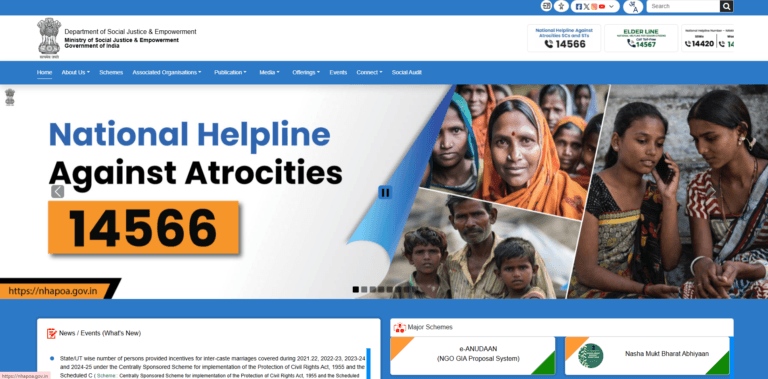
India is a diverse nation where people belong to different social, economic, cultural, and educational backgrounds. While the Constitution of India guarantees equality, justice, and dignity for every citizen, certain sections of society have historically faced social discrimination, economic backwardness, and limited access to opportunities. To address these challenges and promote inclusive development, the Government of India established the Department of Social Justice and Empowerment, functioning under the Ministry of Social Justice and Empowerment.
This department plays a crucial role in shaping a fair and inclusive society by implementing welfare schemes, protective laws, financial assistance programs, rehabilitation initiatives, and empowerment policies for marginalized communities. Through its official portal https://socialjustice.gov.in/, citizens can access valuable information related to government schemes, scholarships, legal protections, and social welfare programs.
This detailed guide on Digistudylab.in explains the structure, responsibilities, objectives, schemes, and importance of the Department of Social Justice and Empowerment in building a socially just India.
Introduction to the Ministry of Social Justice and Empowerment
The Ministry of Social Justice and Empowerment is a central government ministry responsible for formulating and implementing policies related to:
Social justice
Empowerment of weaker sections
Protection of human dignity
Social inclusion
Equal opportunity for all citizens
The ministry works mainly for communities that require government support due to historical disadvantages or social vulnerability.
These include:
Scheduled Castes (SC)
Other Backward Classes (OBC)
Denotified, Nomadic, and Semi-Nomadic Tribes
Persons with Disabilities
Senior Citizens
Victims of substance abuse
Transgender persons
Economically and socially marginalized groups
The department ensures that development reaches every section of society and that no individual is excluded from progress due to social or physical limitations.
Constitutional Foundation of Social Justice in India
The work of the Ministry of Social Justice and Empowerment is deeply rooted in the Indian Constitution.
Several constitutional provisions guide its functioning:
Fundamental Rights
Equality before law (Article 14)
Prohibition of discrimination (Article 15)
Equal opportunity in public employment (Article 16)
Protection against exploitation (Articles 23 and 24)
Directive Principles of State Policy
Promotion of welfare of the people
Reduction of income inequality
Protection of weaker sections
Promotion of social and economic justice
These constitutional values form the backbone of all schemes and policies implemented by the department.
Role and Objectives of the Department of Social Justice and Empowerment
The department works with a clear mission: to create an inclusive society based on equality, dignity, and opportunity.
Key Objectives
Eliminate social discrimination
Promote educational advancement
Improve economic conditions of weaker sections
Provide legal safeguards
Support rehabilitation and social integration
Empower marginalized individuals through skill development
Ensure accessible infrastructure for persons with disabilities
Promote awareness of social rights
Organizational Structure
The Ministry of Social Justice and Empowerment operates through multiple divisions and autonomous bodies, each focusing on a specific area of social development.
Major divisions include:
Scheduled Castes Development Division
Backward Classes Division
Disability Affairs Division
Senior Citizens Division
Substance Abuse Prevention Division
Social Defence Division
Each division formulates policies, monitors schemes, and coordinates with state governments and implementing agencies.
Major Beneficiary Groups Covered by the Ministry
1. Scheduled Castes (SC)
The ministry implements various schemes to uplift Scheduled Castes through:
Educational scholarships
Hostel facilities
Skill development programs
Economic assistance
Legal protection measures
These initiatives help reduce social inequalities and support long-term empowerment.
2. Other Backward Classes (OBC)
For OBC communities, the department focuses on:
Educational advancement
Vocational training
Financial inclusion
Awareness programs
Economic development initiatives
Special attention is given to students from low-income OBC families.
3. Denotified, Nomadic and Semi-Nomadic Tribes
These communities often lack permanent settlements and access to government benefits. The ministry works toward:
Identification and documentation
Housing support
Education access
Skill development
Social security
4. Persons with Disabilities (Divyangjan)
The department follows a rights-based approach to disability empowerment.
Key focus areas include:
Accessibility in public infrastructure
Inclusive education
Employment opportunities
Assistive devices
Rehabilitation services
Legal rights protection
The term Divyangjan reflects dignity and respect toward persons with disabilities.
5. Senior Citizens
With an increasing elderly population, the ministry ensures:
Social security measures
Healthcare support
Maintenance and welfare laws
Old age homes
Helpline services
Awareness of rights
6. Transgender Persons
The ministry works toward mainstreaming transgender persons by ensuring:
Legal identity
Welfare schemes
Skill development
Healthcare access
Social inclusion
Protection from discrimination
Major Schemes and Programs
The Department of Social Justice and Empowerment manages several important national-level schemes.
Scholarship Schemes
Pre-Matric Scholarships
Post-Matric Scholarships
Top Class Education Scholarships
Overseas Scholarship Schemes
These help students pursue education without financial barriers.
National Action for Mechanised Sanitation Ecosystem (NAMASTE)
This initiative focuses on:
Ending manual scavenging
Providing alternative livelihoods
Skill training
Safety equipment
Rehabilitation support
Assistance to Disabled Persons (ADIP) Scheme
Under this scheme:
Assistive devices are provided
Mobility aids are distributed
Hearing and visual aids are supported
Educational tools are supplied
The goal is to improve independence and quality of life.
Scheme for Implementation of the Rights of Persons with Disabilities Act
This scheme supports:
Accessibility audits
Capacity building
Awareness campaigns
Inclusive public services
Integrated Programme for Senior Citizens
It provides:
Financial support to old age homes
Day-care centers
Mobile medical units
Helpline services
National Drug Demand Reduction Program
This program aims to:
Prevent substance abuse
Provide rehabilitation services
Support counseling
Promote awareness
Encourage community participation
Laws and Acts Administered by the Ministry
The ministry enforces several important laws, including:
Protection of Civil Rights Act
Scheduled Castes and Scheduled Tribes (Prevention of Atrocities) Act
Rights of Persons with Disabilities Act
Maintenance and Welfare of Parents and Senior Citizens Act
Transgender Persons (Protection of Rights) Act
These laws ensure dignity, equality, and protection for vulnerable groups.
Role of Technology and Digital Governance
The official portal https://socialjustice.gov.in/ serves as a digital platform for:
Scheme information
Notifications
Guidelines
Policy documents
Annual reports
Citizen awareness
Digital systems improve transparency, efficiency, and accessibility.
Collaboration with State Governments
Most schemes are implemented through:
State Social Welfare Departments
District-level authorities
NGOs and voluntary organizations
Educational institutions
This cooperative federal structure ensures wider reach and effective implementation.
Importance of Social Justice in Nation Building
Social justice is not merely welfare—it is the foundation of sustainable development.
When marginalized communities are empowered:
Poverty reduces
Literacy increases
Employment improves
Social harmony strengthens
Economic growth becomes inclusive
The Ministry of Social Justice and Empowerment plays a vital role in transforming constitutional ideals into real-life outcomes.
Educational Value for Learners
For learners visiting Digistudylab.in, understanding this ministry helps in:
Learning about Indian governance
Preparing for competitive exams
Understanding constitutional rights
Gaining awareness of welfare systems
Building civic responsibility
Knowledge of such departments strengthens democratic awareness.
How Citizens Can Benefit from the Official Portal
The official website allows citizens to:
Learn about welfare schemes
Check eligibility criteria
Read government notifications
Access policy documents
Understand legal rights
Stay informed about social programs
For authentic and updated information, citizens should always refer to the official portal:
Conclusion
The Department of Social Justice and Empowerment stands as a pillar of inclusive governance in India. By addressing inequality, protecting dignity, and expanding opportunities, the ministry works toward building a society where every individual can live with confidence, respect, and equal rights.
Through education, awareness, policy implementation, and empowerment programs, the ministry ensures that development reaches even the most vulnerable sections of society. Learning about such institutions is essential for understanding how India functions as a welfare-oriented democratic nation.
Digistudylab.in aims to provide such informative and educational content to help you gain deeper knowledge about Indian government systems and social development initiatives.