India experiences everything from intense monsoon rainfall and tropical cyclones to heatwaves, cold waves, droughts, earthquakes, tsunamis, coastal flooding, and long-term climate risks. Behind the scenes, a large part of the scientific work that helps the country observe, model, and forecast these Earth-system processes is coordinated by the Ministry of Earth Sciences (MoES)—a Government of India ministry responsible for Earth system science in an integrated way. Its official portal—moes.gov.in—acts as a central doorway for learning about the ministry, its institutions, its public services (like weather and ocean advisories), its national missions, and its research and technology development.
This educational guide is written for learners and general readers on Digistudylab.in who want to understand (1) what the Ministry of Earth Sciences does, (2) what services and information it offers to citizens, researchers, and industries, and (3) how to use the MoES website responsibly as an official reference. For the most accurate and updated information, always cross-check using the official portal: https://moes.gov.in/.
1) What is the Ministry of Earth Sciences?
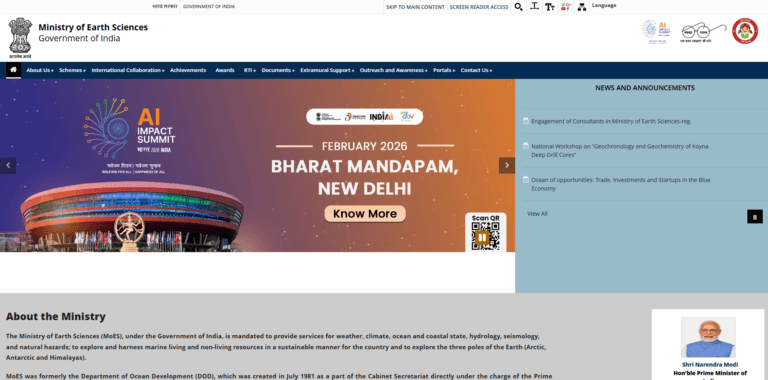
The Ministry of Earth Sciences (MoES) is a ministry under the Government of India that focuses on understanding the Earth as a connected system—atmosphere + ocean + solid Earth + cryosphere (polar regions) + coasts + hazards—and converting scientific knowledge into services that benefit society and the economy. According to the official MoES description, the ministry is mandated to provide services for weather, climate, ocean and coastal state, hydrology, seismology, and natural hazards, and it also works on exploring and harnessing marine living and non-living resources sustainably and exploring the Earth’s “three poles” (Arctic, Antarctic, and the Himalayas).
That single mandate sentence is powerful because it shows two major roles:
Service Role (Public & National Support): forecasting and warnings, ocean advisories, hazard monitoring, and decision-support tools for sectors like disaster management, agriculture, aviation, shipping, fisheries, water resources, tourism, and more.
Science & Technology Role: research, observing systems, modelling, and technology missions—including ocean technology, polar research, and advanced computing for better forecasts and climate understanding.
2) A short history: From Ocean Development to Earth System Science
MoES did not start as a ministry on Day 1. The official MoES “About our Ministry” section explains that it was formerly the Department of Ocean Development (DOD), created in July 1981 (initially under the Cabinet Secretariat), later becoming a separate department in March 1982, and functioning as a nodal institution for ocean development activities. In February 2006, the Government of India notified DOD as the Ministry of Ocean Development. Then, in July 2006, it was reorganized (via presidential notification) into the Ministry of Earth Sciences, bringing major national institutions such as the India Meteorological Department (IMD), the Indian Institute of Tropical Meteorology (IITM), and the National Centre for Medium Range Weather Forecasting (NCMRWF) under the MoES administrative umbrella.
This reorganization matters because it reflects a modern scientific idea: oceans cannot be studied separately from weather and climate; the atmosphere cannot be understood without ocean conditions; and hazards need integrated monitoring and modelling. In simple terms: Earth works as a system, so the ministry evolved to match that reality.
3) Vision and mission: Why the ministry exists beyond “just weather”
MoES is not only about daily weather forecasts. It works at multiple time scales:
Nowcasting (minutes to hours): severe thunderstorms, lightning risk, short-term weather threats
Short- to medium-range (days): rainfall, heat/cold waves, cyclones
Extended range & seasonal (weeks to months): monsoon patterns and variability
Climate (years to decades): climate change signals, extremes, and sector impacts
Its official vision statement highlights the goal to “excel as a knowledge and technology enterprise in the earth system science realm” for socio-economic benefit.
That phrase “socio-economic benefit” is important: it means research and forecasting are not done only for academic interest, but also to protect lives, improve planning, reduce losses, and support sustainable growth.
4) How MoES is organized: ESSO and major institutes
MoES functions through a network of institutions—many under the umbrella of the Earth System Science Organisation (ESSO)—each specializing in a part of the Earth system (atmosphere, ocean, polar science, solid Earth, modelling, technology, and services). The MoES “Organization Setup” page lists major bodies such as NCPOR (Goa), INCOIS (Hyderabad), IITM (Pune), NIOT (Chennai), and NCESS (Thiruvananthapuram).
Below is an easy-to-understand overview of what these institutions generally represent, along with examples of the public value they create (always verify the latest scope from official pages):
A) Indian Meteorological Department (IMD) – Weather services backbone
IMD is India’s primary weather organization and plays a central role in monitoring the atmosphere and issuing public forecasts and warnings. IMD’s work is reflected in MoES service commitments such as weather monitoring, forecasts, warnings, and support for sectors including tourism/pilgrimage and expeditions.
B) NCMRWF & IITM – Modelling and research strength
The reorganization that formed MoES explicitly brought IITM and NCMRWF under its purview. These centres are crucial for numerical weather prediction, climate research, and improving forecast skill.
C) INCOIS – Ocean information and multi-hazard ocean services
INCOIS provides a wide range of ocean information and advisories. Its service portal describes offerings like Potential Fishing Zone (PFZ) advisories, Ocean State Forecast, storm surge warnings, coral bleaching alerts, and tsunami early warnings.
It also hosts the Indian Tsunami Early Warning System portal.
D) NIOT – Ocean technology and engineering solutions
NIOT focuses on developing ocean technology—an important piece of India’s capability in observations, deep-sea exploration, and ocean-resource related technologies (often linked with national missions and programmes). MoES documents and year-end reviews frequently discuss ocean technology themes (including deep ocean activities).
E) NCPOR – Polar and ocean research
The National Centre for Polar and Ocean Research (NCPOR) is described as an autonomous R&D institution of MoES and is associated with India’s polar programmes (including Antarctic and Arctic research).
F) NCESS – Solid Earth science and geoscience studies
NCESS is a national centre focused on Earth science studies and emphasizes multidisciplinary understanding of Earth processes.
This distributed structure helps MoES cover everything from daily weather warnings to deep-ocean exploration and polar science, while keeping services connected to science.
5) What services does MoES deliver to the public?
MoES is a service-driven science ministry. One of the most citizen-friendly ways to understand this is the Citizen Charter & Commitments section on the MoES site, which outlines service standards and timelines. It includes areas such as:
Weather monitoring, forecasts, and warnings
Agro-meteorological advisories
Meteorological support for civil aviation
Rainfall monitoring
Ocean services, including fishing advisories and ocean state forecasts
These service categories show how Earth science directly supports everyday life and national planning.
Why these services matter (real-world examples)
Even without diving into complex equations, it’s easy to see why these services are essential:
Cyclone forecasts & storm surge warnings help coastal administrations plan evacuations and protect infrastructure.
Heatwave warnings help reduce health risks by enabling early advisories.
Agromet advisories help farming decisions (sowing, irrigation timing, pest risk).
Ocean state forecasts support fishermen, port operations, coastal construction, and marine safety.
6) Key programme area: Weather and climate services
The MoES programmes page on Weather & Climate Services explains goals such as developing advanced weather prediction systems that can provide skillful forecasts and advisories for multiple sectors—Agriculture, Disaster Management, Water Resources, Power, Tourism and Pilgrimage, Smart Cities, Renewable Energy, Transport, and more. It also mentions expanding district-level capacity, including District Agro-Met Units (DAMUs) for extending Agromet Advisory Services.
What this means in simple language
Weather and climate services are not just about “rain tomorrow.” They involve:
better observation networks (weather stations, radars, satellites in coordination)
better computer models (Earth system models that simulate atmosphere–ocean interaction)
better communication systems (clear warnings and advisories)
better last-mile reach (district-level advisories and sector-focused services)
So when you see a forecast map or a cyclone track update, it often reflects a multi-layer chain of science, computing, and communication that has been built over years.
7) Key programme area: Ocean services and coastal information
India has a long coastline and a large population dependent on the sea for livelihoods and trade. MoES-supported ocean services help in:
marine safety (high waves, storm surge, tsunami warnings)
fisheries support (PFZ advisories)
coastal state information (ocean state forecasts)
environmental monitoring (events such as coral bleaching risk alerts)
Indian Tsunami Early Warning System
The INCOIS tsunami portal presents the Indian Tsunami Early Warning System as part of MoES–Government of India services, indicating the official institutional role in ocean disaster early warning.
These systems are especially critical in the Indian Ocean region, where timely warnings can reduce loss of life and help coordinate response.
8) MoES and natural hazards: From extreme weather to geophysical risks
MoES’s mandate explicitly includes seismology and natural hazards.
When Earth hazards are discussed, people often think only of earthquakes—but the broader hazard landscape includes:
cyclones and heavy rainfall events
floods and droughts
heat and cold waves
lightning and thunderstorms
storm surge and high waves
tsunamis
landslide-related triggers (linked with rainfall and terrain, studied across geoscience bodies)
The ministry’s integrated Earth-system approach supports multi-hazard risk reduction by improving observations and forecasts and by strengthening advisory services.
9) Big-science and national capability: Deep ocean work and advanced computing
MoES documents and official reports frequently mention large-scale national efforts such as deep ocean-related activities and the importance of advanced capability building in observation, modelling, and technology. For example, a recent MoES year-end review PDF (December 2025) references discussion items in deep ocean mission verticals such as deep-sea mining & manned submersible, ocean climate change advisory services, exploration and conservation of deep-sea biodiversity, and more.
Another MoES achievements document (2014–2021) highlights high-performance computing (HPC) as a national facility to improve weather and climate forecasts and discusses the broader objective of world-class forecast services and multi-hazard risk reduction.
Why HPC matters in Earth sciences
Weather and climate models require massive computation because the Earth system is complex: millions of grid points, many variables (wind, temperature, humidity, pressure, ocean currents, etc.), and continuous updates from observations. Better computing power typically allows:
higher-resolution models (finer details of storms and rainfall)
more frequent model updates (faster assimilation)
ensemble forecasts (probabilistic risk ranges)
improved ocean–atmosphere coupling (better monsoon understanding)
10) Exploring the “Three Poles”: Arctic, Antarctic, and the Himalayas
MoES describes one of its important focus areas as exploring the Earth’s three poles: Arctic, Antarctic, and Himalayas.
This focus exists because polar regions influence global climate systems (ice, albedo, ocean circulation) and because the Himalayas significantly influence South Asian climate and water resources.
Institutions like NCPOR are central to India’s polar and ocean research programmes.
11) How to use the MoES website (moes.gov.in) effectively
If you are visiting https://moes.gov.in/ for learning or reference, here’s a smart way to navigate it:
A) Start with “About the Ministry”
This section explains the mandate, history, and overall purpose of MoES. It’s a strong foundation for learners.
B) Explore “Organization Setup”
This helps you understand which institutions handle which parts of Earth science—ocean, atmosphere, polar research, solid Earth, and technology.
C) Read the “Citizen Charter & Commitments”
This section is very useful because it shows service categories and standards—what services exist and what users can generally expect.
D) Check “Programmes”
The programmes pages provide an overview of national activities like weather and climate services.
E) For updates: Press releases, circulars, tenders, reports
The MoES portal hosts official updates and documents such as press releases and monthly reports.
Tip for learners on Digistudylab.in: When you read an official PDF or press note, focus on (1) the problem it addresses, (2) the science/technology approach, and (3) the public value (warnings, advisories, safer planning, sustainable resource use).
12) Educational value: What you can learn from MoES as a subject
The MoES portal is not just a government site; it is also an educational resource. It naturally connects to many learning topics:
Earth System Science (Interdisciplinary learning)
Earth sciences today are not isolated subjects. MoES demonstrates how:
atmospheric science connects with ocean circulation
land and coastal processes connect with storms and sea level
polar research connects with monsoon behaviour and climate variability
Climate literacy and disaster awareness
By reading about forecasts, warnings, and services, you build climate and hazard awareness—how early warnings work, why “probabilistic forecasts” matter, and how science supports public safety.
Data and technology
Earth science is also a data science field: satellites, sensors, modelling, high-performance computing, and information systems are essential. MoES achievements documents emphasize national computing and forecasting capability building.
13) Important connected portals and official service sources (useful links)
To keep this guide useful, here are official links directly related to MoES and its services. These links are not meant to replace the MoES portal; they are complementary official sources:
MoES official website: https://moes.gov.in/
MoES – About our Ministry (mandate & history): https://www.moes.gov.in/about-our-Ministry?language_content_entity=en
MoES – Citizen Charter & Commitments (service standards): https://www.moes.gov.in/about-us/Citizen-Charter-%26-Commitments?language_content_entity=en
MoES – Weather & Climate Services programme page: https://moes.gov.in/programmes/weather-climate-services?language_content_entity=en
INCOIS services portal (ocean advisories like PFZ, ocean state forecast, etc.): https://services.incois.gov.in/
Indian Tsunami Early Warning System (INCOIS): https://tsunami.incois.gov.in/
INCOIS main site (multi-hazard ocean services): https://incois.gov.in/
(As with any official portals, page structure can change over time; use the site search or menus if a link shifts.)
14) Who benefits from MoES work?
MoES supports many sectors. Here are clear examples of beneficiaries:
General public: daily forecasts, severe weather warnings, hazard advisories
Farmers & rural planning: agromet advisory services and district-level support
Fishermen & coastal communities: PFZ advisories, ocean state forecasts, tsunami warnings
Disaster management authorities: cyclone forecasts, flood risk support, ocean hazards, multi-hazard services
Aviation and transport: meteorological support (noted in service commitments)
Researchers and students: programmes, reports, data-driven science ecosystem, and institutional outputs
15) Contact and official headquarters (for reference)
The MoES “About our Ministry” page includes headquarters details (Prithvi Bhawan, Lodhi Road, New Delhi) and also lists contact details for attached/subordinate offices and autonomous bodies.
For official communication, always prefer contacts listed on the government site itself.
Conclusion
The Ministry of Earth Sciences is a modern scientific ministry that helps India observe the Earth system, improve prediction capabilities, and deliver critical public services—from weather forecasts and climate services to ocean advisories and hazard early warning systems. Its official website moes.gov.in brings together programmes, institutions, service commitments, and official updates in one place, making it a strong learning resource for understanding how science supports public safety, economic planning, and sustainable development.
For readers of Digistudylab.in, exploring the MoES portal is a practical way to strengthen knowledge about Earth system science, government-supported research institutions, national services like weather and ocean advisories, and the real-world importance of forecasting and hazard preparedness. For the latest and most accurate information, always refer to the official MoES website: https://moes.gov.in/.