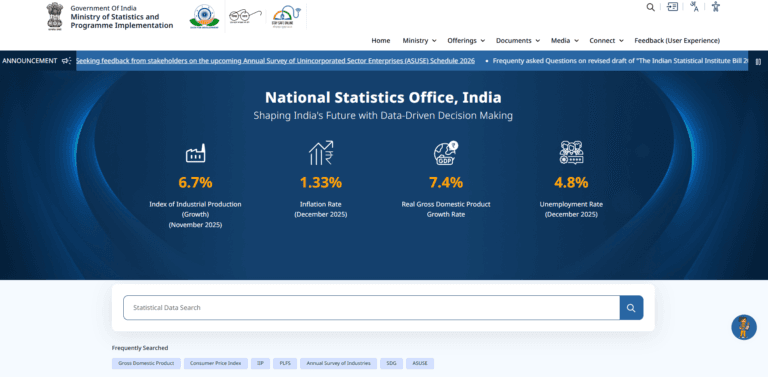
In a modern democratic country like India, reliable and authentic data is the backbone of evidence-based decision-making and good governance. Whether it is about understanding the performance of the economy, tracking employment trends, or monitoring the progress of national development programs — official statistics play a crucial role. At the heart of India’s statistical system is the Ministry of Statistics and Programme Implementation (MoSPI), a key Government of India ministry responsible for the collection, processing, analysis, and dissemination of official statistics.
In this detailed educational guide, you will learn what MoSPI is, how it is structured, the services and data it provides to the public, how its official portal works, and why this ministry is vital for India’s planning and development. You will also find direct links to explore the official website and its resources.
➡️ Visit the official MoSPI portal: https://www.mospi.gov.in/
1. What is the Ministry of Statistics and Programme Implementation?
The Ministry of Statistics and Programme Implementation (MoSPI) is an executive ministry of the Government of India with the primary role of strengthening and overseeing the national statistical system. It serves as the nodal authority for official statistics, ensuring that data produced and published in the country is scientifically sound, reliable, and consistent with international standards.
MoSPI was established on 15 October 1999 by merging the “Department of Statistics” and the “Department of Programme Implementation.” Its creation reflected the Government’s commitment to improving the quality and accessibility of statistical information, as well as enhancing the monitoring of social and economic programs across the nation.
In simpler terms, MoSPI’s mandate includes:
Collecting and analysing data about the Indian economy, society, and human development.
Publishing key statistical indicators and reports that inform public policy and research.
Monitoring the performance of government programs, infrastructure projects, and development schemes.
2. The Official Website: Accessing Data and Services
The Ministry’s official portal (https://www.mospi.gov.in/) is a treasure trove of free and authoritative statistical information. It serves students, researchers, policy-makers, journalists, and citizens who want to explore facts and figures about India’s economy, industry, employment, prices, and social trends.
Key Sections of the MoSPI Portal
Here are major sections you can explore on the portal:
About the Ministry: Learn about MoSPI’s vision, mission, history, leadership, and organizational structure.
Data and Statistics: Access a wide range of data sets across economic, social, industrial, and environmental statistics.
Publications and Reports: Download official documents such as national accounts reports, survey results, annual industry surveys, consumer price indices, and more.
Download Reports: A dedicated area where users can find historic and current statistical publications.
Support and Queries: Find help for accessing data, portal navigation, and other general questions.
Exploring the official website is highly recommended if you want authentic and updated statistical information about India’s development indicators.
3. Structure of MoSPI: Wings and Departments
MoSPI has a well-defined organizational structure designed to coordinate India’s statistical system and implement development programs effectively.
A. Statistics Wing
The statistics wing is responsible for collecting, processing, and disseminating official data. This includes:
National Statistical Office (NSO) – The primary statistical body which brings together:
Central Statistics Office (CSO): Responsible for national accounts, price indices, and major macroeconomic indicators.
National Sample Survey Office (NSSO): Conducts large-scale socio-economic sample surveys across India.
The NSO sets standards for data collection and ensures that statistics across sectors are comparable, consistent, and reliable.
B. Programme Implementation Wing
This wing focuses on monitoring government programs and projects. It is further divided into:
Twenty Point Programme (TPP) Division
Infrastructure Monitoring and Project Monitoring Division
Member of Parliament Local Area Development Scheme (MPLADS) Division
Together, these divisions ensure that major government schemes are implemented effectively, progress is tracked transparently, and outcomes are evaluated scientifically.
C. National Statistical Commission (NSC)
The National Statistical Commission is an independent body established in 2006 to provide guidance on statistical matters and strengthen the statistical framework across India. It advises on methodology, quality assurance, and the application of global best practices.
4. Major Statistical Surveys and Reports by MoSPI
MoSPI conducts and publishes a wide range of statistical series that are essential for understanding India’s socio-economic landscape.
A. National Accounts Statistics
These statistics include measures like Gross Domestic Product (GDP), consumption expenditure, savings, and capital formation. They are widely used to assess the economic performance of the country.
B. Index of Industrial Production (IIP)
The IIP is a monthly indicator that reflects the performance of key sectors such as manufacturing, mining, and electricity.
C. Annual Survey of Industries (ASI)
Conducted every year, ASI provides detailed statistics on industries, their output, employment, wages, and productivity.
D. Periodic Labour Force Survey (PLFS)
Launched to replace traditional employment surveys, the PLFS offers updated estimates on employment, unemployment, and labour force participation.
E. Consumer Price Index (CPI)
The CPI tracks changes in price levels of goods and services purchased by households, serving as a key indicator of inflation.
Each of these statistical products plays a crucial role in planning and decision-making processes across government departments and the private sector.
5. MoSPI’s Role in Modernizing Data and Technology
In recent years, the ministry has focused on using advanced technology to improve accessibility and quality of data. This includes:
📊 eSankhyiki Portal
MoSPI launched the eSankhyiki portal, a comprehensive data management and sharing system that enables users to search, visualize, and download datasets, covering national accounts, price indices, industrial data, labour force surveys, and more.
📱 GOIStats Mobile App
To make government data more accessible on mobile devices, MoSPI introduced the GOIStats app, enabling users to view official statistics anytime, anywhere.
🤖 Artificial Intelligence Tools
MoSPI has also started integrating AI tools such as chatbots in surveys to make data collection more efficient and accurate — a step toward digital transformation.
These innovative steps are helping researchers, analysts, and ordinary citizens engage with official data in more user-friendly formats.
6. How MoSPI Supports Government Planning and Public Policy
MoSPI’s work is at the core of evidence-based policy-making in India. Its data supports:
Budget planning and economic forecasting
Poverty alleviation and social welfare programs
Infrastructure planning and monitoring
Labour and employment policies
Urban and rural development strategies
By producing trusted and timely statistics, MoSPI enables policymakers to evaluate outcomes, identify trends, and allocate resources more effectively.
7. Why Official Statistics Matter for Citizens and Learners
Understanding how statistics are generated and used is important for:
Students and researchers seeking authentic information for academic work.
Journalists and media professionals reporting on economic and development trends.
Entrepreneurs and investors making informed decisions based on economic indicators.
Citizens interested in knowing how development programs are progressing.
Official statistics are public goods that empower people with knowledge about their society and economy.
8. How to Use the MoSPI Website for Learning and Research
To make the most of the Ministry’s portal:
Visit https://www.mospi.gov.in/ and explore key sections like Data, Publications, and Download Reports.
Use the eSankhyiki portal for interactive exploration of datasets.
Refer to statistical documents to improve understanding of macroeconomic concepts such as GDP, IIP, CPI, and labour force data.
Follow MoSPI’s announcements and updates to remain informed about new data releases and tools.
9. Role of MoSPI in National Development Monitoring
One of the most important responsibilities of the Ministry of Statistics and Programme Implementation is monitoring the progress of national development programs. While many ministries design and execute schemes, MoSPI plays a neutral and analytical role by evaluating how effectively these programs are being implemented on the ground.
Through systematic data collection and performance analysis, MoSPI helps the Government of India understand:
Whether public funds are being utilized efficiently
Whether infrastructure projects are progressing on time
Whether development goals are being achieved as planned
This monitoring framework ensures transparency, accountability, and better governance.
10. Infrastructure Monitoring by MoSPI
The Programme Implementation wing of MoSPI monitors major infrastructure projects across India. These include projects related to:
Power generation
Railways
Roads and highways
Petroleum and natural gas
Telecommunications
Ports and shipping
Large infrastructure projects often involve huge investments and long timelines. MoSPI tracks delays, cost overruns, and physical progress through structured reporting systems. This helps the government identify bottlenecks and take corrective measures early.
Such monitoring plays a crucial role in improving project execution and strengthening India’s infrastructure ecosystem.
11. Twenty Point Programme (TPP)
The Twenty Point Programme is a long-standing initiative aimed at improving the quality of life of people, especially in rural and economically weaker sections.
MoSPI is responsible for monitoring this program by collecting data from states and union territories on key indicators such as:
Employment generation
Housing development
Education access
Health facilities
Poverty reduction
Rural infrastructure growth
By evaluating progress under these indicators, MoSPI provides valuable feedback on the effectiveness of welfare initiatives implemented by different government departments.
12. Member of Parliament Local Area Development Scheme (MPLADS)
Another major responsibility under MoSPI is the MPLADS scheme. Under this program:
Members of Parliament can recommend development works in their constituencies
Funds are allocated for creating durable community assets
Projects include roads, drinking water facilities, schools, health centers, and public infrastructure
MoSPI oversees the implementation, financial utilization, and reporting mechanism of MPLADS. This ensures that funds are used responsibly and development works benefit local communities effectively.
13. Importance of MoSPI for Competitive Exams and Education
For learners preparing for government examinations, MoSPI is an extremely important subject area. Questions related to this ministry frequently appear in:
General Studies
Indian Economy
Governance and Administration
Current Affairs
Key topics often include:
GDP calculation methodology
Index of Industrial Production
Consumer Price Index
Employment and unemployment surveys
Role of National Statistical Office
For educational platforms like Digistudylab.in, explaining MoSPI helps learners build strong conceptual clarity about how India measures growth, development, and economic performance.
14. MoSPI and Evidence-Based Policy Making
Modern governance relies heavily on evidence rather than assumptions. MoSPI enables evidence-based policy making by providing:
Accurate datasets
Time-series comparisons
Sector-wise performance analysis
Regional development statistics
For example:
Employment data helps design labour policies
Price data supports inflation control measures
Industrial data guides manufacturing strategies
Consumption surveys influence welfare planning
Without such reliable data, long-term planning would lack scientific support.
15. Data Transparency and Public Accessibility
A major strength of MoSPI is its commitment to open data. Most of its reports, surveys, and publications are freely accessible to the public through the official portal.
This openness helps:
Students learn from real government data
Researchers perform independent analysis
Media ensure factual reporting
Citizens understand national development trends
By promoting transparency, MoSPI strengthens democratic participation and informed public discussion.
16. Statistical Standards and Global Alignment
MoSPI follows internationally accepted statistical standards and frameworks recommended by global organizations. This ensures that India’s data remains comparable with global indicators.
Such alignment helps in:
International economic comparisons
Global development assessments
Investment analysis
Policy benchmarking
As India’s global role expands, the credibility of its official statistics becomes increasingly important — a responsibility carried primarily by MoSPI.
17. Capacity Building and Training
The ministry also focuses on improving statistical capacity across states and institutions. This includes:
Training statistical officers
Updating survey methodologies
Improving digital data collection tools
Enhancing data validation systems
By strengthening statistical skills nationwide, MoSPI ensures uniform data quality across regions.
18. Future Vision of the Ministry
The future direction of MoSPI emphasizes:
Real-time data systems
Advanced analytics
Integration of administrative data
Digital surveys and automation
Faster publication cycles
The goal is to make India’s statistical ecosystem more responsive, accurate, and citizen-centric.
19. Why Learning About MoSPI Matters
Understanding the Ministry of Statistics and Programme Implementation helps you:
Grasp how national data is created
Interpret economic news correctly
Understand government reports logically
Build awareness of India’s development planning
For learners using Digistudylab.in, such knowledge strengthens both academic understanding and general awareness about India’s governance system.
Conclusion
The Ministry of Statistics and Programme Implementation plays a vital role in shaping how India collects, analyses, and uses official data. It bridges the gap between raw data and informed decision-making, ensuring that policymakers, researchers, and citizens have access to high-quality information. Through its official portal and related data services, MoSPI continues to strengthen India’s statistical foundations in a rapidly evolving data ecosystem.
If you are curious about India’s economy, social indicators, or development progress, exploring the MoSPI website is a great starting point.
👉 Explore the official MoSPI portal here: https://www.mospi.gov.in/

![Statistical Pocket Book India 1997 [Paperback] Ministry Of Planning And Programme Implementation(Paperback, Ministry of Planning and Programme Implementation)](https://rukminim1.flixcart.com/image/800/800/xif0q/regionalbooks/x/f/t/statistical-pocket-book-india-1997-paperback-ministry-of-original-imagj5yqr4rg2spz.jpeg?q=90)