India’s progress in research, innovation, and technology-driven development is powered not only by universities and laboratories, but also by government institutions that shape policy, fund research, build infrastructure, and connect ideas with real-world impact. One of the most important institutions in this ecosystem is the Department of Science and Technology (DST), which works under the Ministry of Science and Technology, Government of India.
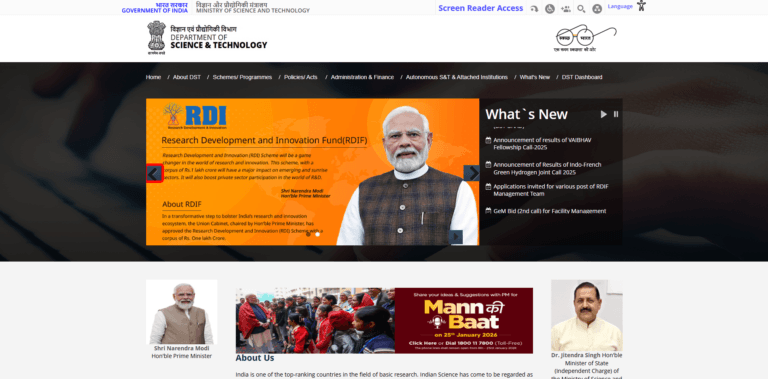
If you’ve ever searched for science scholarships, research grants, innovation support, startup incubation programs, national missions in emerging technologies, or official calls for research proposals, you’ve likely come across DST. The official DST portal— https://dst.gov.in/ —acts as a central gateway to information, announcements, schemes, and opportunities.
This educational guide on Digistudylab.in explains what DST is, why it matters, and how to use the DST website to explore its programmes and services.
1) Clarifying the Names: “Ministry of Science and Technology” vs “Department of Science and Technology”
Many people search using different terms such as:
“Ministry of Science and Technology”
“DST Ministry”
“Department of Science & Technology”
(Sometimes due to typos) “Ministry of Ministry of Science and Technology”
Here’s the correct structure:
Ministry of Science and Technology (MoST) is the parent ministry.
It works through major departments including the Department of Science & Technology (DST).
So, when you visit dst.gov.in, you are specifically visiting the official portal of the Department of Science & Technology (DST).
2) What is DST? (Simple Explanation)
The Department of Science & Technology (DST) is a Government of India department responsible for strengthening the country’s science, technology, and innovation ecosystem. It plays a key role in promoting scientific research, developing new technology areas, and building national capacity through funding, policy support, infrastructure development, and innovation programmes.
3) DST Vision and Mission: What the Department Aims to Build
DST publicly shares its guiding direction through its Vision & Mission page. One of the strongest takeaways from the recent vision statement is its focus on building a seamless, collaborative, inclusive science and innovation ecosystem aligned with national aspirations and goals like Viksit Bharat by 2047.
Why this matters for learners:
It shows DST is not only about laboratories—it’s also about building opportunities, strengthening institutions, supporting innovation, and ensuring science benefits society.
4) DST Mandate: The Core Responsibilities
DST’s mandate includes responsibilities like:
Formulating science & technology policy
Promoting new and emerging areas of science and technology
Supporting and coordinating scientific and technological activities across India
In a practical sense, this mandate becomes real through:
Research funding and grants
Science infrastructure support (labs, equipment, centres)
Scholarships and fellowships
Technology development and translation
Startup and innovation ecosystem support
Partnerships with states and institutions
5) Why DST Matters in Everyday Life (Not Just for Scientists)
DST’s impact is broader than many people realize. Its programmes influence:
A) Education and Scientific Temper
Through initiatives that encourage students and young researchers to enter science and research careers.
B) National Innovation and Startup Ecosystem
Through support systems that turn ideas into prototypes and prototypes into scalable solutions.
C) Technology for Society
Science and technology-based approaches to societal challenges—such as sustainability, rural development, healthcare technology, and inclusive growth.
D) Scientific Infrastructure in Universities and Institutions
Many higher-education institutions benefit when DST supports labs and advanced research facilities.
6) The DST Website (dst.gov.in): What You Can Do There
The DST portal is designed as a public information and services gateway. From a learner’s point of view, these are the most useful areas to explore:
6.1) “About Us” and DST Basics
You can learn:
What DST does
Its mission and mandate
How it supports India’s S&T ecosystem
6.2) Calls for Proposals (Grants, Fellowships, Research Opportunities)
DST posts official calls for proposals directly on its portal. For example, the website lists calls such as India Science and Research Fellowship (ISRF) 2025–26 with an end date shown on the site.
This section is extremely important if you are:
A researcher looking for funding calls
A faculty member seeking project grants
A student exploring fellowships
An institution tracking opportunities
6.3) What’s New (Updates, Notices, Recruitment, Announcements)
The What’s New area highlights current notices like recruitment posts, new calls, and administrative updates.
6.4) National Missions and Major Science Programmes
DST also publishes pages covering national missions, which help you understand how India organizes science and technology efforts at scale.
7) Major DST Schemes and Programmes (High-Value for Learners)
DST runs and supports many programmes, and different pages and documents show how these programmes are structured and implemented. Below are some of the most widely known and practically useful ones for students, institutions, innovators, and researchers.
7.1) INSPIRE: Encouraging Talent Toward Science and Research
INSPIRE (Innovation in Science Pursuit for Inspired Research) is one of DST’s flagship initiatives to attract talented youth towards science and research careers.
Why learners search for INSPIRE:
It is often associated with scholarships, fellowships, and research motivation.
It is meant to strengthen India’s future research base by encouraging bright minds into science and technology pathways.
Tip: If you are exploring scholarships/fellowships, always verify eligibility, deadlines, and official notices directly on DST and linked official pages.
7.2) FIST: Strengthening University and Institutional Infrastructure
FIST (Fund for Improvement of S&T Infrastructure) is known for supporting S&T infrastructure in universities and higher educational institutions—helping departments improve labs, equipment, and research capacity.
Why this matters:
Better infrastructure improves learning quality, research output, and training opportunities.
It supports long-term institutional development, not just short-term projects.
7.3) NIDHI: Supporting Innovation, Startups, and Technology-Based Entrepreneurship
NIDHI (National Initiative for Developing and Harnessing Innovations) is an umbrella programme developed by DST to nurture ideas and innovations into successful startups.
The NIDHI ecosystem is especially relevant for:
Student innovators
Early-stage founders
Institutions running incubators
Technology entrepreneurs in Tier 2/3 cities
DST year-end summaries have highlighted NIDHI’s focus on nurturing startups and expanding support structures.
NIDHI is publicly described as a programme that supports the journey from idea → innovation → startup, through structured support mechanisms.
7.4) NSTEDB: Building the National Entrepreneurship Support Network
Within DST’s innovation landscape, the National Science & Technology Entrepreneurship Development Board (NSTEDB) has built a wide network of Technology Business Incubators and Centres of Excellence, supporting innovation and entrepreneurship nationwide.
This is important because:
Incubators are local entry points for innovators to access mentorship, networking, prototyping support, and early funding guidance.
It helps build an ecosystem rather than isolated success stories.
7.5) Technology Development Board (TDB): Turning Indigenous Technology into Commercial Reality
The Technology Development Board (TDB) provides financial assistance for development and commercial application of indigenous technology and for adapting imported technology for domestic applications.
In simple words:
If a technology is proven and needs support to become a product or scalable solution, TDB is one of the important institutions in that journey.
8) Innovation and Technology Development Programmes: From Proof-of-Concept to Real Impact
DST also presents structured innovation and technology development programmes. These include multiple approaches such as technology missions, entrepreneurship development, and technology transfer initiatives.
A key point mentioned in DST’s technology development description is that these programmes aim to move technologies from proof-of-concepts toward advanced prototypes and validation in field settings.
This is crucial in India’s innovation chain because:
Many ideas fail not due to lack of creativity, but due to gaps in prototype validation, field testing, and structured development pathways.
9) How to Use the DST Website Step-by-Step (Practical Guide)
If you are visiting dst.gov.in for the first time, use this simple approach:
Step 1: Start with “About Us” + “Vision/Mission”
Understand what DST is and what it prioritizes.
Step 2: Go to “Call for Proposals”
If you are actively searching for opportunities, this section is one of the fastest ways to find official calls, timelines, and attachments.
Step 3: Check “What’s New”
For announcements, recruitment, and latest updates.
Step 4: Explore Programmes and National Missions
This helps you learn the bigger structure of India’s science and innovation efforts and find programme pages relevant to your field.
Step 5: Use Official Linked Portals (When Provided)
Some DST programmes have dedicated portals (example: NIDHI has its own programme portal).
10) Who Can Benefit from DST Services?
DST’s public information and programmes can be useful for:
Students and Learners
Understanding science programmes and national initiatives
Exploring scholarships, fellowships, and research pathways
Discovering innovation missions and opportunities
Researchers and Faculty
Finding calls for proposals and research funding updates
Understanding national priorities and mission areas
Tracking institutional support initiatives
Institutions (Universities, Colleges, Research Centres)
Infrastructure strengthening initiatives
Participation in national programmes
Collaboration opportunities
Startups and Innovators
Incubation networks, early-stage support, prototype funding models
Technology development and translation support pathways
General Public (Science and Society)
Understanding how government supports innovation and R&D
Learning about policy direction and public programmes
11) DST and the Ministry Ecosystem: How It Fits into India’s S&T Governance
The Ministry of Science and Technology works through multiple major departments, including DST.
This matters because:
Science and technology governance is distributed across specialized departments.
DST often acts as a nodal connector across academia, R&D institutions, industry, and other government departments—something also reflected in DST’s annual reporting descriptions.
12) Why Digistudylab.in is Sharing This Information
Digistudylab.in is dedicated to educational content that helps you learn about important government portals and public services in a clear, structured way. The DST portal is not only a “government website”—it is also a learning resource for understanding how science policy, innovation funding, national missions, and research support systems work in India.
If you are preparing for competitive exams, building awareness of Indian governance, exploring research options, or simply learning how India supports science and innovation—DST is a must-know institution.
13) Official Website Link (For Direct Reference)
To explore complete official information, programme pages, calls, notices, and updates, visit:
Department of Science & Technology (DST), Government of India: https://dst.gov.in/
(Always rely on the official portal for the latest eligibility rules, deadlines, documents, and announcements.)
14) Quick FAQs (Learner-Friendly)
Q1) Is DST the same as the Ministry of Science and Technology?
DST is a department under the Ministry of Science and Technology, not the entire ministry.
Q2) Does DST provide scholarships or fellowships?
DST runs and supports programmes such as INSPIRE, and the portal also lists calls for fellowships and proposals from time to time.
Q3) Where can I find the latest opportunities?
Check Call for Proposals and What’s New on dst.gov.in.
Q4) Does DST support startups?
Yes, initiatives like NIDHI are designed to nurture innovations into successful startups.
Conclusion:
DST as a Gateway to India’s Science and Innovation Ecosystem
The Department of Science and Technology (DST) is one of India’s most important institutions for building a strong scientific future—by funding research, promoting emerging technologies, strengthening institutional infrastructure, supporting innovation and entrepreneurship, and shaping policy direction.
For learners, the DST portal is valuable because it provides:
A clear picture of national science priorities
Official information on programmes and missions
Announcements and calls for proposals
Access pathways for researchers and innovators
A deeper understanding of how science and government connect in real development
If you want to explore India’s official science ecosystem, dst.gov.in is one of the most useful portals to bookmark.