Introduction to the Reserve Bank of India (RBI)
The Reserve Bank of India (RBI) is the central bank of India, responsible for regulating the country’s monetary policy, ensuring financial stability, and overseeing the banking sector. Established in 1935, the RBI plays a crucial role in the Indian economy by managing inflation, currency issuance, and foreign exchange reserves. It operates under the Ministry of Finance, Government of India, and is headquartered in Mumbai, Maharashtra.
RBI has recently launched a new online portal alongside its official website to improve accessibility and transparency. These include:
This guide provides a detailed overview of the RBI, its functions, services, and its role in India’s economic growth, along with essential insights into its latest digital initiatives.
History and Evolution of RBI
The Reserve Bank of India Act, 1934 established the RBI, which began operations on April 1, 1935. Initially, it was a privately owned institution, but it was nationalized in 1949, bringing it under full government control. The RBI has since played a pivotal role in India’s financial system, including handling crises such as the global financial crisis of 2008 and the COVID-19 pandemic economic impact.
Key milestones in RBI’s history:
- 1935 – Establishment of RBI.
- 1949 – Nationalization of RBI.
- 1955 – State Bank of India (SBI) was brought under RBI’s control.
- 1991 – Economic liberalization, with RBI implementing major banking reforms.
- 2016 – Introduction of the Monetary Policy Committee (MPC).
- 2023 – Launch of RBI’s new website portal to enhance digital services.
- 2024 – RBI expands its digital transformation with a focus on AI-driven financial analysis and consumer-centric banking reforms.
Key Functions of RBI
The RBI serves as the backbone of the Indian financial system. Its core functions include:
1. Monetary Policy Implementation
RBI regulates the supply of money in the economy to control inflation and growth. The Monetary Policy Committee (MPC) sets the repo rate, reverse repo rate, and cash reserve ratio (CRR) to manage liquidity.
2. Currency Issuance and Management
RBI is the sole issuer of currency notes in India, except for one-rupee notes and coins, which are issued by the Ministry of Finance. The central bank ensures adequate money supply and prevents counterfeiting.
3. Regulation and Supervision of Banks
RBI supervises all commercial banks, NBFCs (Non-Banking Financial Companies), cooperative banks, and financial institutions. It ensures compliance with banking regulations to protect depositors.
4. Management of Foreign Exchange Reserves
Under the Foreign Exchange Management Act (FEMA) 1999, RBI regulates foreign exchange reserves and transactions, ensuring stability in the forex market.
5. Financial Inclusion and Digital Banking
RBI promotes financial inclusion by encouraging digital banking services such as UPI (Unified Payments Interface), Rupay cards, and Bharat Bill Payment System (BBPS). With the advancement of CBDC (Central Bank Digital Currency), RBI is shaping India’s digital financial ecosystem.
6. Consumer Protection and Grievance Redressal
The Banking Ombudsman Scheme ensures that consumers’ complaints against banks are addressed effectively. The RBI has also introduced a Digital Banking Ombudsman for complaints related to digital transactions and fraud prevention.
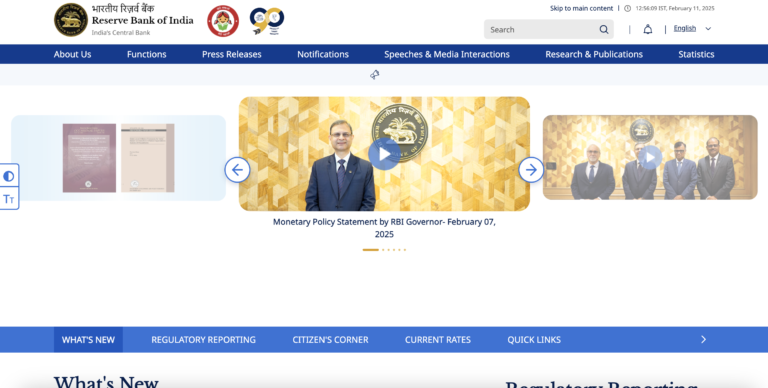
RBI’s Official Website and New Web Portal
RBI has two major online platforms for providing information and services:
1. RBI Official Website (www.rbi.org.in)
This website serves as the primary source for all official announcements, reports, and regulatory updates. Key sections include:
- Monetary Policy Statements
- Annual Reports and Circulars
- Foreign Exchange Management (FEMA) Regulations
- Financial Market Updates
- Real-time Economic Data and Reports
2. RBI’s New Web Portal (website.rbi.org.in)
RBI recently launched a new web portal to improve accessibility for citizens, businesses, and financial institutions. Features include:
- Simplified access to regulations and circulars
- Enhanced user experience for financial consumers
- AI-powered financial analysis tools
- Direct links to financial literacy resources
Services Offered by RBI
1. Banking and Financial Services
RBI provides guidelines for bank licensing, regulates interest rates, and oversees financial institutions to ensure economic stability.
2. Foreign Exchange and International Trade
The RBI plays a key role in managing India’s foreign exchange reserves and regulating foreign trade policies.
3. Digital Payments and Financial Inclusion
RBI regulates UPI, NEFT, RTGS, and IMPS systems to ensure smooth and secure digital transactions.
4. Financial Consumer Protection
The Banking Ombudsman Scheme allows customers to file complaints against banks for service-related issues.
5. Government Debt Management
RBI issues government bonds, treasury bills, and securities to finance public sector projects and manage national debt.
RBI and the Indian Government
RBI works closely with the Government of India to formulate economic policies, manage public debt, and regulate banking operations. It acts as the banker to the government and plays a significant role in fiscal policymaking.
Key RBI-Government Initiatives
- Pradhan Mantri Jan Dhan Yojana (PMJDY) – Financial inclusion initiative.
- Digital India Programme – Encouraging digital banking.
- Demonetization (2016) – Managing the transition of new currency notes.
- GST Implementation – Streamlining taxation policies.
- National Strategy for Financial Education (NSFE) – Promoting financial literacy.
Conclusion
The Reserve Bank of India (RBI) is the cornerstone of India’s financial system, regulating monetary policy, ensuring banking stability, and promoting financial inclusion. Its official website and new web portal serve as valuable resources for individuals and businesses seeking financial and economic information.
For official updates and resources, visit:
By understanding RBI’s role, services, and impact on the economy, individuals can make informed financial decisions and stay updated on India’s economic landscape. Stay informed with Digistudylab.in for more educational and financial insights.