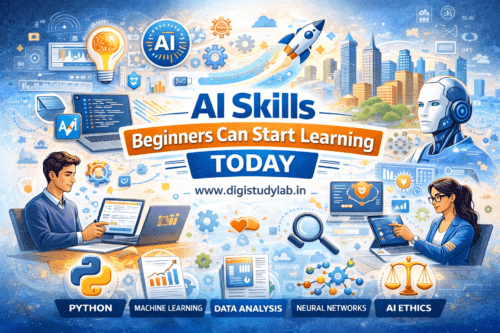
About Course
Computers have revolutionized the world, becoming integral to virtually every aspect of life, from work to entertainment. Understanding how computers work is no longer a specialized skill but a necessity in today’s technology-driven society. If you’re looking to build a solid foundation in computing, from the basic concepts to advanced topics, this comprehensive course on computers, offered on Digistudylab.in, is the perfect place to start.
This course is designed for learners of all levels, whether you’re a beginner looking to grasp the fundamentals or someone with some prior knowledge seeking to deepen your understanding of more complex topics. Throughout the course, you’ll be taken through detailed lessons that break down complex concepts in a way that is easy to understand, ensuring that by the end, you’ll have a well-rounded knowledge of how computers work and how to apply this understanding in real-world scenarios.
Why Learn About Computers?
Computers are everywhere—from the smartphones in our pockets to the powerful machines that control businesses, governments, and space exploration. Understanding the internal mechanisms of computers, including hardware, software, and networks, provides valuable skills that can open up career opportunities in information technology, engineering, and many other fields.
With computers becoming smarter and more powerful, there is a growing need for individuals who not only use them but also understand their underlying systems and can engage with more technical aspects such as programming, system administration, and network management. By learning how computers operate, you can stay ahead of technological trends, boost your problem-solving skills, and even explore creative outlets through programming and development.
At Digistudylab.in, we believe in delivering courses that not only inform but also empower learners. This computer course is designed to guide you through every step of understanding computers—starting from the very basics and advancing toward more specialized knowledge, such as computer networks, software development, and even quantum computing.
Course Overview
This course on Digistudylab.in is divided into six comprehensive modules, each covering key areas of computer knowledge. Let’s take a closer look at what each module offers.
Module 1: Introduction to Computers
The first module serves as the foundation of the course. Here, you’ll learn the fundamental concepts of computing, starting with the very definition of what a computer is. We’ll explore the different types of computers, from personal computers and laptops to larger systems like mainframes and supercomputers.
You’ll also dive into the history of computers, tracing the evolution of computational devices from early tools like the abacus to today’s powerful machines. This historical context provides important insights into how computers have developed over time and how key figures, such as Charles Babbage and Ada Lovelace, contributed to the field of computing. Understanding the past of computing lays the groundwork for comprehending modern advancements in technology.
Module 2: Computer Hardware
In this module, we move from the general to the specific, breaking down the physical components that make up a computer system. This is where you’ll get familiar with key terms like the CPU (Central Processing Unit), memory, storage, and more.
By learning about these internal components, you’ll understand how computers process information and how data flows through the system. The lessons cover the importance of the motherboard as the backbone of all hardware interactions, and explain how system buses work to transport data between components. This knowledge can help you make informed decisions when purchasing or upgrading a computer and can also provide insights into troubleshooting hardware issues.
Module 3: Computer Software
Once you’re familiar with hardware, it’s time to turn your attention to the software side of computing. Module 3 covers the two major types of software: system software (like operating systems) and application software (like word processors and multimedia tools).
You’ll learn how operating systems manage both hardware and software resources, ensuring that the computer runs smoothly. This includes an exploration of popular operating systems such as Windows, macOS, and Linux. We’ll also take a closer look at application software, which includes everything from productivity tools to more specialized programs such as graphic design or video editing software.
Additionally, this module introduces basic programming concepts, which are crucial if you’re considering software development. Programming languages like Python, C++, and Java are discussed, alongside an overview of software development processes.
Module 4: Computer Networks
In today’s hyper-connected world, understanding networks is essential. This module will introduce you to the basics of computer networking, helping you grasp how computers communicate with each other across the globe.
The lessons will cover network types, including Local Area Networks (LANs), Wide Area Networks (WANs), and the internet. You’ll learn how devices are connected through various topologies, such as star or mesh networks, and how data is transmitted efficiently. We also touch on critical protocols, such as IP addresses and DNS, that make the web function as we know it.
Moreover, you’ll explore network security principles, which are key to protecting sensitive information. This module will explain firewalls, VPNs, and encryption methods that keep networks secure from threats like hacking or malware.
Module 5: The Future of Computing
The fifth module looks toward the future, providing insights into emerging technologies that are shaping the world of computing. Cloud computing, artificial intelligence (AI), machine learning (ML), and quantum computing are covered in detail.
Cloud computing is becoming increasingly popular as more companies and individuals use it for data storage, processing, and application hosting. In this module, you’ll learn about the benefits of cloud computing, including scalability, flexibility, and cost efficiency.
AI and ML are two of the most exciting developments in computing, with applications ranging from personal assistants like Siri and Alexa to self-driving cars. This module explores the basic principles of AI and ML, how they are trained, and their implications for the future.
Quantum computing, though still in its infancy, holds the promise of solving problems that are currently impossible for classical computers. This module provides an introduction to the basic principles of quantum computing, including qubits and superposition, and how this technology might revolutionize industries.
Module 6: Hands-On Applications
The final module focuses on practical, hands-on skills that learners can apply in real-life situations. From building your own custom computer to basic programming with Python, this module offers opportunities to put your newfound knowledge to use.
In the lesson on building your own computer, we’ll guide you through the process of selecting the right components and assembling them. This includes a detailed look at the role each part plays, from the CPU and GPU to the cooling system, storage, and power supply.
The programming lesson introduces you to Python, a versatile and beginner-friendly language. You’ll learn basic syntax, how to write functions, and how to use loops and conditionals to create simple programs. By the end, you’ll have enough knowledge to start exploring more advanced programming projects on your own.
Lastly, the lesson on setting up a home network will give you practical networking skills, such as configuring routers and ensuring security through encryption and firewalls. Whether you want to share files between devices or set up a remote access system, this module provides step-by-step instructions.
Why Choose Digistudylab.in for Learning Computers?
At Digistudylab.in, we are committed to delivering high-quality, engaging courses that go beyond the basics. This comprehensive computer course is structured to provide you with all the tools and knowledge you need to excel in the digital age. With detailed lessons, hands-on applications, and a look into the future of computing, this course ensures that you’ll have the skills to not only use computers effectively but also understand the technology behind them.
Whether you’re a student, a professional looking to enhance your IT skills, or someone simply curious about how computers work, this course will guide you step-by-step, ensuring you grasp even the most complex concepts with ease. Explore the exciting world of computing with us, and start your journey toward mastering the technology that powers modern life.
Join us on Digistudylab.in, where learning is made simple, thorough, and accessible for everyone.
Course Content
Module 1: Introduction to Computers
-
Lesson 1.1: What is a Computer?
00:00 -
Lesson 1.2: The History of Computers
00:00 -
Lesson 1.3: Types of Computers
00:00
Module 2: Computer Hardware
Module 3: Computer Software
Module 4: Computer Networks
Module 5: The Future of Computing
Module 6: Hands-on Computing and Practical Applications
Student Ratings & Reviews