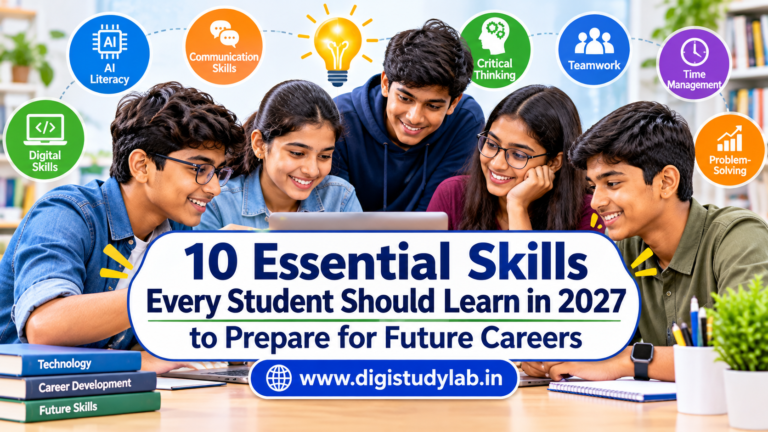
Introduction
The world is changing rapidly, and the skills required to succeed in education, employment, and everyday life are changing along with it.
Artificial Intelligence (AI), automation, digital technologies, and new ways of working are transforming industries and creating different career opportunities. As a result, academic qualifications alone may not always be enough to prepare students for the challenges of the future.
Students also need practical abilities that help them communicate effectively, solve problems, understand technology, manage money, and adapt to changing situations.
Whether you are studying in school, pursuing a college degree, preparing for competitive examinations, or planning your first career, developing the right skills can make a significant difference.
But which skills should students focus on in 2027?
In this guide, DigiStudyLab.in explores 10 essential skills that can help students strengthen their knowledge, improve their confidence, and prepare for future career opportunities.
Why Should Students Learn New Skills in 2027?
Traditional education provides an important foundation through subjects such as mathematics, science, languages, and social studies.
However, modern workplaces increasingly require people who can apply their knowledge, work with technology, communicate ideas, and handle unfamiliar challenges.
The India Skills Report 2026 highlights the growing importance of emerging technology capabilities, including Artificial Intelligence, data analytics, cloud computing, and cybersecurity.
It also highlights the importance of communication, problem-solving, digital literacy, and adaptability in a changing employment landscape.
Similarly, NITI Aayog’s 2026 report, Reimagining Skilling for Viksit Bharat@2047, emphasizes the need to strengthen foundational employability skills and connect education more effectively with practical workplace requirements.
This makes skill development an important part of a student’s educational journey.
10 Essential Skills Every Student Should Learn in 2027
1. Artificial Intelligence (AI) Literacy
Artificial Intelligence is becoming an important part of education, business, healthcare, communication, and many other industries.
Students are increasingly interacting with AI-powered applications, intelligent assistants, recommendation systems, and automated tools.
Understanding how these technologies work can help students use them more effectively.
AI literacy does not necessarily mean becoming a programmer or developing advanced machine learning systems. It starts with understanding what AI can do, how it generates results, and where its limitations exist.
What students should learn:
- Basic concepts of Artificial Intelligence.
- How generative AI tools work.
- How to write effective prompts.
- How to verify AI-generated information.
- Responsible and ethical AI usage.
- Data privacy and digital safety.
- Basic understanding of machine learning.
How to develop this skill:
Students can explore beginner-friendly AI applications, use AI tools to understand difficult academic concepts, and experiment with educational activities.
However, AI should support independent learning rather than replace reading, research, and critical thinking.
Why it matters: AI literacy can help students understand emerging technologies and prepare for workplaces where AI-assisted tools are increasingly being used.
2. Communication Skills
Communication is one of the most important skills for students, regardless of their academic background or career goals.
Being knowledgeable is valuable, but students must also be able to explain their ideas clearly and understand others.
Good communication skills are useful during classroom discussions, presentations, interviews, group projects, and professional interactions.
Students should develop both verbal and written communication abilities.
What students should learn:
- Speaking clearly and confidently.
- Writing professional emails.
- Improving vocabulary and grammar.
- Listening actively.
- Participating in discussions.
- Presenting ideas effectively.
- Communicating in English and other relevant languages.
How to develop this skill:
- Read newspapers, books, and educational articles regularly.
- Practice speaking about different topics.
- Participate in debates and group discussions.
- Write short essays and summaries.
- Practice explaining difficult concepts in simple language.
- Record presentations and identify areas for improvement.
Why it matters: Communication helps students express their knowledge, collaborate with others, and participate more confidently in academic and professional environments.
3. Critical Thinking and Problem-Solving
Critical thinking is the ability to examine information, evaluate evidence, identify assumptions, and make logical decisions.
In an environment where information is easily accessible through the internet and AI tools, students need to understand how to distinguish reliable information from misleading or inaccurate content.
Problem-solving is closely connected with critical thinking. It involves identifying a challenge, examining possible solutions, and choosing an appropriate approach.
What students should learn:
- Analyzing information logically.
- Identifying problems and their causes.
- Comparing different solutions.
- Evaluating facts and evidence.
- Recognizing misleading information.
- Making informed decisions.
- Approaching unfamiliar problems systematically.
How to develop this skill:
Students can solve mathematical problems, participate in quizzes, play logic-based games, work on science projects, and discuss real-life situations.
Reading different viewpoints and asking questions instead of accepting every statement immediately can also strengthen critical thinking.
Why it matters: Critical thinking and problem-solving are useful across almost every field, from education and business to science, technology, and public services.
4. Digital Literacy and Computer Skills
Digital literacy is no longer limited to knowing how to operate a computer or smartphone.
It includes understanding how to use digital tools, access information, communicate online, manage files, and protect personal information.
Students who develop strong digital skills can use technology more effectively for education, research, and professional activities.
What students should learn:
- Basic computer operations.
- Internet browsing and online research.
- Word processing and spreadsheets.
- Presentation software.
- Email and digital communication.
- Cloud storage and file management.
- Online privacy and cybersecurity basics.
- Identifying trustworthy websites and information sources.
How to develop this skill:
Students can practice creating documents, preparing presentations, organizing spreadsheets, and researching educational topics using reliable websites.
They can also explore free digital learning resources and introductory computer courses.
Why it matters: Digital literacy is useful in education, employment, entrepreneurship, and everyday activities. It also provides a foundation for learning more advanced technologies.
5. Financial Literacy
Financial literacy is the ability to understand money, budgeting, saving, spending, borrowing, and basic financial decision-making.
Many students complete their education without having a clear understanding of how to manage personal finances.
Developing financial knowledge at an early stage can help students make more responsible decisions as they become financially independent.
What students should learn:
- Understanding income and expenses.
- Creating a personal budget.
- Importance of saving money.
- Basics of banking.
- Understanding interest and inflation.
- Digital payment safety.
- Basics of loans and credit.
- Identifying financial scams.
How to develop this skill:
Students can begin by maintaining a simple record of their pocket money or monthly expenses.
They can learn how savings accounts work, understand the difference between needs and wants, and explore basic financial concepts through practical examples.
Why it matters: Financial literacy helps students develop responsible money habits and prepares them for managing their finances independently.
6. Creativity and Innovation
Creativity is the ability to develop new ideas, explore different possibilities, and approach challenges in original ways.
It is not limited to artistic activities such as drawing, music, or writing. Creativity is also important in science, business, engineering, technology, and everyday problem-solving.
Innovation involves turning useful ideas into practical solutions.
What students should learn:
- Creative thinking.
- Idea generation.
- Design thinking.
- Experimentation.
- Independent problem-solving.
- Developing original projects.
- Learning from mistakes.
How to develop this skill:
Students can participate in science exhibitions, create simple projects, write stories, design presentations, build models, or explore new ways to solve everyday problems.
They should also be encouraged to ask questions and experiment with different approaches.
Why it matters: Creativity helps students explore opportunities, develop original solutions, and contribute new ideas in different fields.
7. Adaptability and Continuous Learning
Technology, industries, and employment requirements continue to change.
A skill that is useful today may need to be updated in the future. This makes adaptability and continuous learning particularly important.
Adaptability means being able to adjust to new situations, learn unfamiliar concepts, and respond positively to changes.
Continuous learning means regularly developing new knowledge and improving existing abilities.
What students should learn:
- Learning new tools and technologies.
- Accepting constructive feedback.
- Adjusting to changing situations.
- Developing independent learning habits.
- Managing unexpected challenges.
- Recognizing areas for improvement.
- Updating knowledge regularly.
How to develop this skill:
Students can explore subjects beyond their regular syllabus, take free online courses, learn new software, and participate in activities that introduce unfamiliar challenges.
They should also develop the habit of setting learning goals and reviewing their progress.
Why it matters: Adaptability helps students remain prepared for changing academic requirements, new technologies, and evolving career opportunities.
8. Teamwork and Collaboration
Most educational and professional environments involve working with other people.
Teamwork is the ability to contribute effectively towards a shared goal while respecting different ideas, responsibilities, and perspectives.
Students who develop collaboration skills can participate more confidently in group activities and professional environments.
What students should learn:
- Working towards common goals.
- Sharing responsibilities.
- Listening to different viewpoints.
- Respecting others’ opinions.
- Resolving disagreements.
- Supporting team members.
- Giving and receiving constructive feedback.
How to develop this skill:
Students can participate in group assignments, sports, classroom activities, volunteering, and community projects.
They should learn to contribute their ideas while giving others an opportunity to participate.
Why it matters: Teamwork improves cooperation, communication, and the ability to complete tasks through collective effort.
9. Time Management and Self-Discipline
Managing time effectively is an important skill for students balancing classes, examinations, assignments, hobbies, and personal responsibilities.
Without proper planning, students may struggle to complete tasks on time or maintain consistent study habits.
Time management involves deciding what needs to be done, setting priorities, and allocating sufficient time to each activity.
Self-discipline helps students remain consistent even when motivation is low.
What students should learn:
- Setting daily and weekly goals.
- Preparing realistic study schedules.
- Prioritizing important tasks.
- Avoiding unnecessary distractions.
- Breaking large tasks into smaller steps.
- Maintaining consistent routines.
- Reviewing progress regularly.
How to develop this skill:
Students can create a weekly timetable, use a simple task list, set study periods, and take planned breaks.
They should also avoid unrealistic schedules that leave insufficient time for sleep, physical activity, and relaxation.
Why it matters: Effective time management can help students improve productivity, reduce last-minute pressure, and develop consistent learning habits.
10. Entrepreneurship and Financial Decision-Making
Entrepreneurship involves identifying opportunities, developing ideas, understanding customer needs, and creating useful products or services.
Students do not need to start a business to benefit from entrepreneurial thinking.
It can help them become more independent, creative, resourceful, and confident when approaching challenges.
What students should learn:
- Identifying problems and opportunities.
- Understanding customer needs.
- Basic business planning.
- Budgeting and resource management.
- Marketing fundamentals.
- Decision-making.
- Taking calculated risks.
- Understanding the value of innovation.
How to develop this skill:
Students can participate in school business activities, organize small projects, explore simple business ideas, and learn how products and services are developed.
They can also study successful businesses to understand how entrepreneurs identify problems and create solutions.
Why it matters: Entrepreneurial thinking can help students explore self-employment, business opportunities, innovation, and independent career pathways.
Technical Skills vs Soft Skills: What Should Students Focus On?
Students often concentrate on technical skills because they are directly connected with specific careers.
However, technical knowledge and soft skills complement each other.
Technical skills help individuals perform specialized tasks, while soft skills support communication, collaboration, decision-making, and professional development.
| Technical skills | Soft skills |
|---|---|
| Artificial Intelligence | Communication |
| Programming | Critical thinking |
| Data analytics | Problem-solving |
| Cybersecurity | Teamwork |
| Cloud computing | Adaptability |
| Computer applications | Time management |
| Digital marketing | Creativity |
For example, a software developer may have excellent programming knowledge, but communication and teamwork are also important when working with colleagues and understanding project requirements.
Similarly, a business professional may understand financial concepts but also needs problem-solving and decision-making abilities.
The best approach is to develop a balanced combination of technical and human skills.
How Can Students Develop These Skills for Free?
Developing useful skills does not always require expensive training programmes or paid certifications.
Students can make significant progress through free educational resources, regular practice, and practical activities.
Here are some ways to get started.
1. Explore Free Online Courses
Students can learn about technology, communication, business, and other subjects through free online learning platforms.
Some useful platforms include:
- SWAYAM: https://swayam.gov.in/
- NPTEL: https://nptel.ac.in/
- Skill India Digital Hub: https://www.skillindiadigital.gov.in/
- FutureSkills Prime: https://futureskillsprime.in/
Check individual course conditions because learning access, assessments, and certificates may have different requirements or charges.
2. Practice Using Free Digital Tools
Students can explore word processors, spreadsheets, presentation applications, coding platforms, and AI tools.
Regular practice can help develop practical digital abilities.
3. Read Educational Articles and Books
Reading helps improve vocabulary, comprehension, general knowledge, and critical thinking.
Students can explore educational articles, science publications, newspapers, and books related to their interests.
4. Participate in Quizzes and Brain Games
Quizzes and logical reasoning games can provide opportunities to practise general knowledge, memory, pattern recognition, and problem-solving.
Students can also use educational quizzes to identify areas where they need additional learning.
5. Work on Small Projects
Practical projects can help students apply their knowledge.
Examples include:
- Preparing a monthly budget using a spreadsheet.
- Creating a presentation about a scientific topic.
- Developing a simple website.
- Writing an educational article.
- Building a basic coding project.
- Preparing a research presentation.
Small projects can also become useful examples of practical work when students prepare for internships or employment.
A Simple 30-Day Skill Development Plan for Students
Students do not need to develop all these skills simultaneously.
A structured 30-day plan can help them begin building good learning habits.
| Period | Learning activities |
|---|---|
| Days 1–5 | Improve communication through reading, writing, and speaking practice |
| Days 6–10 | Explore digital literacy and basic computer applications |
| Days 11–15 | Learn AI fundamentals and practise responsible AI usage |
| Days 16–20 | Solve puzzles, logical reasoning questions, and practical problems |
| Days 21–25 | Learn budgeting, financial literacy, and basic money management |
| Days 26–30 | Complete a small project and review your progress |
Students can continue practising these skills after the first 30 days and gradually introduce additional learning goals.
Consistency is more important than trying to learn everything at once.
Free Learning Resources for Students on DigiStudyLab.in
Students can also use DigiStudyLab.in to explore different learning opportunities without paying for access to educational content.
The website provides educational resources designed to support students and general learners.
Depending on their interests, visitors can explore:
- Free online courses and learning materials.
- General Knowledge questions and quizzes.
- Educational blog articles.
- Brain games and logical reasoning activities.
- Free online tools.
- Government services and educational portals.
These resources can complement classroom learning and help students develop knowledge through independent practice.
Explore the available resources at https://www.digistudylab.in/
Frequently Asked Questions About Skills Students Should Learn in 2027
1. What are the most important skills students should learn in 2027?
Some important skills include AI literacy, communication, critical thinking, problem-solving, digital literacy, financial literacy, creativity, teamwork, adaptability, and time management.
2. Which technical skills are useful for students?
Useful technical skills include programming, Artificial Intelligence, data analytics, cybersecurity, cloud computing, computer applications, and digital marketing. The most suitable skills depend on a student’s interests and career goals.
3. Why should students learn Artificial Intelligence?
AI knowledge can help students understand modern technologies, use AI-powered tools responsibly, evaluate generated information, and explore future learning and career opportunities.
4. Are soft skills important for students?
Yes. Soft skills such as communication, teamwork, adaptability, critical thinking, and problem-solving help students participate effectively in academic and professional environments.
5. Can students learn useful skills without spending money?
Yes. Students can use free online courses, educational websites, digital resources, books, practical projects, and interactive learning activities to develop useful skills.
6. Which skills should school students develop first?
School students should begin with foundational skills such as reading, writing, mathematics, communication, logical reasoning, digital literacy, and responsible technology use.
7. What skills are useful for college students?
College students can focus on communication, digital literacy, AI awareness, critical thinking, teamwork, financial literacy, practical technical knowledge, and career-related skills.
8. Is coding necessary for every student?
No. Coding can be useful for students interested in technology and software development, but it is not necessary for every career. Basic digital literacy and an understanding of technology are valuable across many fields.
9. How can students improve their communication skills?
Students can improve communication by reading regularly, practising conversations, participating in discussions, writing, preparing presentations, and learning to express ideas clearly.
10. How much time should students spend learning additional skills?
There is no fixed requirement. Students can begin with 30–60 minutes of focused practice several days a week, depending on their academic workload and personal schedule.
11. What is the difference between skills and qualifications?
Qualifications generally demonstrate completed education or formal training, while skills refer to the abilities a person can apply to perform tasks and solve problems. Both can contribute to educational and career development.
12. How can students prepare for future careers?
Students can prepare by developing strong academic foundations, learning relevant technical and interpersonal skills, gaining practical experience, exploring career opportunities, and continuing to update their knowledge.
Conclusion
The future of education and employment will require more than academic knowledge alone. Students will need a combination of technical abilities, practical experience, communication, creativity, and the confidence to learn continuously.
Artificial Intelligence, digital literacy, critical thinking, financial awareness, and adaptability are among the areas worth exploring as students prepare for changing career opportunities.
However, there is no need to master every skill immediately. Students should begin with their interests, identify areas for improvement, and develop useful abilities through regular practice.
Every new skill learned today can become an opportunity tomorrow.
At DigiStudyLab.in, our aim is to make quality educational resources and learning opportunities accessible to everyone. Continue exploring our free courses, quizzes, educational articles, and learning activities to strengthen your knowledge and prepare for the future.
Start learning today. Build skills for tomorrow.
Official References and Further Reading
- India Skills Report 2026 – Confederation of Indian Industry: https://www.cii.in/
- NITI Aayog – Reimagining Skilling for Viksit Bharat@2047 (2026): https://www.niti.gov.in/node/2397
- Ministry of Skill Development and Entrepreneurship – Skill India Mission: https://www.msde.gov.in/
- Skill India Digital Hub: https://www.skillindiadigital.gov.in/
- FutureSkills Prime: https://futureskillsprime.in/
- SWAYAM: https://swayam.gov.in/
- NPTEL: https://nptel.ac.in/
Note: Career requirements and employer skill preferences vary across industries and change over time. Students should research the requirements of their chosen career paths and select learning opportunities accordingly.