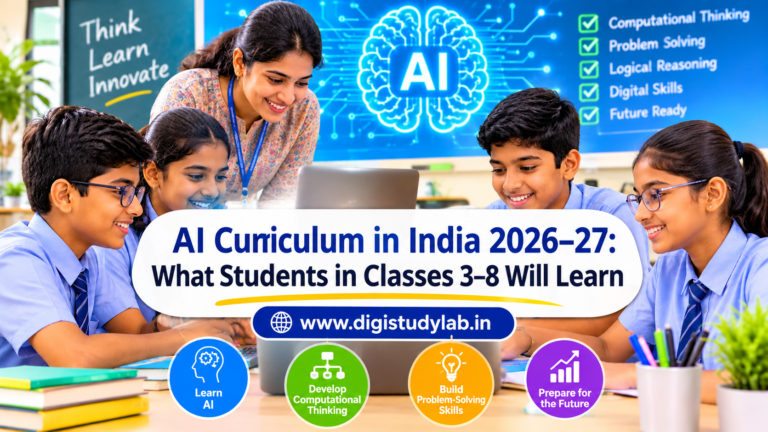
The AI curriculum in India is taking an important step forward in the 2026–27 academic session. With the introduction of Computational Thinking and Artificial Intelligence education for Classes III to VIII through CBSE, students will get opportunities to develop logical reasoning, problem-solving abilities, creativity, and an understanding of emerging technologies.
Introduction
Artificial Intelligence (AI) is becoming an important part of everyday life, influencing how people learn, communicate, work, and solve problems. From voice assistants and recommendation systems to self-driving technologies and AI-powered educational tools, intelligent technology is changing the world around us.
As technology continues to develop, understanding how it works is becoming an increasingly valuable skill for students.
Recognizing this changing educational landscape, India is taking steps to introduce Artificial Intelligence (AI) and Computational Thinking (CT) into school education.
For the 2026–27 academic session, the Central Board of Secondary Education (CBSE), in collaboration with the National Council of Educational Research and Training (NCERT), has introduced a dedicated Computational Thinking and Artificial Intelligence curriculum for Classes III to VIII.
This initiative aims to help young learners develop logical reasoning, problem-solving abilities, creativity, and an understanding of responsible technology use.
But what exactly will students learn? Why is computational thinking important? And how can these skills prepare children for the future?
Let’s explore the new direction of AI education in India.
What Is the New AI Curriculum Introduced in Indian Schools?
The new Computational Thinking and Artificial Intelligence curriculum is designed to introduce students to important concepts that form the foundation of modern technology.
According to CBSE Circular No. Acad-15/2026, dated April 1, 2026, the curriculum is being introduced for Classes III to VIII from the academic session 2026–27.
The initiative aligns with the National Education Policy (NEP) 2020 and the National Curriculum Framework for School Education.
Rather than focusing only on teaching students how to use digital devices, the curriculum aims to develop the thinking skills required to understand problems, recognize patterns, create logical solutions, and understand how intelligent systems work.
The key learning objectives include:
- Developing computational thinking abilities.
- Strengthening logical reasoning.
- Improving problem-solving skills.
- Understanding patterns and relationships.
- Learning algorithmic thinking.
- Building digital literacy.
- Encouraging creativity and innovation.
- Understanding responsible and ethical AI usage.
The overall objective is to help students become informed and capable users of technology rather than simply consumers of digital tools.
What Is Computational Thinking?
Computational Thinking is a problem-solving approach that involves breaking complicated problems into smaller, manageable steps and developing logical solutions.
It is one of the foundational skills behind computer programming, software development, and Artificial Intelligence.
However, computational thinking is not limited to computers or coding. Students can develop these abilities through everyday activities, puzzles, mathematics, games, and logical exercises.
There are four commonly recognized elements of computational thinking.
1. Decomposition
Decomposition means breaking a large problem into smaller and easier tasks.
For example, if a student wants to organize a school event, the task can be divided into several smaller activities:
- Selecting the event date.
- Preparing a list of participants.
- Arranging the required materials.
- Assigning responsibilities.
- Planning the schedule.
Breaking a complex task into smaller parts makes it easier to understand and complete.
2. Pattern Recognition
Pattern recognition involves identifying similarities, sequences, and repeated structures.
For example, students may identify number sequences such as:
2, 4, 6, 8, 10…
By recognizing the pattern, they can understand that each number increases by two.
Pattern recognition is also important in AI systems because machine learning technologies identify patterns in data to make predictions or classifications.
3. Abstraction
Abstraction means focusing on the important information needed to solve a problem while ignoring unnecessary details.
For example, when using a map to find the shortest route to school, a student focuses on roads, distances, and possible routes rather than every building or object along the way.
This helps students concentrate on relevant information.
4. Algorithmic Thinking
Algorithmic thinking involves creating a logical sequence of instructions to complete a task.
For example, preparing a cup of tea involves following a sequence:
- Heat water.
- Add tea leaves.
- Add milk and sugar if required.
- Boil the mixture.
- Strain and serve.
Computers also follow instructions arranged in logical sequences to perform tasks.
Learning these concepts helps students develop structured thinking and problem-solving abilities.
What Will Students Learn About Artificial Intelligence?
Artificial Intelligence allows computer systems to perform tasks that generally require human-like capabilities, such as recognizing patterns, understanding language, analyzing information, and generating content.
The new school curriculum aims to introduce students to AI through age-appropriate learning activities.
Some important areas associated with AI education include:
1. Understanding Artificial Intelligence
Students can learn what AI means, how it is used, and where they encounter it in everyday life.
Examples include:
- Voice assistants.
- Language translation applications.
- Recommendation systems.
- Image recognition.
- Smart navigation.
- AI-powered learning applications.
Understanding these examples helps students connect classroom learning with real-world technology.
2. Introduction to Data and Patterns
AI systems depend on data to identify patterns and generate results.
Students can develop an introductory understanding of how information is collected, organized, compared, and used.
For example, a simple activity could involve organizing information about different animals based on their characteristics.
This introduces the basic idea of classification and pattern recognition.
3. Understanding How AI Makes Predictions
Students can explore how AI systems use available information to generate predictions or suggestions.
For example, a weather forecasting system analyzes different types of data to estimate future weather conditions.
Such examples can help students understand that AI predictions depend on information and are not always correct.
4. Responsible and Ethical Use of AI
Understanding the limitations and responsible use of AI is just as important as learning how it works.
Students should learn about:
- Protecting personal information.
- Recognizing incorrect AI-generated information.
- Avoiding plagiarism.
- Respecting copyright.
- Identifying misleading digital content.
- Understanding bias in AI systems.
- Using technology responsibly.
These concepts can help students become more informed digital citizens.
Why Is AI Education Important for School Students?
Introducing AI and computational thinking at an early stage can help students develop abilities that are useful beyond computer science.
Here are some important benefits.
1. Develops Logical Thinking
Students learn to analyze situations, identify relationships, and find solutions using logical reasoning.
These abilities are useful in mathematics, science, and everyday decision-making.
2. Encourages Creativity
AI education can encourage students to explore new ideas, experiment with solutions, and approach problems from different perspectives.
3. Improves Problem-Solving Skills
Computational thinking teaches students to understand problems systematically rather than depending entirely on trial and error.
4. Builds Digital Literacy
As digital technology becomes increasingly common, students need to understand how digital systems work and how to use them safely.
5. Introduces Future Career Opportunities
AI and related technologies are creating opportunities across many industries.
Early exposure can help students discover interests in fields such as:
- Artificial Intelligence.
- Machine Learning.
- Data Science.
- Robotics.
- Software Development.
- Cybersecurity.
- Automation.
- Computer Engineering.
Students do not need to choose a technology career at an early age. The purpose is to help them understand emerging fields and develop foundational skills.
How Will AI and Computational Thinking Be Taught?
The emphasis of computational thinking education is not simply on memorizing definitions or learning programming commands.
Students can develop these abilities through practical and interactive learning activities.
Examples include:
Puzzles and Logical Games: Activities involving sequences, patterns, classification, and logical reasoning can help students develop structured thinking.
Mathematical Activities: Mathematics can be connected with computational thinking through problem-solving exercises, number patterns, and logical challenges.
Everyday Problem-Solving: Teachers can use real-life situations to help students understand decomposition, sequencing, and decision-making.
Coding Activities: Age-appropriate coding exercises can introduce students to instructions, algorithms, and basic programming concepts.
Group Projects: Students can work together to identify problems, discuss possible solutions, and develop simple projects.
Digital Learning Activities: Where suitable infrastructure is available, students can explore digital tools and introductory AI applications under appropriate guidance.
The curriculum aims to develop an age-appropriate progression of computational thinking and AI learning.
What Is SOAR? Government Initiative for AI Readiness
Alongside curriculum developments in schools, the Government of India has also introduced the Skilling for AI Readiness (SOAR) programme.
SOAR is an initiative under the Ministry of Skill Development and Entrepreneurship designed to promote AI awareness and foundational skills.
The programme includes three progressive learning modules for students:
| Module | Main focus |
|---|---|
| AI to be Aware | Understanding basic AI concepts |
| AI to Acquire | Developing foundational AI-related skills |
| AI to Aspire | Exploring further AI learning and career opportunities |
The three student modules are designed as 15-hour learning programmes.
SOAR also includes a separate 45-hour module called AI for Educators, intended to support teachers in developing AI literacy.
The programme introduces concepts such as:
- AI fundamentals.
- Generative AI.
- AI applications in everyday life.
- Programming fundamentals.
- AI ethics.
- Cybersecurity.
- Future career opportunities.
Students and interested learners can explore the programme through the Skill India Digital Hub.
Official website: https://www.skillindiadigital.gov.in/
What Skills Should Students Develop Alongside AI?
Learning about Artificial Intelligence alone is not enough to prepare students for a changing world.
Students should also develop a combination of technical, academic, and personal skills.
Here are eight important areas worth developing.
1. Mathematics
Mathematics provides the foundation for understanding algorithms, data, statistics, and many AI concepts.
2. Logical Reasoning
Logical reasoning helps students analyze information and develop structured solutions.
3. Communication Skills
Clear communication is essential for explaining ideas, collaborating with others, and presenting solutions.
4. Critical Thinking
Students should learn to question information, examine evidence, and distinguish reliable information from misleading content.
5. Creativity
Creativity helps learners develop original ideas and explore different approaches to solving problems.
6. Digital Literacy
Students should understand how to use computers, internet services, digital applications, and online resources safely.
7. Programming Fundamentals
Learning basic programming concepts can help students understand how software and digital systems operate.
8. Adaptability and Continuous Learning
Technology changes quickly. Developing the habit of learning new skills can help students remain prepared for future opportunities.
How Can Parents Help Children Develop AI-Related Skills?
Parents do not need advanced technical knowledge to help children develop computational thinking and digital awareness.
Simple activities at home can support these abilities.
Here are some practical suggestions:
- Encourage children to solve puzzles and brain games.
- Introduce age-appropriate mathematical challenges.
- Encourage curiosity about how everyday technology works.
- Let children explore supervised educational applications.
- Discuss how voice assistants and recommendation systems work.
- Encourage reading and creative activities.
- Teach children not to share personal information online.
- Explain that AI-generated answers should be checked rather than accepted automatically.
Most importantly, children should continue developing foundational reading, writing, mathematics, communication, and social skills.
Technology should support learning rather than replace these essential foundations.
Will AI Replace Traditional Subjects in Schools?
No. AI education is intended to complement existing learning rather than replace essential subjects.
Mathematics, science, languages, social studies, and other subjects continue to play important roles in a student’s overall development.
In fact, many of these subjects provide the foundation for understanding emerging technologies.
For example:
- Mathematics supports logical and analytical thinking.
- Science encourages observation and experimentation.
- Languages improve communication and comprehension.
- Social studies help students understand society and ethical responsibilities.
- Arts encourage creativity and original expression.
A balanced education combines traditional academic foundations with modern digital and technological knowledge.
How Is India’s Education System Preparing Students for the Future?
India’s efforts to integrate AI and computational thinking into education are connected with broader educational and skill-development initiatives.
The National Education Policy 2020 emphasizes multidisciplinary learning, critical thinking, creativity, and the development of contemporary skills.
The government is also supporting technology-related training through initiatives such as:
1. National Education Policy 2020: Promotes modern learning approaches and the development of important skills for the future.
2. Computational Thinking and AI Curriculum: Introduced by CBSE in collaboration with NCERT for Classes III to VIII from the 2026–27 academic session.
3. SOAR Programme: Promotes AI awareness and foundational learning for students and educators.
4. Skill India Digital Hub: Provides a digital platform for exploring skill-development, training, and learning opportunities.
5. PMKVY 4.0: Supports training in industry-relevant and emerging technology-related skills.
These initiatives reflect the growing importance of digital literacy and technology education in India’s learning and skill-development ecosystem.
Frequently Asked Questions About AI Education in India
1. Is Artificial Intelligence being introduced in Indian schools from 2026–27?
Yes. CBSE has introduced a dedicated Computational Thinking and Artificial Intelligence curriculum for Classes III to VIII from the 2026–27 academic session, in collaboration with NCERT.
2. Which classes are covered under the new CBSE AI curriculum?
The dedicated Computational Thinking and Artificial Intelligence curriculum introduced through CBSE Circular No. Acad-15/2026 covers Classes III to VIII.
3. Is coding compulsory for all school students?
The curriculum emphasizes computational thinking and introduces age-appropriate technology concepts. Students should refer to their board’s prescribed curriculum and school instructions for specific coding requirements.
4. What is computational thinking in simple words?
Computational thinking is a way of solving problems by breaking them into smaller tasks, recognizing patterns, identifying important information, and following logical steps.
5. Do students need a computer to learn computational thinking?
No. Many computational thinking activities can be performed without computers through puzzles, mathematics, games, and everyday problem-solving exercises. Digital tools can provide additional learning opportunities.
6. What is the difference between AI and computational thinking?
Computational thinking is a problem-solving approach based on logical reasoning and structured steps. Artificial Intelligence involves computer systems performing tasks such as recognizing patterns, processing information, and generating predictions or content.
7. What is the SOAR programme?
SOAR stands for Skilling for AI Readiness. It is a government initiative that promotes AI awareness and foundational AI skills through structured learning modules for students and educators.
8. Can school students learn Artificial Intelligence without programming experience?
Yes. Students can begin by understanding AI applications, recognizing patterns, exploring data, and learning basic concepts. Programming can be introduced progressively according to their learning level.
9. What career opportunities are available in Artificial Intelligence?
AI-related career fields include machine learning engineering, data science, AI development, robotics, AI research, automation, and AI-related cybersecurity.
10. Where can students find official information about the new AI curriculum?
Students, parents, and teachers can visit the CBSE Academic website to explore official circulars, curriculum documents, and educational resources.
Official website: https://cbseacademic.nic.in/
Conclusion
Artificial Intelligence and Computational Thinking are becoming important parts of modern education.
The introduction of a dedicated curriculum for Classes III to VIII from the 2026–27 academic session represents an important development in India’s approach to preparing students for a technology-driven future.
By developing logical reasoning, creativity, problem-solving abilities, and digital awareness, students can build a stronger foundation for understanding emerging technologies.
However, the goal of AI education should not simply be to teach children how to use intelligent tools. It should help them understand technology, think independently, evaluate information, and use digital resources responsibly.
As India continues to strengthen its education and skill-development ecosystem, students who combine strong academic foundations with digital literacy and continuous learning will be better prepared to explore future opportunities.
At DigiStudyLab.in, we believe that quality learning should be accessible to everyone. Explore our free educational resources, quizzes, and learning materials to continue building your knowledge and skills.
Official References and Further Reading
- CBSE – Computational Thinking and Artificial Intelligence Curriculum Circular: https://cbseacademic.nic.in/web_material/Circulars/2026/15_Circular_2026.pdf
- CBSE – Academic Website: https://cbseacademic.nic.in/
- Ministry of Education – Artificial Intelligence and Digital Education in Government Schools: https://www.pib.gov.in/PressReleasePage.aspx?PRID=2295050
- Ministry of Skill Development and Entrepreneurship – Integration of AI into the Skill Development Ecosystem: https://www.pib.gov.in/PressReleasePage.aspx?PRID=2298226
- Skill India Digital Hub: https://www.skillindiadigital.gov.in/
- National Education Policy 2020: https://www.education.gov.in/
Note: The curriculum described above refers specifically to the CBSE initiative. Other education boards and state governments may have their own implementation plans and academic requirements.