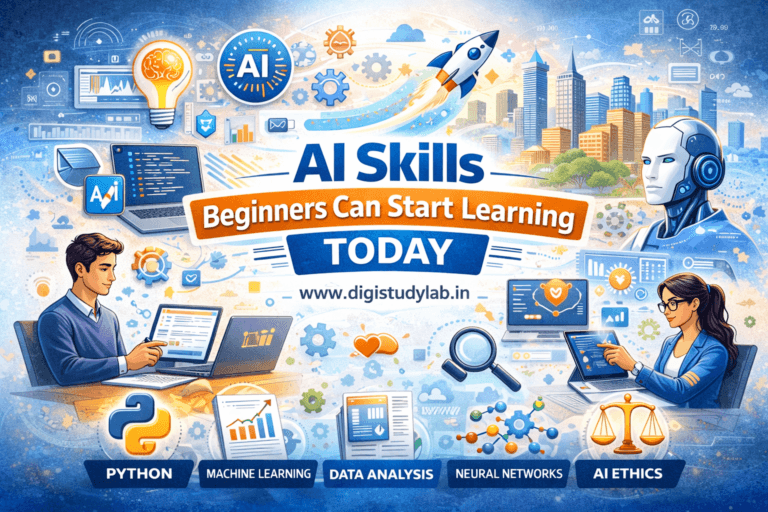
Artificial Intelligence (AI) is no longer a futuristic concept discussed only in research laboratories or science fiction movies. It has become a powerful force shaping industries, education systems, businesses, healthcare services, and everyday life. From voice assistants and recommendation systems to smart automation and predictive analytics, AI technologies are influencing how the world operates.
As industries rapidly adopt AI-driven tools and solutions, the demand for AI-related skills continues to grow. Students, job aspirants, and professionals who develop AI skills today will be better prepared for future career opportunities. Understanding where to start and what to learn is essential for beginners.
Educational platforms such as Digistudylab.in focus on spreading awareness about future-ready skills and guiding learners toward meaningful educational growth. This detailed guide explains the essential AI skills beginners can start learning today, why they matter, and how they contribute to career development.
Understanding Artificial Intelligence in Simple Terms
Artificial Intelligence refers to the ability of machines and computer systems to perform tasks that normally require human intelligence. These tasks include learning from data, recognizing patterns, understanding language, solving problems, and making decisions.
AI is built using algorithms and data. Algorithms are step-by-step instructions that allow computers to analyze information and produce results. When large amounts of data are processed through these algorithms, machines can identify patterns and improve performance over time.
AI is widely used in applications such as search engines, recommendation systems, fraud detection, medical diagnosis, and autonomous vehicles. Because of its broad impact, learning AI-related skills opens doors to various industries.
Why AI Skills Are Important for Beginners
The importance of AI skills extends beyond technology companies. Almost every sector, including finance, healthcare, education, agriculture, manufacturing, and public administration, integrates AI solutions to improve efficiency.
One reason AI skills are valuable is automation. Many repetitive tasks are being automated, while new roles are emerging that require oversight, analysis, and innovation. Individuals who understand AI systems can adapt more easily to these changes.
Another reason is data-driven decision-making. Organizations rely heavily on data analysis to guide strategies. AI tools enhance data interpretation, making analytical skills highly valuable.
AI skills also support innovation and entrepreneurship. Individuals who understand AI can create new solutions, develop intelligent applications, and contribute to technological advancements.
Foundational Skills Required Before Learning AI
Before diving into advanced AI topics, beginners should build certain foundational skills. These skills provide the necessary understanding to grasp AI concepts effectively.
A strong understanding of mathematics, particularly basic algebra and statistics, helps in understanding how algorithms function. Logical reasoning and analytical thinking also play important roles in solving computational problems.
Digital literacy is another foundational requirement. Beginners should be comfortable using computers, navigating software, and understanding basic programming concepts.
Problem-solving ability is equally important. AI systems are designed to solve real-world problems, and learners must develop the capacity to identify and analyze such problems.
Programming Skills for AI
Programming forms the backbone of AI development. Beginners do not need to master multiple languages immediately, but understanding at least one programming language is essential.
Python is widely used in AI and machine learning because of its simplicity and extensive libraries. Learning basic programming concepts such as variables, loops, conditions, and functions provides a solid start.
Programming helps learners understand how algorithms are implemented. It also improves logical thinking and structured problem-solving.
Practicing small coding exercises strengthens confidence and builds technical competence.
Understanding Machine Learning Concepts
Machine Learning (ML) is a major branch of AI. It focuses on enabling machines to learn from data without being explicitly programmed for every task.
Beginners should understand the basic types of machine learning:
Supervised learning involves training models using labeled data.
Unsupervised learning identifies patterns without labeled inputs.
Reinforcement learning uses feedback mechanisms to improve performance.
Understanding these concepts builds awareness of how AI systems operate in real-world applications.
Data Literacy and Analysis
AI systems rely heavily on data. Therefore, beginners must learn how to handle and interpret data effectively.
Data literacy involves understanding how data is collected, cleaned, organized, and analyzed. It includes the ability to read charts, interpret trends, and draw meaningful conclusions.
Learning basic data visualization tools helps in presenting findings clearly. Data analysis skills enhance employability in both AI-specific and general professional roles.
Understanding Algorithms and Logical Thinking
Algorithms are the instructions that guide AI systems. Beginners should learn how algorithms work and why they are important.
Studying simple sorting or search algorithms helps in understanding computational logic. Logical thinking ensures structured problem-solving and efficient code development.
Understanding algorithmic thinking improves the ability to design systems that perform accurately and efficiently.
Introduction to Neural Networks
Neural networks are inspired by the human brain. They consist of layers of interconnected nodes that process information.
Beginners do not need deep mathematical expertise to understand basic neural network concepts. Learning how input data moves through layers and produces outputs provides conceptual clarity.
Neural networks are used in image recognition, speech processing, and natural language applications.
Natural Language Processing Awareness
Natural Language Processing (NLP) enables machines to understand and interpret human language. Applications include chatbots, voice assistants, and translation systems.
Understanding NLP basics helps beginners see how AI interacts with human communication.
Learning about text analysis, sentiment detection, and language modeling builds awareness of this important AI branch.
AI Ethics and Responsible Usage
AI development must consider ethical implications. Beginners should understand issues such as data privacy, bias in algorithms, and responsible AI usage.
Ethical awareness ensures that AI systems are designed fairly and used responsibly. Understanding the social impact of AI enhances professional credibility.
Soft Skills Required for AI Careers
Technical knowledge alone is not sufficient. Soft skills play a crucial role in AI-related professions.
Communication skills help professionals explain technical concepts to non-technical audiences. Teamwork supports collaborative projects. Critical thinking ensures better problem-solving.
Adaptability is especially important because AI technologies evolve rapidly.
How Beginners Can Start Learning AI Today
Beginners can begin with basic programming tutorials and gradually move toward machine learning concepts. Participating in small projects strengthens understanding.
Online courses, practical exercises, and hands-on experimentation improve learning outcomes.
Reading about AI trends and exploring real-world applications builds contextual knowledge.
Consistency and curiosity are key to mastering AI skills.
Career Opportunities with AI Skills
AI skills open doors to diverse career paths. These include roles such as data analyst, machine learning engineer, AI researcher, software developer, and AI consultant.
Even non-technical roles benefit from AI awareness. Marketing professionals use AI tools for analytics. Healthcare professionals use AI for diagnostics. Financial institutions rely on AI for fraud detection.
AI competence enhances employability across industries.
Role of Educational Awareness
Educational awareness plays an essential role in guiding learners toward AI readiness. Platforms like Digistudylab.in provide informative content that helps individuals understand evolving trends and prepare for future opportunities.
Learning AI does not require immediate specialization. Starting with foundational knowledge and gradually progressing ensures steady growth.
The Future of AI Skills
AI will continue shaping industries and job markets. Automation, robotics, smart systems, and predictive analytics will influence how work is performed.
Individuals who develop AI skills early will adapt more easily to future workforce demands.
Continuous learning ensures long-term relevance and career growth.
Conclusion
AI skills are becoming increasingly important in modern education and employment. Beginners can start learning by building foundational programming knowledge, understanding data analysis, exploring machine learning concepts, and developing ethical awareness.
Technical competence combined with soft skills enhances career readiness. AI awareness supports innovation, adaptability, and professional growth.
Educational guidance and consistent practice make AI learning accessible to everyone. Platforms like Digistudylab.in contribute by providing informative resources that help learners prepare for future-ready careers.
The future belongs to those who understand technology, apply knowledge effectively, and remain committed to continuous improvement.