Education has always played a vital role in shaping individuals, societies, and economies. For many decades, traditional degree education was considered the primary path toward knowledge, professional success, and social recognition. However, the modern world is changing rapidly. Industries are evolving, technology is advancing, and the skills required for careers are shifting continuously. As a result, the focus of education is gradually moving from degrees to skills.
Today, an important discussion has emerged in the education sector:
Is traditional degree education still enough, or is skill-based learning more relevant in today’s world?
This question is especially important for learners preparing for careers, competitive exams, and real-world challenges. Educational platforms such as Digistudylab.in aim to help learners understand these evolving trends and make informed decisions about their learning journeys.
To understand this debate clearly, it is necessary to explore both systems in detail — what they mean, how they function, their advantages, limitations, and their relevance in the modern era.
Understanding Traditional Degree Education
Traditional degree education refers to structured academic programs offered by schools, colleges, and universities under regulated systems. These programs are designed to provide theoretical knowledge, conceptual understanding, and academic expertise in specific fields.
For example, degrees such as Bachelor of Arts, Bachelor of Science, Bachelor of Commerce, Engineering, Medicine, and Law are part of traditional education systems. These programs usually follow a defined curriculum, a fixed timeline, and standardized evaluation methods.
The primary goal of traditional education is to build foundational knowledge and intellectual understanding. Learners study subjects in depth, understand theories, explore academic perspectives, and develop discipline in learning. This system has been the backbone of educational development for generations and has produced professionals in fields such as medicine, research, teaching, governance, and engineering.
Traditional degree education also promotes structured learning environments where learners interact with teachers, peers, and academic mentors. This environment helps in building discipline, routine, and a sense of responsibility toward learning.
Core Characteristics of Traditional Degree Education
Traditional education systems are built on certain defining characteristics that shape how learning is delivered and assessed.
One of the most important features is the structured curriculum. Educational institutions follow predefined syllabi approved by academic authorities. Learners progress through subjects in a sequential and organized manner, ensuring coverage of essential concepts and theoretical foundations.
Another key aspect is the focus on theoretical learning. Subjects are taught through lectures, textbooks, and academic discussions. The emphasis is placed on understanding principles, historical developments, and conceptual frameworks. While this builds intellectual depth, it sometimes limits exposure to real-world applications.
Traditional education also relies heavily on examination-based evaluation. Learners are assessed through written tests, assignments, and semester examinations. Performance in these assessments often determines academic progress and recognition.
Additionally, traditional degree programs are time-bound. Most degrees require three to five years to complete, depending on the field of study. This structured duration ensures systematic learning but may delay entry into professional environments.
Finally, traditional education offers formal certification. Degrees are widely recognized by institutions, employers, and governments. They serve as proof of academic qualification and are often mandatory for regulated professions such as medicine, law, civil services, and teaching.
Importance of Traditional Degree Education
Despite the rise of skill-based learning, traditional education continues to hold significant importance in many areas.
It provides a strong conceptual foundation that supports higher learning and specialization. Fields such as research, medicine, engineering, and law require in-depth theoretical understanding before practical application. Without academic grounding, it becomes difficult to build expertise in such domains.
Traditional education also supports academic exploration. Learners engage with diverse subjects, perspectives, and research methodologies. This broad exposure encourages intellectual growth and analytical thinking.
Another important role of traditional education is social development. College environments encourage interaction, teamwork, cultural participation, and exchange of ideas. These experiences contribute to personal growth beyond academics.
Furthermore, degrees remain essential for many professional and government roles. Competitive exams, administrative positions, and regulated professions often require formal qualifications.
Limitations of Traditional Degree Education in the Modern Era
While traditional education has many strengths, it also faces certain limitations in today’s fast-changing world.
One major challenge is the gap between academic learning and industry requirements. Many graduates possess theoretical knowledge but struggle to apply it in real work environments. This gap affects employability and job readiness.
Another limitation is the slow pace of curriculum updates. Technology and industries evolve rapidly, but academic programs often take time to incorporate these changes. As a result, learners may study outdated concepts that are less relevant to current job markets.
Traditional education also emphasizes examination performance. Learners often focus on memorization and scoring marks rather than understanding practical applications. This approach limits creativity and independent thinking.
Additionally, long duration and financial costs make degree programs inaccessible to some learners. The time required to complete degrees may delay career opportunities.
Understanding Skill-Based Learning
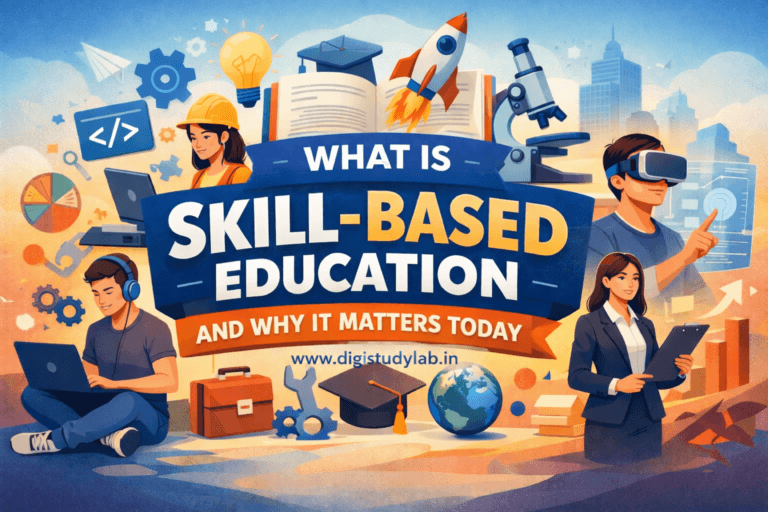
Skill-based learning is an educational approach that focuses on developing practical abilities that can be applied directly in real-life situations and professional environments. Instead of concentrating only on theoretical knowledge, this method emphasizes hands-on experience, problem-solving, and real-world application.
Skill-based education answers a practical question:
How effectively can you use what you have learned?
This learning model includes technical training, vocational education, digital learning, project-based training, internships, and professional certifications.
Skill-based learning does not replace academic knowledge; instead, it complements it by ensuring that learners can apply concepts in practical situations.
Core Characteristics of Skill-Based Learning
Skill-based learning is defined by several important characteristics that distinguish it from traditional education.
The most prominent feature is practical application. Learners engage in activities, projects, and exercises that simulate real-life situations. This approach helps them understand how knowledge functions in real contexts.
Another key aspect is hands-on experience. Learners use tools, technologies, and real-world processes to build competence. Whether it is coding, designing, writing, analyzing data, or operating equipment, practical exposure strengthens understanding.
Skill-based learning also focuses on industry relevance. Courses are designed according to market needs, ensuring that learners acquire abilities that are in demand.
Flexibility is another defining feature. Many skill-based programs allow self-paced learning, enabling individuals to progress according to their convenience.
Finally, skill-based learning often involves continuous improvement. Learners update their skills regularly to stay relevant in evolving industries.
Importance of Skill-Based Learning in Today’s World
The modern world requires adaptability, innovation, and problem-solving abilities. Skill-based learning addresses these needs effectively.
Industries today prioritize performance and efficiency. Employers seek individuals who can contribute immediately rather than those who require long training periods. Skill-based education prepares learners for such expectations.
It also supports entrepreneurship. Individuals with practical skills can create opportunities independently instead of relying solely on traditional employment.
Another important aspect is career flexibility. Skill-based learners can shift between roles, industries, and technologies more easily because they focus on abilities rather than fixed academic paths.
Skill development also enhances confidence. When learners know how to apply knowledge in real situations, they feel more capable and prepared.
Advantages of Skill-Based Learning in the Modern Education System
Skill-based learning has emerged as one of the most practical and relevant approaches in modern education. Its importance is growing because it directly connects learning with real-world applications and professional environments. Unlike systems that rely only on theoretical understanding, this model focuses on developing abilities that can be used in everyday situations and workplaces.
One of the most important advantages of skill-based learning is that it improves employability. When learners develop practical abilities such as communication, technical knowledge, analytical thinking, and problem-solving, they become more prepared to enter the job market. Employers value individuals who can perform tasks efficiently from the beginning rather than those who require long training periods. This makes skill-based learners more confident and competitive.
Another key advantage is adaptability. The modern world changes rapidly due to technology, globalization, and innovation. Skill-based learning helps individuals adapt to new environments, tools, and methods. When learners focus on developing abilities instead of memorizing information, they become flexible and capable of adjusting to new challenges.
Skill-based learning also encourages independent thinking. Instead of following fixed patterns, learners explore solutions, experiment with ideas, and develop creativity. This helps in building innovation and leadership qualities, which are essential for future careers.
Practical exposure is another major benefit. When individuals learn by doing, they understand concepts better and retain knowledge for longer periods. Whether it involves using software, conducting experiments, writing reports, or solving real-life problems, hands-on experience strengthens understanding and builds confidence.
Additionally, skill-based learning promotes lifelong learning. It encourages individuals to continuously upgrade their knowledge and abilities. In a world where industries evolve quickly, continuous learning becomes essential for staying relevant.
Comparison Between Skill-Based Learning and Traditional Degree Education
Understanding the difference between these two systems requires a deeper comparison of their purposes, methods, and outcomes.
Traditional degree education primarily focuses on academic knowledge and theoretical understanding. It aims to build intellectual foundations and structured learning habits. Skill-based learning, on the other hand, emphasizes application, performance, and real-world problem-solving.
In traditional systems, learners often study subjects through textbooks, lectures, and written examinations. Skill-based learning involves projects, training, simulations, and practical tasks that mirror real-life situations.
Evaluation methods also differ significantly. Traditional education assesses performance through exams and grades, while skill-based learning evaluates practical ability, creativity, and task completion.
Another major difference lies in learning flexibility. Traditional education follows fixed schedules and structured timelines. Skill-based learning often allows self-paced progress, enabling learners to develop abilities according to their interests and pace.
Career outcomes also vary. Degree education supports professions that require academic qualifications, such as medicine, law, teaching, and research. Skill-based learning prepares individuals for roles that demand technical abilities, adaptability, and performance-based output.
Both systems have their strengths and limitations, and neither can fully replace the other. Instead, they complement each other and together create a balanced learning environment.
Role of Skill-Based Learning in Career Development
Career development today depends not only on academic knowledge but also on practical competence. Skill-based learning plays a critical role in preparing individuals for modern professional environments.
It helps learners identify their strengths and interests. Through practical exposure, individuals understand what they enjoy doing and what they excel at. This awareness helps them make better career decisions.
Skill-based learning also prepares individuals for interviews and workplace expectations. Communication, teamwork, time management, and problem-solving abilities are highly valued in professional environments.
Another important contribution is entrepreneurship. Skill-based learners often develop the confidence to start their own ventures, create solutions, and innovate. They are not limited to job roles but can create opportunities independently.
Career flexibility is another advantage. When individuals possess transferable skills, they can shift between roles and industries more easily. This is essential in a world where job profiles continue to evolve.
Role of Traditional Degrees in Professional Fields
While skill-based learning is gaining importance, traditional degree education remains essential in many areas.
Professions such as medicine, engineering, law, scientific research, and teaching require strong theoretical foundations. These fields demand structured learning, academic discipline, and formal qualifications.
Degrees also provide credibility. Employers and institutions often require formal certification as proof of academic competence. Government jobs and public sector roles usually mandate recognized qualifications.
Traditional education also supports research and innovation. Academic institutions provide platforms for scientific exploration, experimentation, and knowledge creation.
Therefore, traditional education continues to play a vital role in professional development, especially in fields that require deep conceptual understanding.
Why the Modern World Needs a Combination of Both
The debate between skill-based learning and traditional degrees should not be about choosing one over the other. The most effective approach is to combine both systems.
Academic knowledge provides conceptual clarity, discipline, and structured thinking. Skill-based learning ensures practical application, adaptability, and real-world readiness.
When these two approaches work together, learners gain comprehensive development. They understand theories and also know how to apply them. They build intellectual strength and practical competence simultaneously.
Modern education systems are gradually adopting this integrated approach. Schools, colleges, and digital learning platforms are introducing project-based learning, internships, vocational training, and practical modules alongside academic studies.
This balanced approach prepares learners not only for careers but also for real-life challenges.
Future of Education: From Degrees to Skills
Education is shifting toward performance-based learning. Industries now prioritize abilities, creativity, and adaptability over memorized knowledge.
Technological advancements are also accelerating this transformation. Digital tools, online learning platforms, and interactive resources provide opportunities for learners to build practical skills from anywhere.
The future learning environment will focus on:
Problem-solving abilities
Innovation and creativity
Digital and technical competencies
Communication and collaboration
Continuous learning
Learners who adapt to this change will be better prepared for future opportunities.
How Learners Can Balance Degrees and Skills
Individuals can benefit the most when they combine academic learning with skill development.
They can focus on understanding concepts deeply while also practicing their application. Participating in internships, projects, workshops, and online training programs helps in building practical exposure.
Learning new tools, technologies, and communication methods enhances employability. Continuous practice and improvement strengthen confidence and competence.
The key is to treat education as a lifelong process rather than a one-time achievement.
Role of Educational Platforms in Promoting Skill-Based Learning
Educational platforms play an important role in spreading awareness and providing accessible learning opportunities. They bridge the gap between theoretical knowledge and practical application by offering structured learning materials, concept explanations, and skill development resources.
Digistudylab.in focuses on delivering educational and informative content that supports learners in understanding modern education trends, career skills, and real-world learning approaches. By promoting both academic awareness and skill development, such platforms help learners make informed decisions about their future.
Conclusion
The debate between skill-based learning and traditional degree education reflects the changing nature of education in the modern world. While traditional degrees provide academic foundations and structured knowledge, skill-based learning ensures practical competence and real-world readiness.
Both approaches have unique strengths and limitations. Traditional education builds intellectual depth, discipline, and theoretical understanding, while skill-based learning enhances employability, adaptability, and problem-solving abilities.
The most effective learning model is one that integrates both systems. When learners combine academic knowledge with practical skills, they become better prepared for careers, innovation, and personal growth.
As education continues to evolve, awareness about these approaches becomes essential. Platforms like Digistudylab.in contribute by providing educational insights, learning guidance, and knowledge-driven content that helps individuals understand how to balance degrees and skills for future success.
The future belongs to those who can think, adapt, learn, and apply their knowledge effectively. Education is no longer just about obtaining a degree; it is about becoming capable, confident, and prepared for the realities of the modern world.